Bambusa ventricosa McClure
Summary
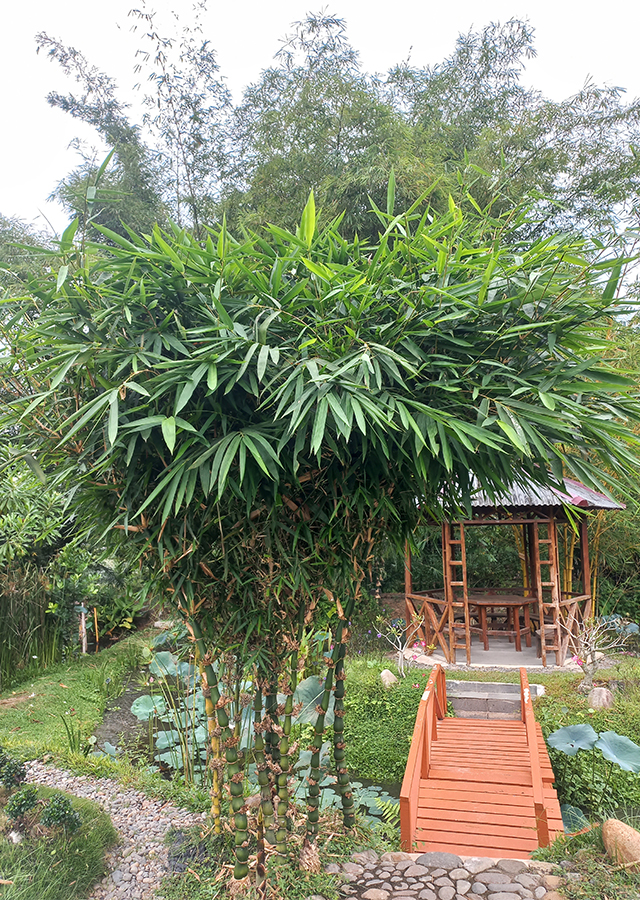
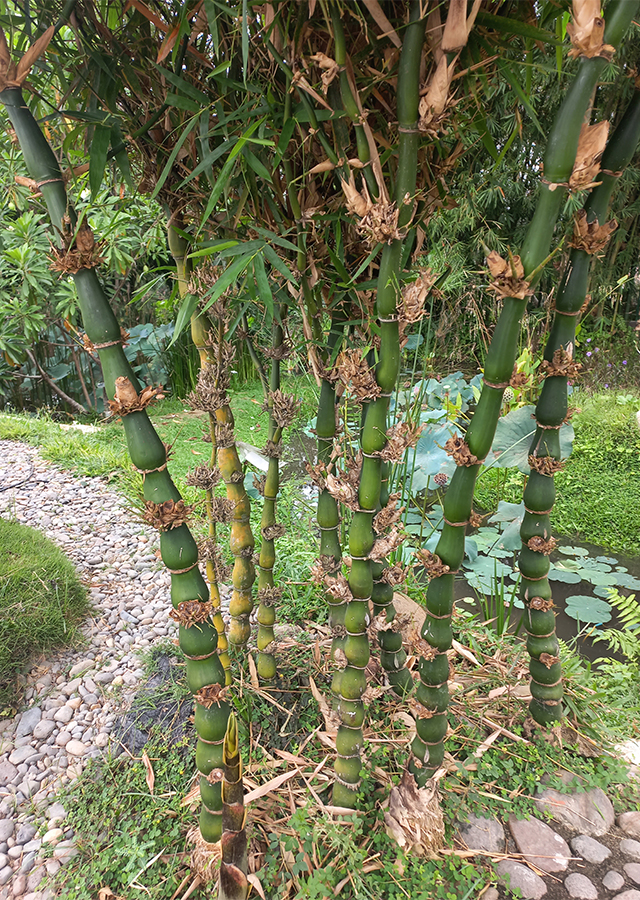
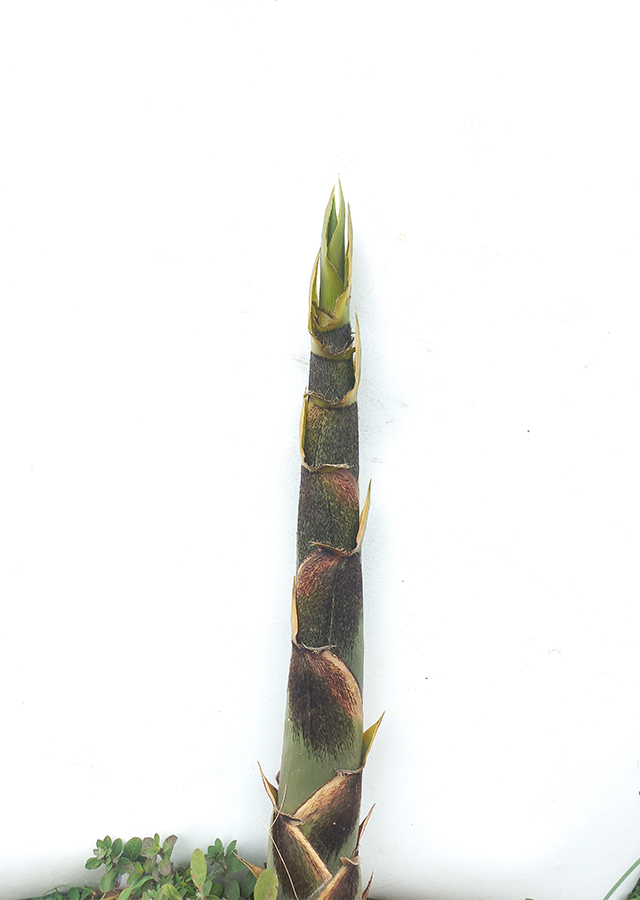
Bambusa ventricosa or Buddha belly bamboo is native to Vietnam and Guangdong Province in southern China, known for its uniquely rounded stem shape which makes it favored as an ornamental and bonsai material. Its shoots can be eaten as a vegetable, while its leaves and young stems have long been used in traditional Chinese medicine to reduce fever and relieve lung disorders.
Agroecology
Buddha belly bamboo grows in direct sunlight to partial shade. Requires fertile, humus-rich, well-drained soil. This plant prefers a warm, humid climate, is cold-hardy, and can withstand light frost and extreme low temperatures around 0°C.
Morphology
- Stem dimorphic; normal culms 8-10 m, diameter 3-5 cm, essentially flexible, apex slightly drooping; internodes 30-35 cm, essentially slightly swollen, not powdery white, initially hairless; lower nodes with a ring of fine grayish-white hairs below and above the sheath scar; branching from the 3rd or 4th node upward, basal node 1 or 2 also with short aerial roots; branches 1-3 at the lower nodes; these branches sometimes condensed into weak thorns; branching several to many at the mid-culm and upper nodes, with the 3 middle branches slightly longer and thicker. Abnormal culms (common in potted plants) 25-50 cm, diameter 1-2 cm, internodes shortened and swollen at the base, branch internodes also shortened and swollen; branches only at the upper nodes, usually solitary, without thorns. Culm sheath deciduous, distinctly striate, hairless, apex nearly symmetric, broadly arched or truncate; auricles unequal; the larger auricle nearly ovate becoming ovate-lanceolate, 5-6 mm; the smaller auricle ovate, 3-5 mm; oral setae curved; ligule 0.5-1 mm, very shortly finely fimbriate.
- Leaves, blade upright or curved, ovate to ovate-lanceolate, base slightly curved, narrowing, slightly narrower than the sheath apex. Leaf sheath hairless; ligule subtruncate, very short; auricles ovate or falcate; oral setae several, curved; blade linear-lanceolate to lanceolate, 9-18 × 1-2 cm, densely puberulent abaxially, hairless adaxially.
- Pseudospikelet solitary or clustered in numbers at each node, linear-lanceolate, slightly compressed, 3-4 cm; profile oval, 2.5-3 mm, 2-keeled, tip blunt; gemmiferous bracts 1 or 2, narrowly ovate, 4-5 mm, 13-15-veined, tip acute; florets 6-8, basal 1 or 2 and apical 2 or 3 usually sterile; rachilla segments flat, 2-3 mm, tip swollen and butterfly-shaped. Glume absent or 1, ovate-elliptic, 6.5-8 mm, 15-17-veined, apex acute; lemma ovate-elliptic, 9-11 mm, hairless, 19-21-veined, apex acute; palea nearly as long as the lemma, ciliate near the tip, 4-veined between and on both sides of the keel, tip tapering with a cluster of white hairs; lodicules 3, about 2 mm, margin long ciliate, 2 anterior slightly asymmetric, posterior broadly elliptic. Filaments slender; anthers yellow, about 6 mm, tip blunt. Ovary ovoid, 1-1.2 mm, stalked, tip thickened and hairy; style very short, hairy; stigmas 3, about 6 mm.
- Fruit unknown.
Cultivation
- Propagation of Buddha belly bamboo is done with seed and cuttings.
- For propagation by cuttings, select a culm and cut the main branch of the Buddha belly bamboo. Branches should be cut at young to medium age (1-2 years) to ensure a high survival rate. Remove the top, leaving 2-3 nodes and the basal swelling. This bamboo cutting is usually about 30 cm long. Alternatively (to give faster results) dip the bamboo cutting into a mixture of growth regulator or rooting hormone for 24 hours, and cover the top of the cutting with wax to prevent drying out. Plant the bamboo cutting vertically (preferably slightly tilted), either in a polybag or a bed, such that the swollen rhizome and one node remain below the soil surface and at least one or two nodes are above the surface.
Chemical Content
Tannins, polyphenols, saponins, general glycosides, cyanogenic glycosides, flavonoids, coumarins.
Benefits
Removes toxins from the body, used for fever, hematuria, epistaxis (nosebleeds), and infantile epilepsy, cooling, calming, and clearing phlegm, treats the lungs.
Simplisia
- Take Buddha belly bamboo stem and wash until clean.
- Peel off the greenish middle layer of the stem.
- Cut into pieces then grate.
- Dry in a shaded place until completely dry.
- Store the simplicia in a dry, airtight container.
Local Names
Bambu blenduk, Bambu perut, Bambu gendang.
Traditional Recipes
The following recipes reflect traditional knowledge passed down through generations, not a substitute for professional medical diagnosis or advice. Consult a healthcare provider before use.
1. Fever
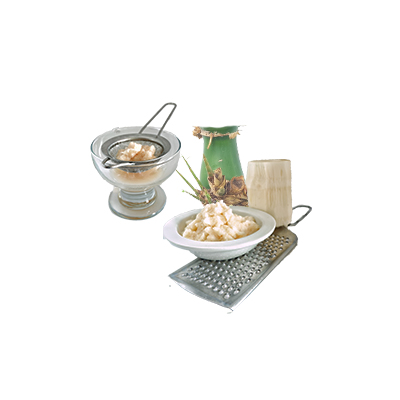
- Take 1 Buddha belly bamboo stem and wash until clean.
- Peel off the greenish middle layer of the stem.
- Grate then squeeze and take the liquid.
- Drink.
Reference Sources
- Royal Botanic Gardens. Plants of the World Online: Bambusa ventricosa McClure. https://powo.science.kew.org/taxon/urn:lsid:ipni.org:names:392561-1#synonyms. 23-07-2022.
- Flora of China. Bambusa ventricosa. FOC Vol. 22 Page 10, 11, 17, 24. http://www.efloras.org/florataxon.aspx?flora_id=2&taxon_id=242307748. 23-07-2022.
- G. Y. Coffie, C. Antwi-Boasiako, N. A. Darkwa. 2014. hytochemical constituents of the leaves of three bamboo (Poaceae) species in Ghana. Journal of Pharmacognosy and Phytochemistry 2014; 2 (6): 34-38. https://www.researchgate.net/publication/279963419_Phytochemical_constituents_of_the_leaves_of_three_bamboo_Poaceae_species_in_Ghana. 23-07-2022.
- Iris. Raya Gardens. 2021. Buddha Belly Bamboo: Grow & Care for Bambusa Ventricosa. https://www.rayagarden.com/garden-care/buddha-belly-bamboo-grow-care-for-bambusa-ventricosa.html. 23-07-2022.
- MedicinalLive. 2018. Bamboo buddha belly – Bambusa ventricosa. https://medicinallive.com/product/bamboo-buddha-belly-bambusa-ventricosa/. 23-07-2022.
- Stuartexchange. 2020. Buddha Bamboo. http://www.stuartxchange.org/BuddhaBamboo. 23-07-2022.