Bauhinia acuminata L.
Summary
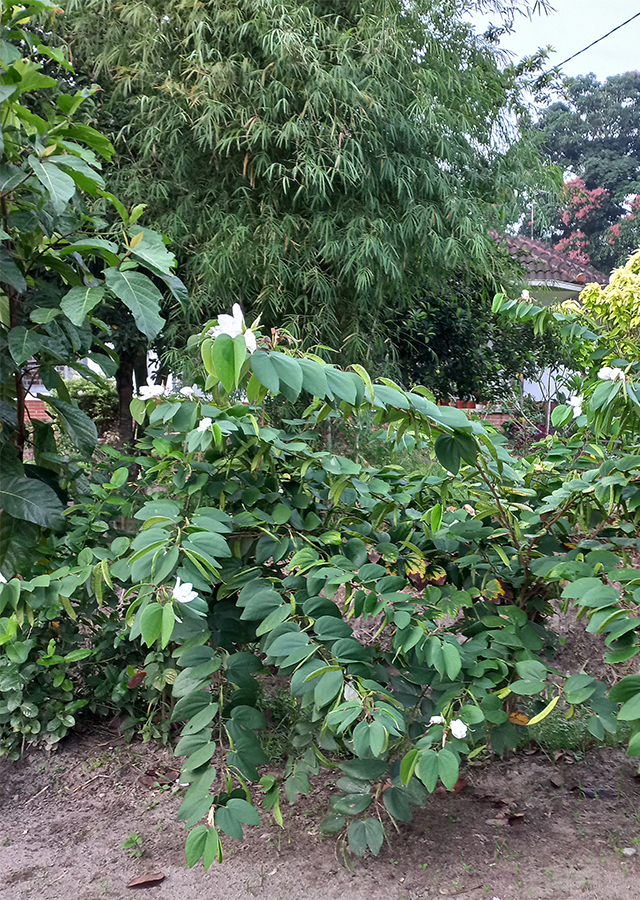
Kupu-kupu putih (Bauhinia acuminata) is a shrub up to 3 meters tall from the Fabaceae family that originates from dry monsoon regions of Southeast Asia. Javanese communities use its root for coughs and colds, while in India a decoction of its leaves and bark is used to address asthma attacks. Kupu-kupu putih has proven antimicrobial, anti-inflammatory, and antidiarrheal activity in research.
Agroecology
The kupu-kupu putih plant can be found growing in well-drained, sunny places on hillsides and plains, and in dry dipterocarp forests, especially in secondary formations, teak forests, and thickets. Its growth is suited to a position in full sun, but can survive growing in partial sun. Prefers fertile, moist, well-drained soil conditions, with a somewhat acidic soil acidity (pH) (5.6-6.5), does not tolerate saline conditions, and this plant grows successfully in various soil types.
Morphology
- Roots taproot.
- Stem strong, upright, round, many slender branches, sympodial branching system, young twigs usually pubescent, bark grayish-brown, rough, with transverse cracks and bark peeling.
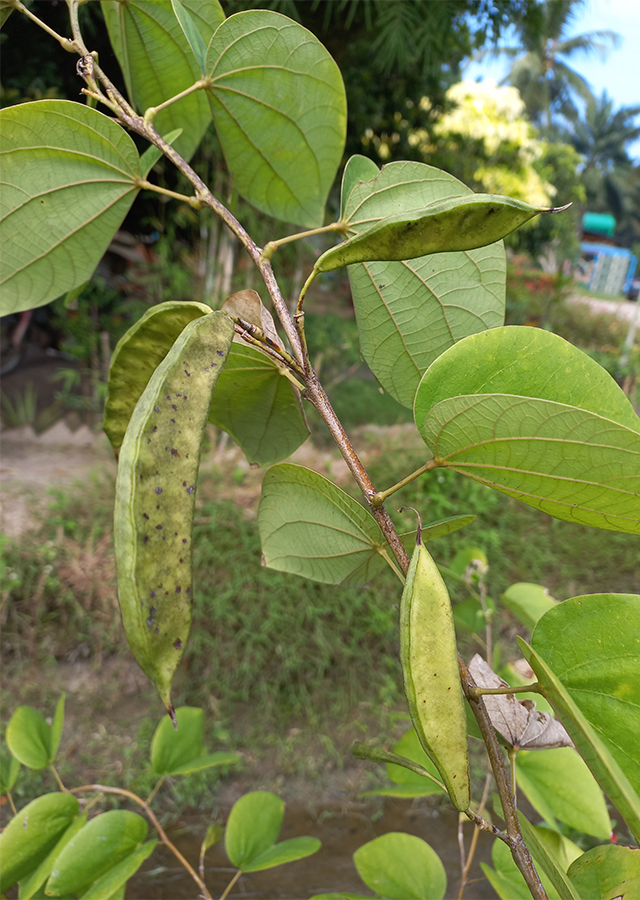
- Leaves single, alternate, broad, ovate and bilobed like a cow's hoof or butterfly wing, with an apical cleft up to 5 cm deep, upper surface (adaxial) dark green and hairless, lower surface (abaxial) light green, pubescent. Lobe tip pointed or tapering and leaf base heart-shaped to rounded, smooth leaf margin.
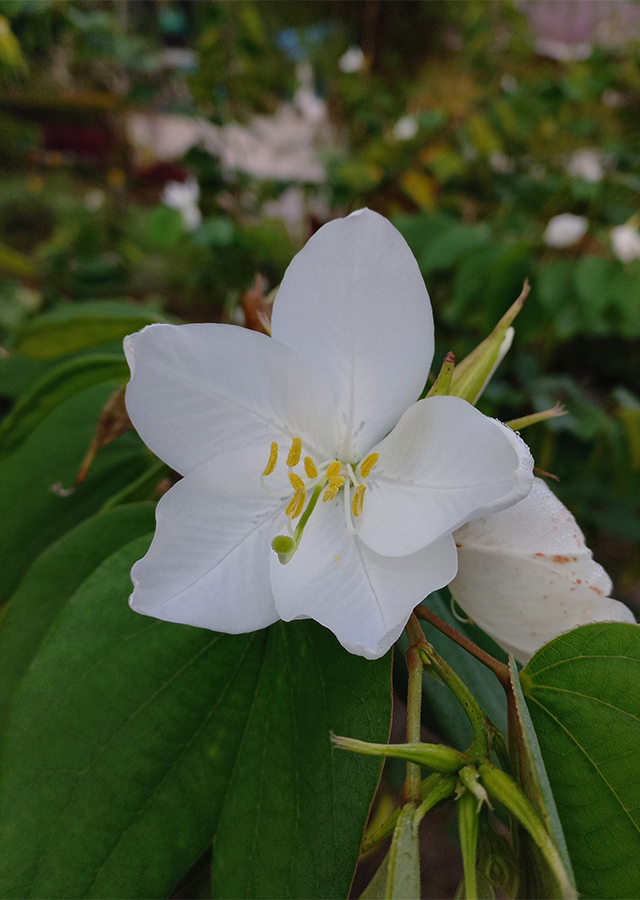
- Flowers fragrant, with five white petals, petal blade elliptical to oblong (oblanceolate), hairless. Stamens about 10, yellow, and stigma green. Inflorescence a compound raceme, sometimes 3-15 flowers in one raceme, located in the leaf axil.
- Fruit a pod, linear elongated, dark brown, hairless, usually containing 5-12 seeds, fruit surface smooth, hairless (glabrous).
- Seeds somewhat round (suborbicular), up to 7-10 mm in diameter.
Cultivation
Plant propagation can be done generatively (seeds).
Chemical Content
Alkaloid, flavonoid, tannin, palmitic acid, three phallic acid esters, gallic acid, ursolic acid, essential oil (phytol, sesquiterpenoids β-caryophyllene, caryophyllene oxide, α-humulene, isomethyl-α-ionone, α-farnesene, β-ionone, humulene epoxide, caryophylla-4(12),8(13)-dien-5α-ol, α-muurolol, α-cadinol, isoaromadendrene), phenolic compounds, saponin, glycoside, steroid, terpenoid, cardiac glycosides, kaempferol, quercetin, apigenin, quercetin derivative (quercetin-3-glucoside).
Benefits
Treats asthma, coughs and colds, headaches, hypertension, bladder stones, venereal disease, skin diseases (including leprosy), burns, nasal ulceration, has thrombolytic properties (breaking down or dissolving dangerous blood clots in blood vessels), cytotoxic, antidiarrheal, antibacterial, antimicrobial, anti-inflammatory, anthelmintic, antioxidant, and hemolytic properties.
Local Names
Panawar saribu (Sunda), Galela (Halmahera), Kupu-kupu (Malay).
Traditional Recipes
The following recipes reflect traditional knowledge passed down through generations, not a substitute for professional medical diagnosis or advice. Consult a healthcare provider before use.
1. Asthma
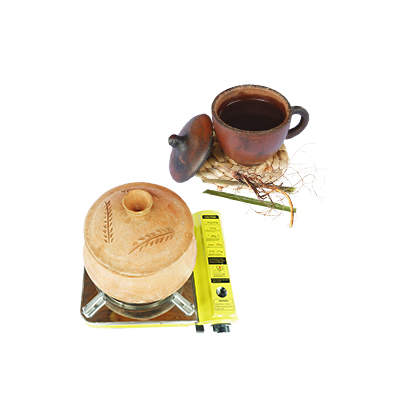
- Take kupu-kupu putih root and bark and wash until clean.
- Boil the ingredients until boiling.
- Let stand until warm/cool.
- Strain, then drink for asthma sufferers.
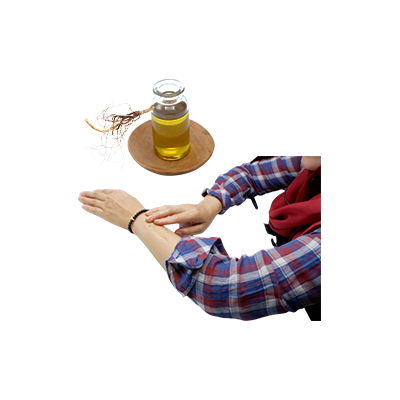
2. Burns
- Prepare kupu-kupu putih root and wash until clean.
- Boil the root with coconut oil until boiling.
- Let stand until warm/cool.
- Apply to the burned skin.
Reference Sources
- Royal Botanic Gardens. 2021. Plants of the World Online: Bauhinia acuminata L. http://www.plantsoftheworldonline.org/taxon/urn:lsid:ipni.org:names:481080-1. 30-10-2021.
- Useful Tropical Plants Database. 2021. Bauhinia acuminata. https://tropical.theferns.info/viewtropical.php?id=Bauhinia+acuminata 30-10-2021.
- Flora Fauna Web. 2021. Bauhinia acuminata L. https://www.nparks.gov.sg/florafaunaweb/flora/3/6/3605 30-10-2021.
- Stuartxchange. 2019. Philippine Medicinal Plants: Bambang. http://www.stuartxchange.org/Bambang.html 30-10-2021.
- PROSEA. 2016. Bauhinia acuminata (PROSEA). https://uses.plantnet-project.org/en/Bauhinia_acuminata_(PROSEA). 30-10-2021.
- Sebastian D., Sophy R. 2020. Review Article: Bauhinia acuminate Linn: A brief review of its phytochemistry and pharmacology. Asian Journal of Pharmacy and Pharmacology, 6(3): 164-170. DOI: https://doi.org/10.31024/ajpp.2020.6.3.2.