Berberis bealei Fortune
Summary
Leatherleaf mahonia (Berberis bealei) is a shrub or small tree 0.5-8 meters tall from the Berberidaceae family native to China, an important ingredient in traditional Chinese medicine. Its berberine content is effective as medicine in small doses but harmful in excess. Leatherleaf mahonia is traditionally used to treat diarrhea, dysentery, and hepatitis.
Agroecology
Leatherleaf mahonia or Berberis bealei is generally found growing in forests, forest edges, lush slopes, riverbanks, roadsides, and shrublands, at elevations of 500-2,000 m asl. This species grows well in moist, well-drained, slightly acidic to neutral, humus-rich soil, but tolerates heavy clay soil. Its growth also favors shaded places or under fairly dense tree cover. This species is winter-hardy, tolerating temperatures down to about -20°C when dormant, but its young growth can be damaged by temperatures around 0°C. This species is also drought- and salt-tolerant. Strong winds should be avoided.
Morphology
- Stem limitedly branched, round, sturdy, becoming grayish brown with age, and its wood yellow.
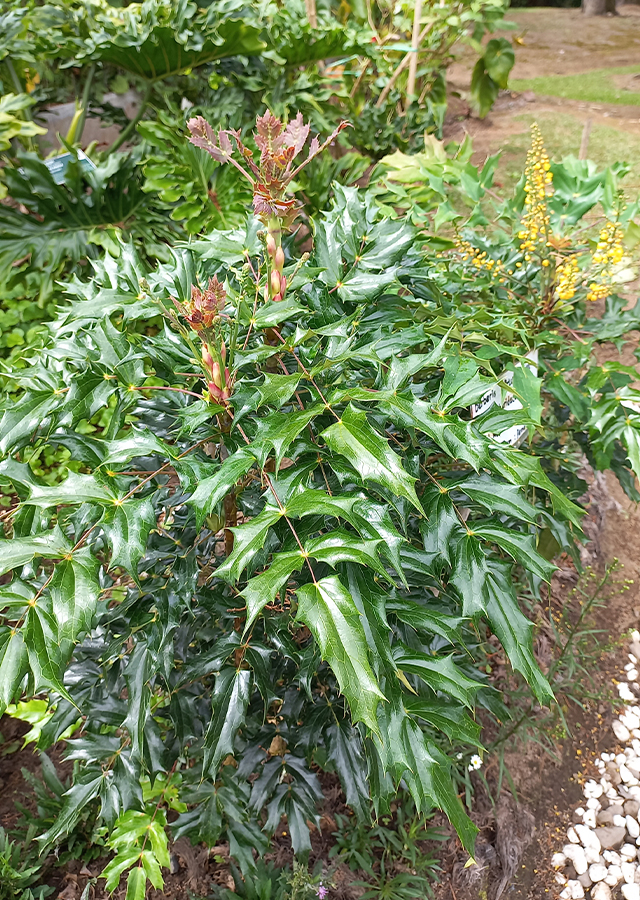
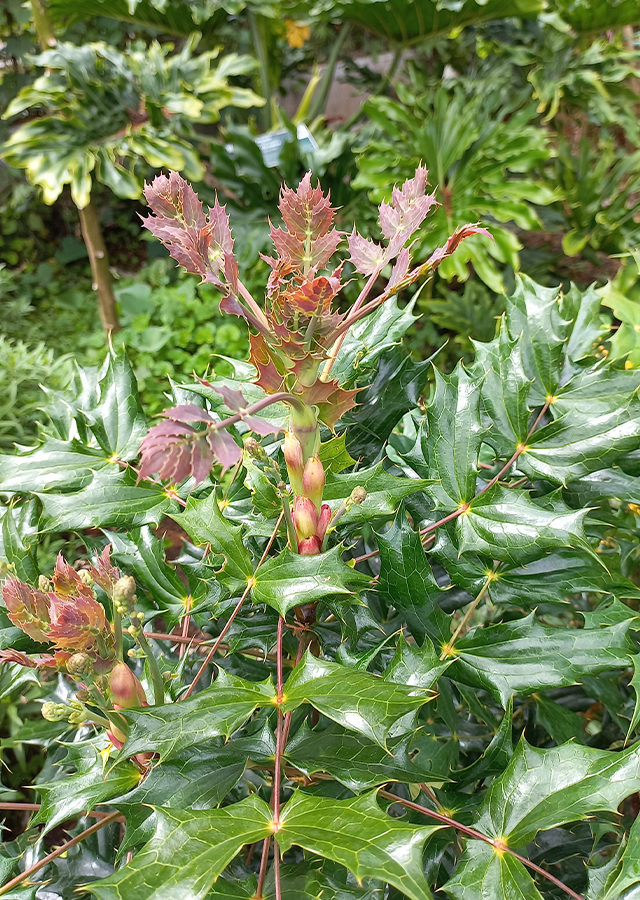
- Leaves alternate, olive green, odd-pinnately compound, consisting of 9-13 leaflets, narrowly obovate to oblong shaped, apex pointed and sharply spiny, base cuneate, leaf margin curving backward and spiny-toothed (2-6 teeth per side). Thick, rough, stiff, increasing in length but decreasing in width from base to tip. Petiole often red.
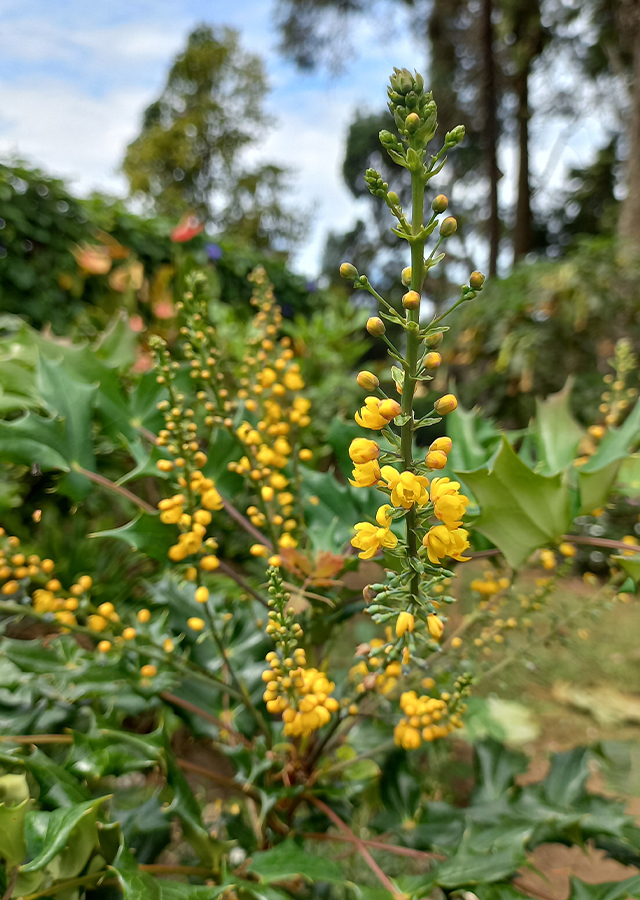
- Flowers lemon yellow, inflorescence a dense terminal raceme. Outer and middle sepals ovate shaped, inner sepals oblong-oval shaped. Petals oblong-elliptic shaped. Style short, ovules 3-4.
- Fruit a globose berry, green then turning blue-black, covered with a waxy coating, less than one inch in size, hanging in clusters, like grapes.
Cultivation
Propagation is generative (seed), and vegetative (offshoot separation, stem cuttings).
Chemical Content
Cerebrosides, three alkaloids (berberine, palmatine, jatrorrhizine), triterpenes (ursolic acid, oleanolic acid, oleanolic acid 3-O-β-D-glucopyranoside), flavonoids (quercetin, quercetin 3-O-β-D-xylopyranoside, tamarixetin 3-O-β-D-glucopyranoside, quercetin 3-O-β-D-xylopyranoside, isorhamnetin 3-O-α-L-rhamnopyranoside, luteolin, isorhamnetin, tricin, and chryseriol), phytosterols (stigmasterol, β-sitosterol), lignans (episyringaresinol, yangambin, epiyangambin, bishexadecyl epiphyllate), erythro-syringoyl glycerol 8-O-β-D-glucoside, 3,4,5-trimethoxyphenyl-1-O-β-D-glucoside, 5,5'-dimethoxylariciresinol-4'-O-β-D-glucoside, phenolics, steroids, a phenylpropanoid group, gallic acid, and trans-cinnamic acid.
Benefits
Treats diarrhea, dysentery, fever, hepatitis, pulmonary tuberculosis, rheumatoid arthritis, back pain, weak knees, enteritis (small intestine inflammation), insomnia, boils, swelling, washes and heals eczema and dermatitis, relieves toothache, sore throat, swollen eyes, as a detoxifying agent. Has antimicrobial, antitumor, antioxidant, antigastrin, and anti-inflammatory activity.
Local Names
Anggur oregon.
Traditional Recipes
The following recipes reflect traditional knowledge passed down through generations, not a substitute for professional medical diagnosis or advice. Consult a healthcare provider before use.
1. Eczema
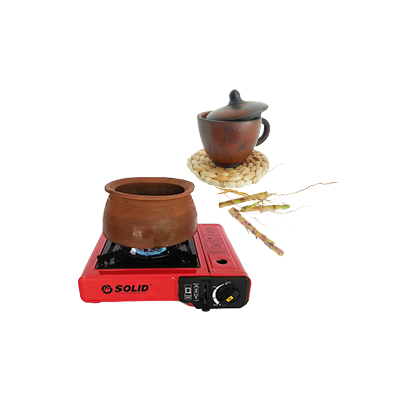
- Prepare an adequate amount of fresh leatherleaf mahonia root and stem and wash until clean.
- Boil until it boils.
- Let it stay warm.
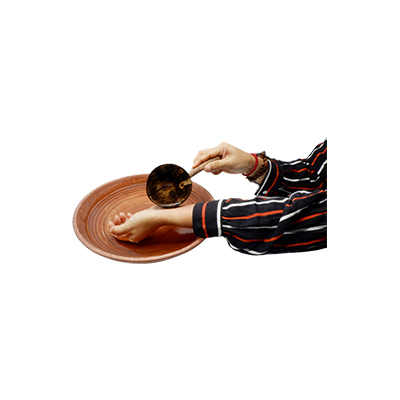
- Wash the eczema in the still-warm decoction.
2. Fever reducer
- Prepare an adequate amount of fresh leatherleaf mahonia root and stem and wash until clean.
- Boil until it boils.
- Let it cool to warm then strain.
- Drink.
Reference Sources
- Royal Botanic Gardens. Plants of the World Online: Berberis bealei Fortune. https://powo.science.kew.org/taxon/urn:lsid:ipni.org:names:106450-1. 02-03-2022.
- Kakar et al. 2019. Phytochemistry and medicinal values of Mahonia bealei: A review. Tropical Journal of Pharmaceutical Research, 18 (10): 2219-2227. http://dx.doi.org/10.4314/tjpr.v18i10.31.
- Temperate Plants Database, Ken Fern. 2021. Mahonia bealei. http://temperate.theferns.info/plant/Mahonia+bealei. 02-03-2022.
- North Carolina. Extension Gardener: Berberis bealei. https://plants.ces.ncsu.edu/plants/berberis-bealei/. 02-03-2022.
- Huagu Ye, Chuyuan Li, Wencai Ye, Feiyan Zeng. 2021. Common Chinese Materia Medica: Volume 2. Chemical Industry Press.