Borago officinalis L.
Summary
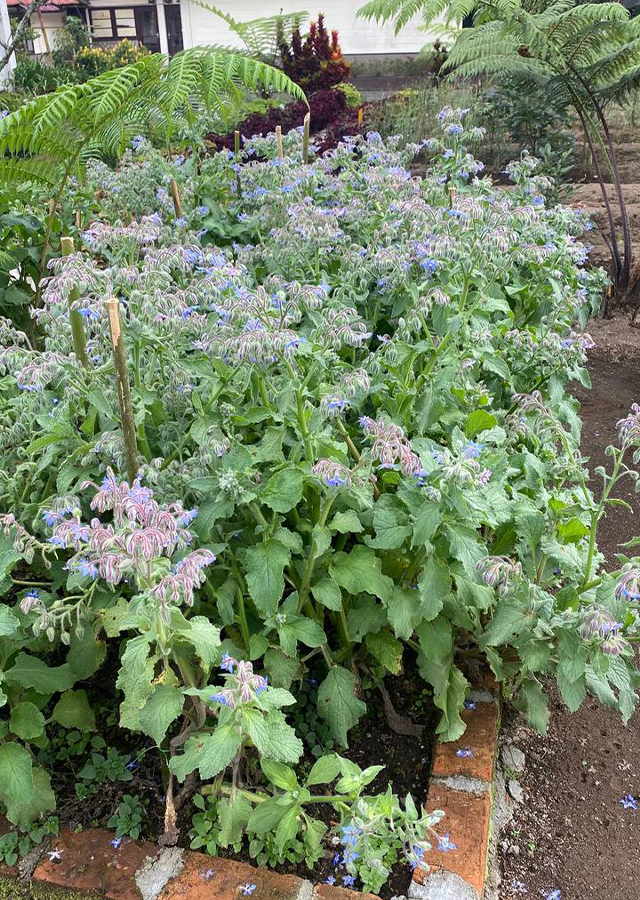
Borage (Borago officinalis) is an annual or biennial herb 70-100 cm tall from the Boraginaceae family native to the Western Mediterranean, known since ancient times for its reputation of calming the mind. Its seed oil is rich in gamma-linolenic acid (GLA), which is prescribed as an anti-inflammatory medicine, while its leaves are eaten as a salad. Borage needs to be used with caution as it contains pyrrolizidine alkaloids that can potentially damage the liver if used excessively.
Agroecology
Borage can be found growing in forests, shrublands, grasslands, at elevations ranging from 1,500-3,600 m asl. This plant has high cold hardiness, and can grow well in loose, rocky soil with a little lime and sand, wet soil with good drainage, lush places, and full sun exposure. However, borage can also grow well in soil with moderate sun exposure. This borage can grow in any soil type including nutrient-poor soil and within a pH scale ranging between 4.5-8.2, though the ideal pH for its growth is 6.6.
Morphology
- Roots taproot.
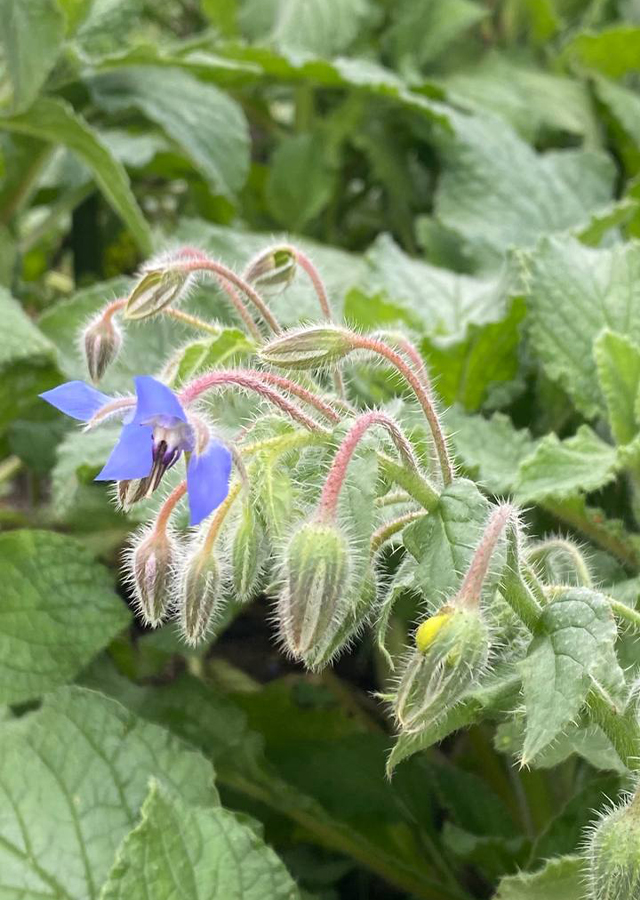
- Stem straight, often branched, hollow, and densely covered with stiff white hairs.
- Leaves alternate, simple, ovate, obovate, or oblanceolate shaped, apex pointed with smooth, slightly wavy margins. Upper leaf surface dark green, wrinkled due to vein indentations, and covered with sparse thin hairs. Lower leaf surface light to medium green and hairy especially along the underside of the veins.
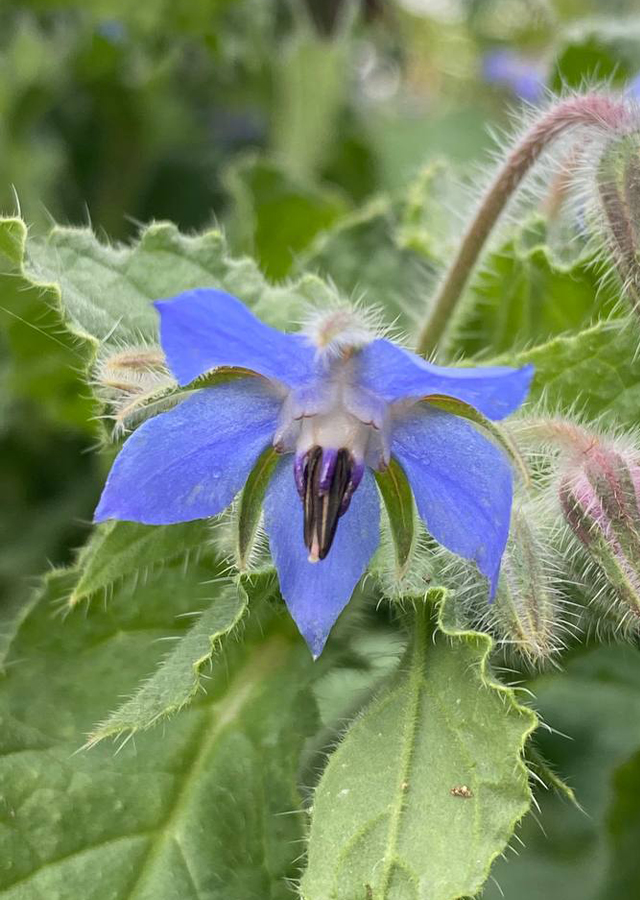
- Flowers have a green calyx and a corolla divided into 5 parts or lobes; the corolla is blue (rarely white or pink), lanceolate shaped, corolla tip pointed and curved. Has 5 dark blue to black anthers joined to form a central beak, and an ovary with a single style. Sepals linear, covered with stiff white hairs along their outer surface. Each inflorescence branch is covered with stiff white hairs, the branches green to dark red.
- Fruit oval, small, brownish, wrinkled. The ripe fruit is dark without albumen.
- Seeds 3-4 per fruit, brownish.
Cultivation
- Propagation is generative (seed).
- The suitable cultivation time for this plant is early spring, and it can also be grown in autumn and late winter.
Chemical Content
Fatty acids (gamma-linolenic acid, oleic acid, palmitic acid, stearic acid, eicosanoic acid, and erucic acid), pyrrolizidine alkaloids, lycopsamine, intermedine, supinine, supinidine, thesinine, choline, silicic acid, malic acid, δ-bornesitol, cynoglossine, glucose, galactose, arabinose, allantoin, tannins, phosphoric acid.
Benefits
Treats multiple sclerosis (a nerve disorder affecting the brain, eyes, and spinal cord), diabetes, heart disease, arthritis and eczema, fever, chest problems and kidney problems, a poultice for inflammatory swelling, autoimmune conditions, helps regulate the hormonal system and lower blood pressure, helps relieve skin complaints and premenstrual tension, treats thrombosis, inflammation and cancer, chronic skin inflammation. Has antioxidant, anticonvulsant, and vasodilator activity.
Local Names
Informasi tidak ditemukan. Butuh penelusuran lebih lanjut.
Traditional Recipes
The following recipes reflect traditional knowledge passed down through generations, not a substitute for professional medical diagnosis or advice. Consult a healthcare provider before use.
1. Fever
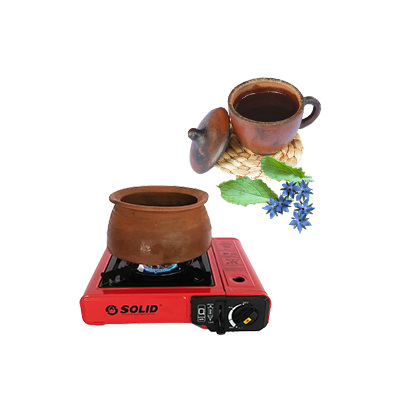
- Take an adequate amount of borage leaves and flowers and wash until clean.
- Boil both ingredients until it boils.
- Let it stay warm.
- Strain then drink; this remedy can induce sweating, lowering the body's fever.
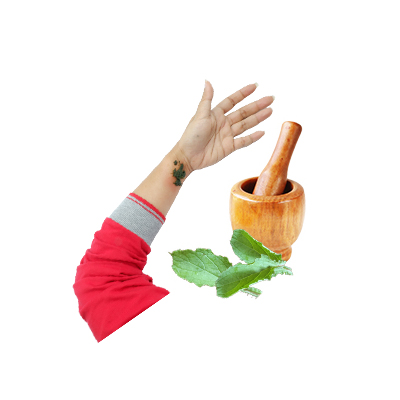
2. Treats swelling
- Prepare an adequate amount of borage leaves and wash until clean.
- Grind until it becomes a paste.
- Apply as a poultice on the swollen skin.
Reference Sources
- Royal Botanical Gardens. 2021. Plant of the World Online: Borago officinalis L. https://powo.science.kew.org/taxon/urn:lsid:ipni.org:names:113618-1. 2-01-2022.
- Useful Temperate Plants Database. 2021. Borago officinalis. http://temperate.theferns.info/plant/Borago+officinalis. 20-01-2022.
- Samani M. A., Bahmani M., Kopaei M. R. 2014. The chemical composition, botanical characteristic and biological
activities of Borago officinalis: a review. Asian Pacific Journal of Tropical Medicine, 7(Suppl 1): S22-S28. - Weedy Wildflowers of Illinois. 2019. Borage. https://www.illinoiswildflowers.info/weeds/plants/borage.htm. 21-01-2022.