Brugmansia x candida Pers.
Summary
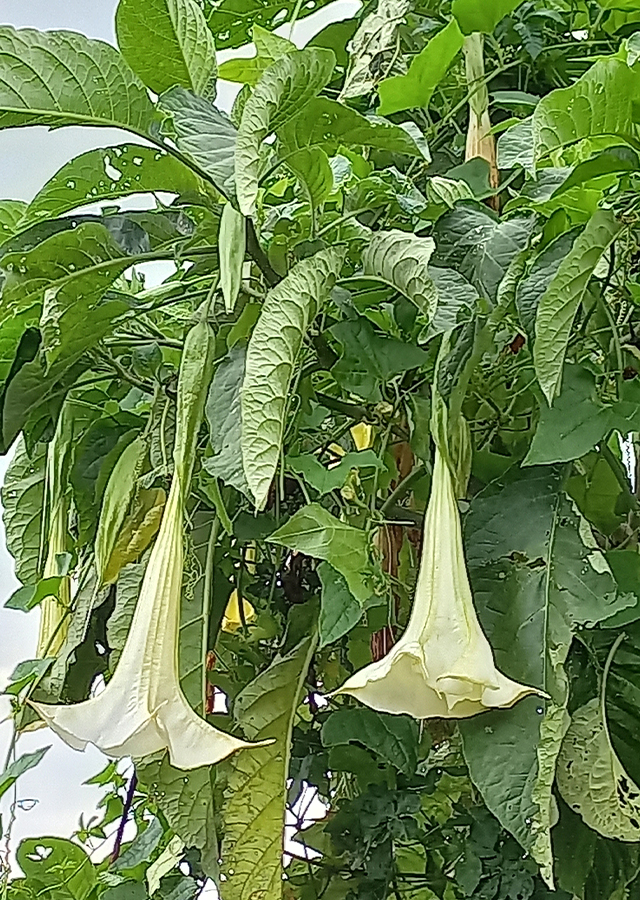
White angel's trumpet (Brugmansia x candida) is a shrub or small tree 3-4 meters tall from the Solanaceae family native to Ecuador and Peru. Its large, striking flowers are popular as an ornamental and hedge plant, even used in religious ceremonies by several South American cultures. White angel's trumpet is traditionally believed to be spasmolytic and helps relieve rheumatic pain.
Agroecology
White angel's trumpet grows best in sandy, loamy, and clay soils that are acidic to slightly alkaline. This species has moderate drought tolerance and poor soil salt tolerance. It grows in areas with mean annual rainfall of 800-3,000 mm, and prefers moist conditions and a position in full sun.
Morphology
- Roots taproot, dirty yellow in color.
- Stem woody, round, branched, growing upright, dirty white in color.
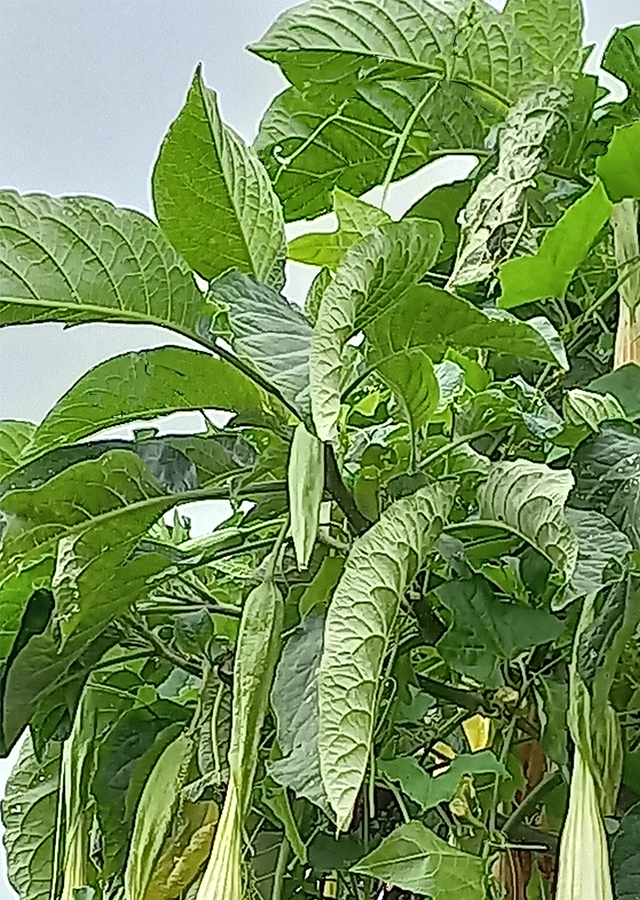
- Leaves simple, alternate, ovate, 15-25 cm long, 8-12 cm wide, margins entire, occasionally with a few shallow lobes, apex pointed to tapering, base oblique, petiole up to 6 cm.
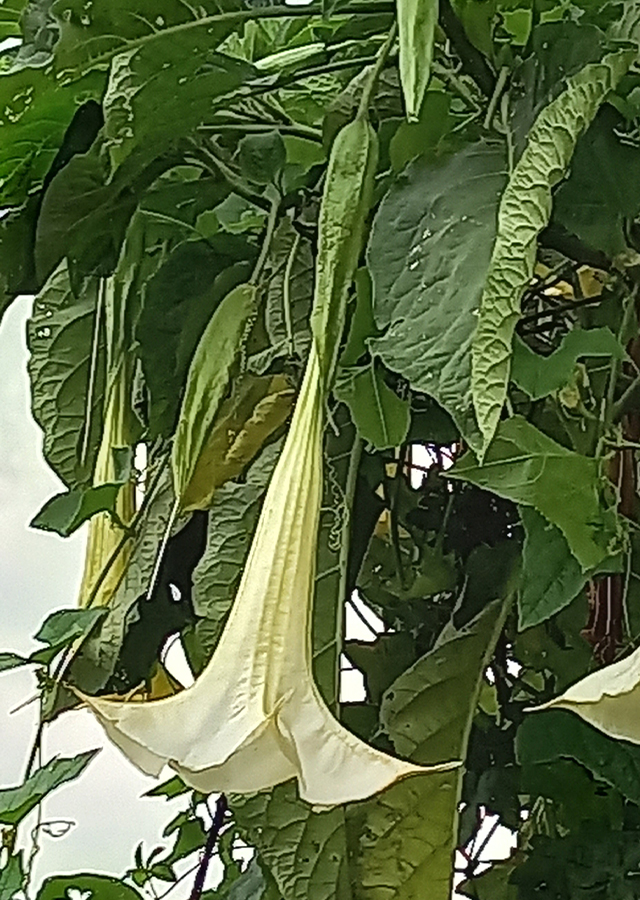
- Flowers solitary, pendulous, stalk 3-5 cm long, sturdy in fruit. Calyx tube-shaped, spathe-like, split on 1 side with lobes not clearly separated, up to 12 cm long. Corolla white apricot or pale in color, 25-30 cm long, tube slender, gradually widening toward the extremities, lobe apex broadly triangular ending in a cusp 2-3 cm long. Stamens number 5, located in the middle of the corolla tube, filaments about 4-5 cm long. Anthers distinct, linear, about 2.5 cm long, opening lengthwise, ovary 2-celled, style about 17-19 cm long. Stigma oblong, 5-7 mm long, located in the throat of the corolla.
- Fruit a capsule, rarely formed, fusiform, up to 20 cm long, 2 cm wide, pendulous.
- Seeds (not observed) reportedly numerous, D-shaped, 6-10 mm long, seed coat corky.
Cultivation
Plant propagation is done using seeds (generative) and stem cuttings (vegetative).
Chemical Content
Alkaloids such as scopolamine, hyoscyamine, and atropine.
Benefits
Acts as a spasmolytic, antiasthmatic, anticholinergic, has anesthetic and analgesic properties for traumatic or rheumatic pain, and is used to treat dermatitis, orchitis, boils, fever, arthritis, headaches, infections, and as an anti-inflammatory.
Local Names
Kecubong, Kecubung gunung.
Traditional Recipes
The following recipes reflect traditional knowledge passed down through generations, not a substitute for professional medical diagnosis or advice. Consult a healthcare provider before use.
1. Boils
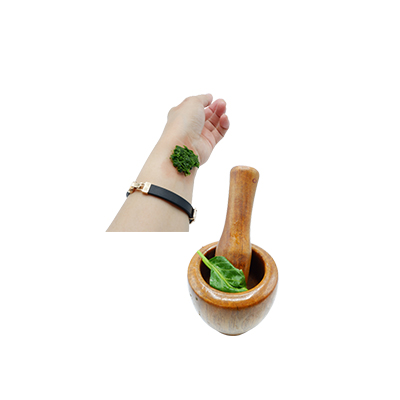
- Prepare an adequate amount of fresh leaves, wash until clean.
- Grind the leaves until fine.
- Apply to the boil to speed up pus drainage and relieve pain.
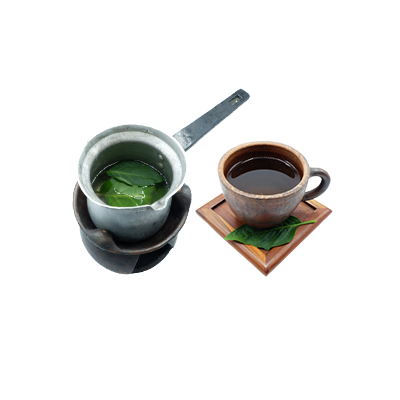
2. Fever
- Take an adequate amount of fresh leaves and wash clean.
- Boil the leaves until it boils.
- Let it sit until warm/cold.
- Strain then drink.
Reference Sources
- Royal Botanic Gardens. 2017. Plants of the World Online: Brugmansia × candida Pers. http://www.plantsoftheworldonline.org/taxon/urn:lsid:ipni.org:names:814597-1. 09-11-2021.
- CAB International. 2021. Brugmansia candida (angel's trumpet). https://www.cabi.org/isc/datasheet/10133. 09-11-2021.
- Flora Fauna Web. 2021. Brugmansia Pers. × candida. https://www.nparks.gov.sg/florafaunaweb/flora/6/0/6038. 09-11-2021.
- Taman Husada Graha Famili. 2015. Kecubung gunung – Brugmansia candida Pers.. https://www.tamanhusadagrahafamili.com/2015/10/kecubung-gunung-brugmansia-candida-pers/. 09-11-2021.