Brunfelsia pauciflora (Cham. & Schltdl.) Benth.
Summary
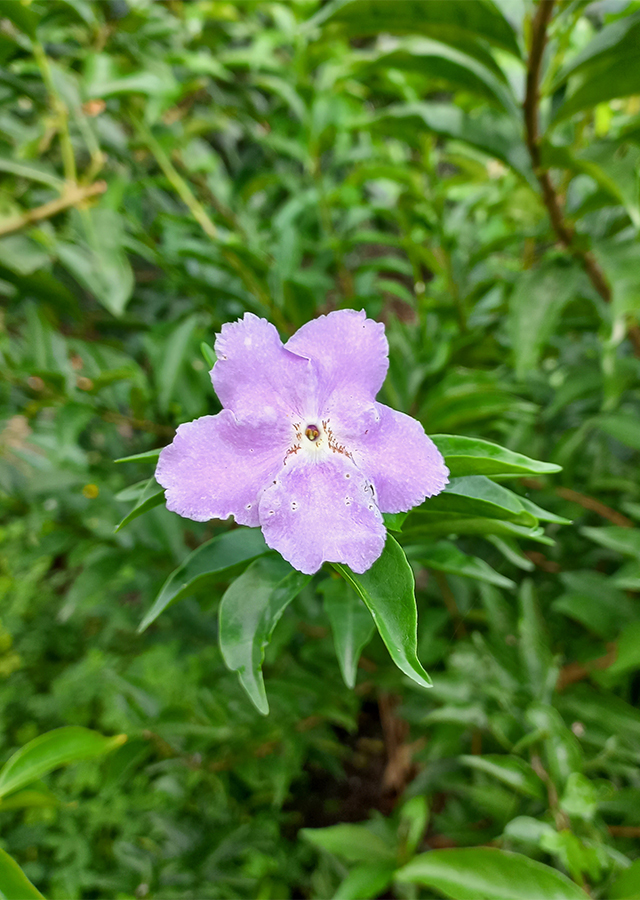
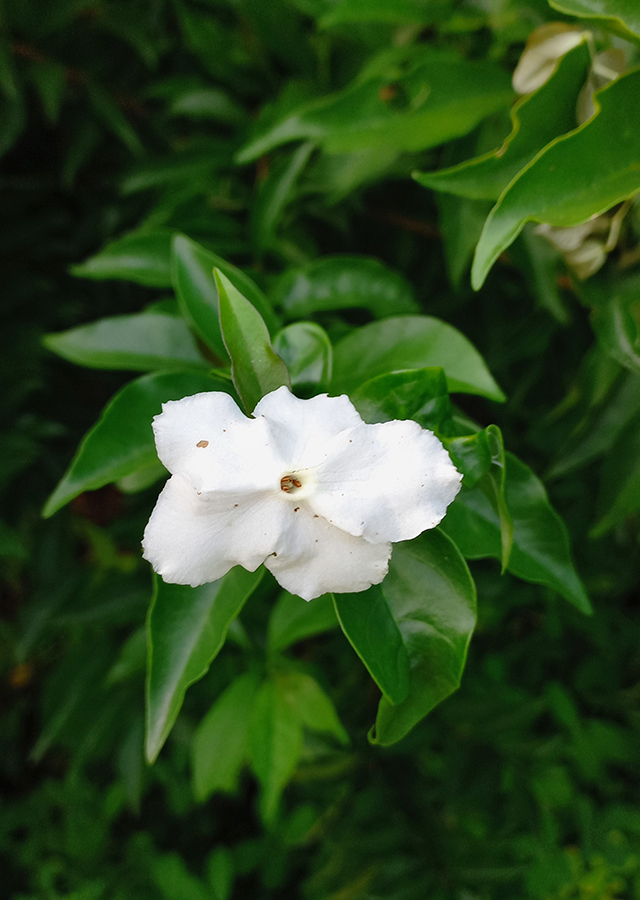
Brunfelsia pauciflora or melati putih ungu (yesterday-today-and-tomorrow) is native to southern Brazil, distributed from Rio de Janeiro to Santa Catarina, and known for its unique flower color that changes from deep purple on the first day to light purple then white on the third day. This uniqueness makes it favored as a hedge plant and garden ornamental, while its aroma also has potential use in aromatherapy.
Agroecology
Melati putih ungu is found in its native region at elevations reaching 1,500 m asl, with a mean annual rainfall of 1,600 mm. Prefers full sun (6 hours or more of direct sunlight a day) to partial shade (direct sunlight for only part of the day, 2-6 hours) in compost-rich soil, with soil acidity below 6 (acidic).
Morphology
- Stem woody, bark grayish brown and mostly smooth, branches dark green.
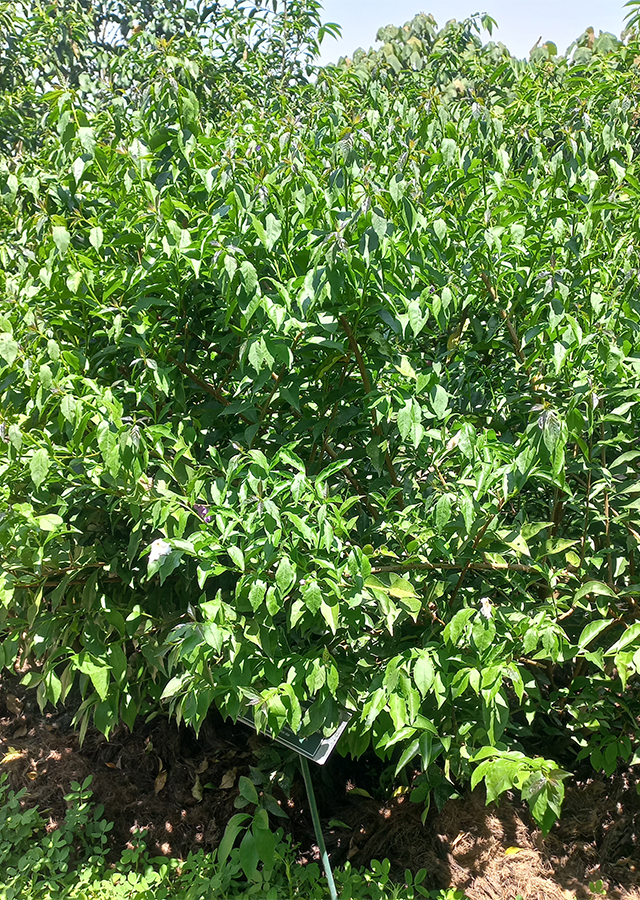
- Leaves coarse green, 8-16 cm long and 2-6.5 cm wide, elongated lanceolate shaped with a pointed tip and wedge-shaped base. Lower surface light green.
- Flowers arranged in terminal clusters of up to 10. Flower color starts purple then matures to lavender then white. Flowers bisexual, 5 petals, overlapping, white center.
- Fruit a smooth light green capsule with several seeds (12 to 30 seeds).
- Seeds 5-6 mm long and 2.5-3 mm in diameter. Elongated-ovoid shape, oblique and dark reddish-brown. Surface dotted like a net.
Cultivation
Propagated with stem cuttings planted in a growing medium of mixed peat and sand.
Chemical Content
Alkaloids, sesquiterpenoids, the alkaloids manacine and manaceine, as well as aesculetin, non-nitrogenous scopoletin (6-methoxy-7-hydroxycoumarin).
Benefits
Has potential for use in aromatherapy.
Local Names
Melati kosta (Jawa), Tanaman kemarin, hari ini dan besok.
Reference Sources
- National Park. Brunfelsia pauciflora.(Cham. & Schltdl.) Benth. https://www.nparks.gov.sg/florafaunaweb/flora/1/7/1733. 11-11-2021.
- Royal Botanical Garden. 2017. Plants of the World Online: Brunfelsia pauciflora (Cham. & Schltdl.) Benth. http://www.plantsoftheworldonline.org/taxon/urn:lsid:ipni.org:names:814676-1. 11-11-2021.
- North Carolina State Extention. Brunfelsia pauciflora. https://plants.ces.ncsu.edu/plants/brunfelsia-pauciflora/#poison. 11-11-2021.
- Cédric Bertrand, Gilles Comte, Florence Piola. 2021. Solid-phase microextraction of volatile compounds from flowers of two Brunfelsia species. Biochemical Systematics and Ecology (ISSN : 0305-1978). https://hal.archives-ouvertes.fr/hal-00124548. 11-11-2021.