Bunchosia armeniaca (Cav) DC
Summary
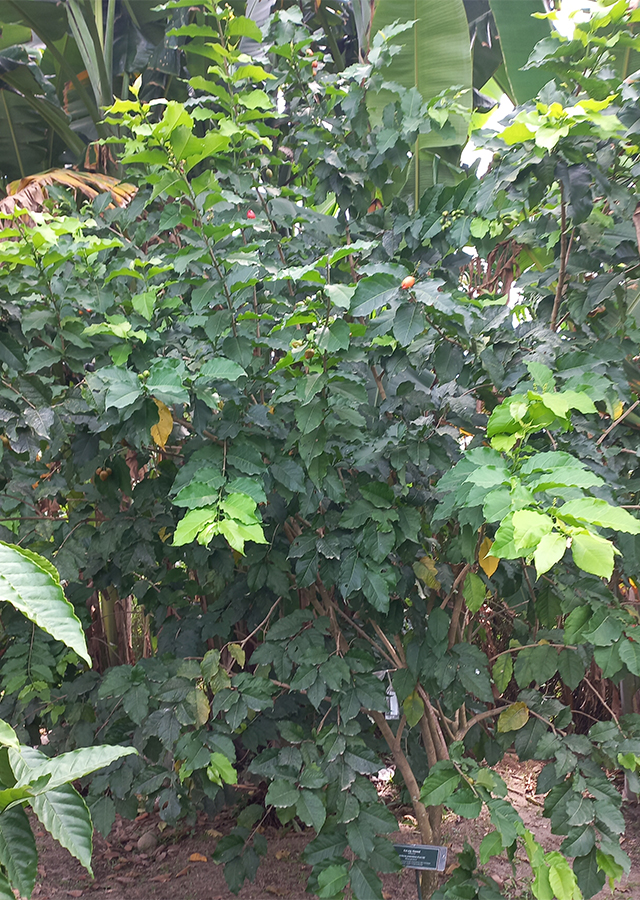
Kacang almond (Bunchosia armeniaca) is a shrub or small tree up to 10 meters tall from the Malpighiaceae family that originates from Bolivia and Northern Brazil. Its sweet fruit flesh is typically eaten raw or used as a food flavoring. Kacang almond leaves have proven antibacterial and anti-inflammatory properties, and are also traditionally believed to lower cholesterol.
Agroecology
Bunchosia armeniaca is a low to medium elevation plant in tropical regions at elevations of 100-2,600 m asl. Kacang almond is somewhat cold-hardy, succeeds in most soil types in full sunshine and should not be placed in overly shaded spots. This plant can begin producing fruit within just two years from seed. Trees can flower and produce fruit almost year-round in suitable climates, with several fruit crops usually produced each year. Grows well in fertile (organic-matter-rich) loamy soil with good drainage.
Morphology
- Stem woody, its branches grow straight and spreading.
- Leaves opposite, ovate with a wavy margin. Primary and secondary veins prominent.
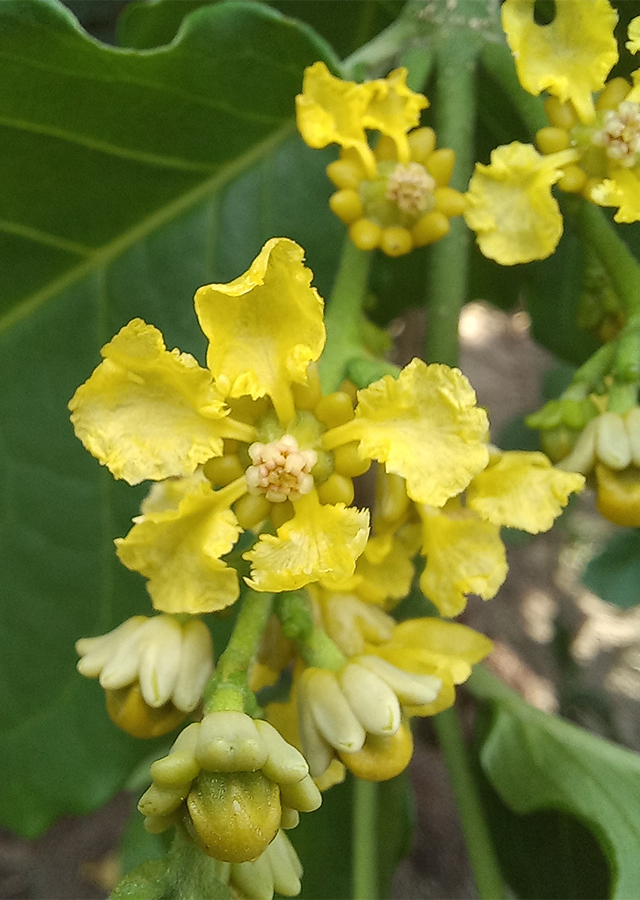
- Flowers emerge from the leaf axils, in a simple raceme 8-15 m long. Hermaphroditic flowers, with a pedicel 0.5-1 cm long, tube-shaped covered with granules with a diameter of 1.5 cm. Calyx 5-parted, 5-6 cm long, oval-shaped, base long and narrowing, margin serrated. Has 10 monadelphous stamens with centered filaments, and open anthers. Individual flowers bright yellow and lightly scented.
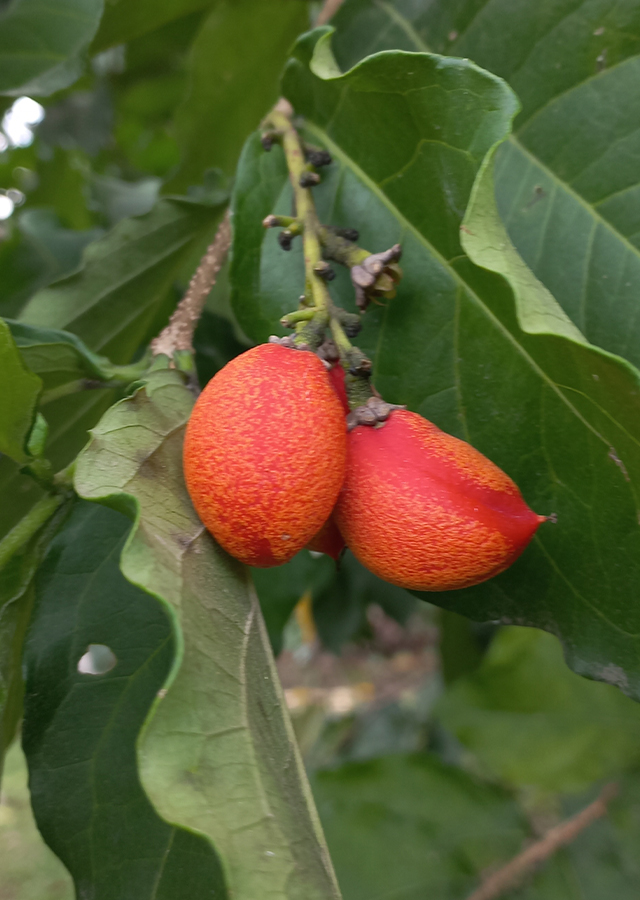
- Fruit ovate with a pointed tip, about 3 cm long, ripening from green to orange or red.
- Seeds two seeds enclosed in one fruit.
Cultivation
This plant can be propagated generatively (seeds) or vegetatively (cuttings and layering). Seed propagation has a high success rate because almond bean seeds germinate easily. After seeds are removed they must be planted quickly as their germination capacity will decrease.
Chemical Content
Flavonoids (rutin, isoquercitrin, afzelin), alkaloids, fatty acids, phenols, saponins, tannins, phytosterols, triterpenoids, steroids, glycosides, phenolic compounds.
Benefits
Treats various diseases including infections and inflammation, a diet or weight-loss snack, increases male libido, lowers cholesterol. Has antibacterial and anti-inflammatory activity.
Simplisia
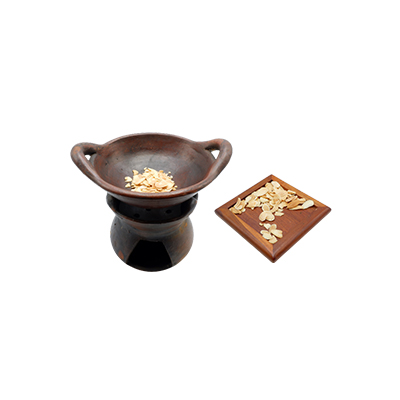
- Prepare almond bean seeds, wash until clean with running water then drain.
- Dry under direct sunlight for several days or with an oven at 40 °C until moisture content reaches 10%.
- Store the dried preparation in a clean, airtight container.
Local Names
Kacang mentega, Kacang amazone.
Traditional Recipes
The following recipes reflect traditional knowledge passed down through generations, not a substitute for professional medical diagnosis or advice. Consult a healthcare provider before use.
1. Weight loss
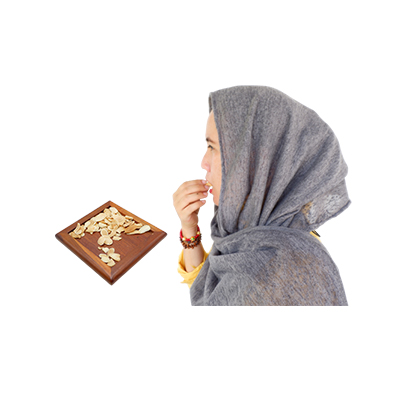
- Prepare almond beans as needed and wash until clean.
- Roast or bake the beans in an oven until slightly golden.
- Remove and enjoy as a snack to help with weight loss.
2. Increasing male libido
- Roast or bake almond beans in an oven until slightly golden.
- Remove and consume the almond beans, which can be beneficial for increasing male libido.
Reference Sources
- Royal Botanic Gardens. 2021. Plants of the World Online: Bunchosia armeniaca (Cav.) DC. http://www.plantsoftheworldonline.org/taxon/urn:lsid:ipni.org:names:555884-1. 28-09-2021.
- Useful Tropical Plants Database. 2021 Bunchosia armeniaca. http://tropical.theferns.info/viewtropical.php?id=Bunchosia+armeniaca. 28-09-2021.
- Flora Fauna Web. 2021. Bunchosia armeniaca (Cav.) DC.. https://www.nparks.gov.sg/FloraFaunaWeb/Flora/2/7/2764. 28-09-2021.
- ACG Publication. 2015. Antibacterial and Anti-Inflammatory activities of Bunchosia armeniaca (Cav.) DC. (Malpighiaceae). https://acgpubs.org/article/records-of-natural-products/2015/3-july-september/antibacterial-and-anti-inflammatory-activities-of-bunchosia-armeniaca-cav-dc-malpighiaceae. 28-09-2021.
- Samudra bibit. 2020. Menanam dan Merawat Si Unik dan Cantik Kacang Amazon. https://samudrabibit.net/blog/menanam-dan-merawat-si-unik-dan-cantik-kacang-amazon. 28-09-2021.
- Udaweediye Lekam Ralalage Ruwanthi Premathilaka dan Ginigandarage Mayumi Shanika Wiranjanee Silva. 2016. Bioaktive Compounds and Antioxidant Activity of Bunchosia armeniaca. World Journal Pharmacy and Pharmaceutical Science. Volume 5, Issue 10, 1237-1247. ISSN 2278 – 4357.
- Mackingsley Kushan Dassanayake. 2019. The in vitro evaluation of antibacterial and antifungal activities of ripe fruit extracts (pericarp and seed) of Bunchosia armeniaca (Cav.) DC. Asian Journal of Pharmacognosy Asian J. Pharmacogn 3(3):20-28.