Calamus draco Willd.
Summary
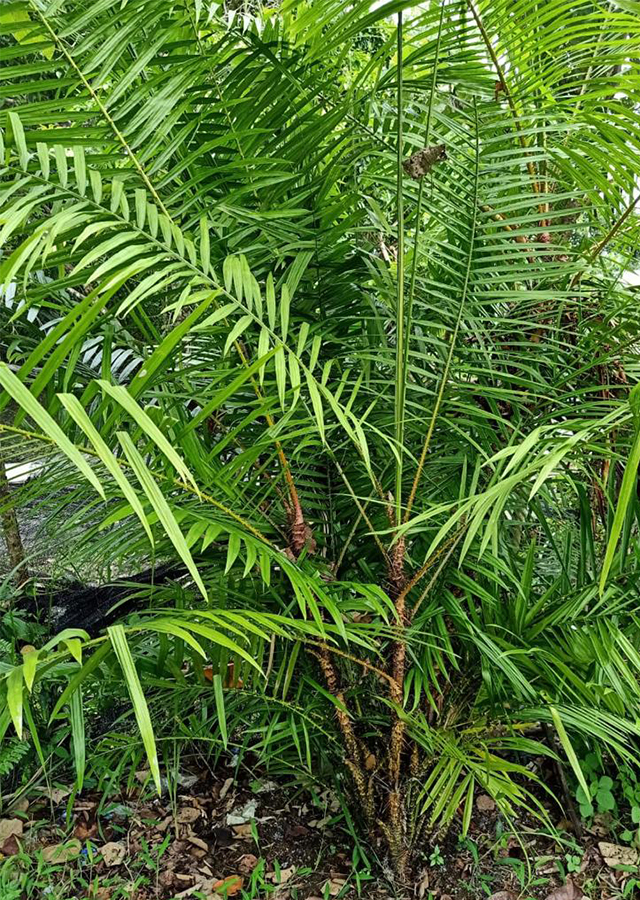
Jernang, or dragon's blood (Calamus draco), is a clump-forming rattan of the Arecaceae family that can trail up to 15 meters, growing naturally in only three countries in the world: Indonesia, Malaysia, and India, with the greatest potential in Sumatra and Kalimantan. Its distinctive red sap is used by communities as medicine and as a natural dye for marble, ceramics, and rattan crafts. Traditionally, dragon's blood sap is also believed to help prevent wound infection and treat dysentery.
Agroecology
Grows in tropical forests at elevations of around 800 m above sea level, rainfall of 1,000–1,500 mm/year, light intensity of 50–55%, air humidity of 60–92%, and air temperature of 23.4–29.4 °C. Lowland forests and shaded locations are very suitable for dragon's blood growth. Favors humus-rich soil with a soil pH of 5.5–6.2.
Morphology
- Stem slender and flexible, 2-3 cm in diameter, covered with small, sharp thorns.
- Leaves green, consisting of leaflet blades arranged in pairs. The underside of the leaf is slightly concave.
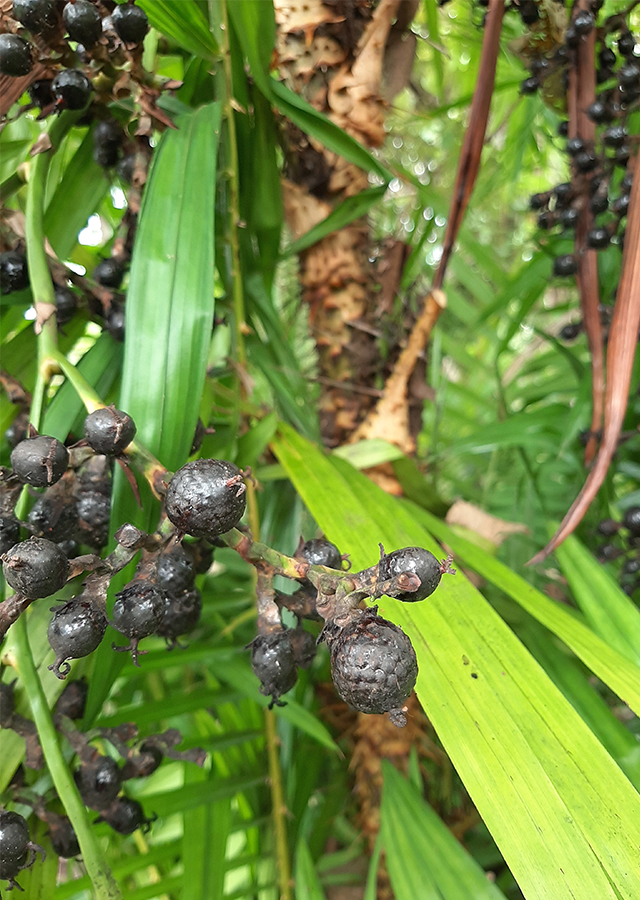
- Fruit round, small, clustered on a single bunch.
Cultivation
- Seedlings are propagated from seed and offshoots.
- Dragon's blood can be harvested twice a year.
Chemical Content
Dracorhodin, dracorubin, dracooxepine, dracoalban, dracoresene, dracoresinotannol, dracoflavan, nordracohobin, nordracorubin, abietic acid, dehydroabietic acid, isopimaric acid, pimaric acid, sandaracopimaric acid, benzoic acid, secobiflavanoid, dammaradienol.
Benefits
Treats dysentery; helps prevent wound infection; helps stabilize body metabolism; antibacterial; supports oral health; helps protect and support eye health; addresses anemia complaints; anti-aging.
Simplisia
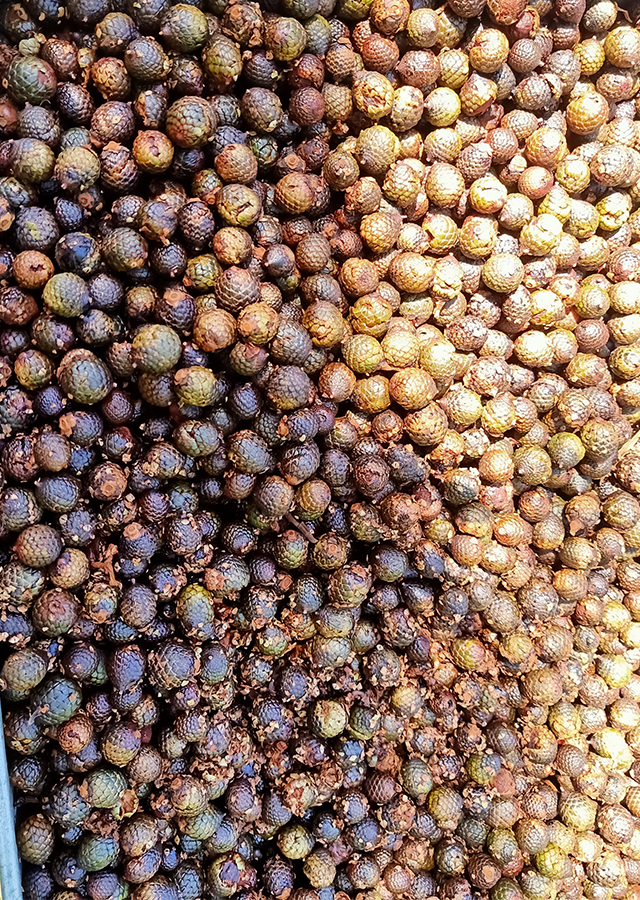
- Place dragon's blood fruit in a cylindrical container (wet extraction device) then add water.
- Rotate the device 1,000 times until the resin attached to the skin fully dissolves in the water, then strain to separate the debris or residue.
- Place the strained water solution in a container for 3 days so the resin settles and floats.
- Separate the resin from the water, then air-dry the resin until its moisture content is 6%.
- The resulting resin is around 7% of the fruit's weight.
Local Names
Rotan, Jornang (Riau), Limbayung (West Sumatra).
Traditional Recipes
The following recipes reflect traditional knowledge passed down through generations, not a substitute for professional medical diagnosis or advice. Consult a healthcare provider before use.
1. Preventing Wound Infection
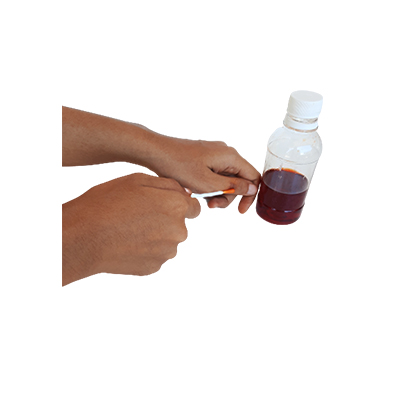
- Take 1-2 tbsp of dragon's blood resin and mash it.
- Add 60% alcohol, then strain through filter paper until it resembles iodine antiseptic.
- Apply to the wound.
Reference Sources
- Tropical Plants Database, Ken Fern. (2014). Daemonorops draco. http://tropical.theferns.info/viewtropical.php?id=Daemonorops+draco. 17-08-2020.
- Gupta, D., Bleakly, B., and Gupta, R.K. (2008). Dragon's blood: Botany, chemistry and therapeutic uses. Journal of Ethno-Pharmacology, (115) (pp361-380).
- Royal Botanic Gardens. (No date). Plants of the World Online: Calamus draco Willd. http://powo.science.kew.org/taxon/urn:lsid:ipni.org:names:665061-1. 17-08-2020.
- Pl@nt Use. (2016). Daemonorops draco (PROSEA). https://uses.plantnet-project.org/en/Daemonorops_draco_(PROSEA). 17-08-2020.
- Purwanti, S., Wahyuni, W.T., and Batubara, I. (2019). Antioxidant Activity of Daemonorops draco Resin, Journal of Scientific and Applied Chemistry, 22 (5) (pp179-183).
- Hutanriau.org. Jernang bukit batabuh Riau. https://hutanriau.or.id/jernang-bukit-batabuh-riau/ 18-04-2020.
- Tantawi Adamy. 2020. Simplisia Jernang. Meulaboh. Aceh.
- Tantawi Adamy. 2020. Ramuan Tradisional Jernang. Meulaboh. Aceh.