Canavalia ensiformis (L.) DC.
Summary
Kacang pedang putih (Canavalia ensiformis) is a climbing annual shrub from the Fabaceae family that originates from South and Central America, cultivated in Mexico since about 3,000 BC. Its young pods are eaten as a vegetable, while its seeds are processed into tempeh or bean sprouts after boiling to remove toxins. The concanavalin A content in this plant is studied as an immunomodulator for cancer therapy.
Agroecology
Kacang pedang putih can be found thriving in temperate to tropical climates at elevations up to 1,500 m asl. Grows best at temperatures between 13-27 °C, with optimal annual rainfall between 800-2,000 mm, but able to tolerate 600-4,300 mm. Prefers areas in full sun but has moderate shade tolerance. Able to grow and adapt to various soil conditions under harsh conditions, even in nutrient-poor, heavily leached, acidic soil, and is drought-resistant, but does not grow well in overly wet soil. Its growth also requires soil conditions with a soil acidity (pH) in the range of 5-6, but tolerating 4.3-8.
Morphology
- Roots have a deep root system, with root nodules for fixing nitrogen.
- Stem cylindrical, puberulent, hairless, with a hollow pith, short and large, becoming somewhat woody with age.
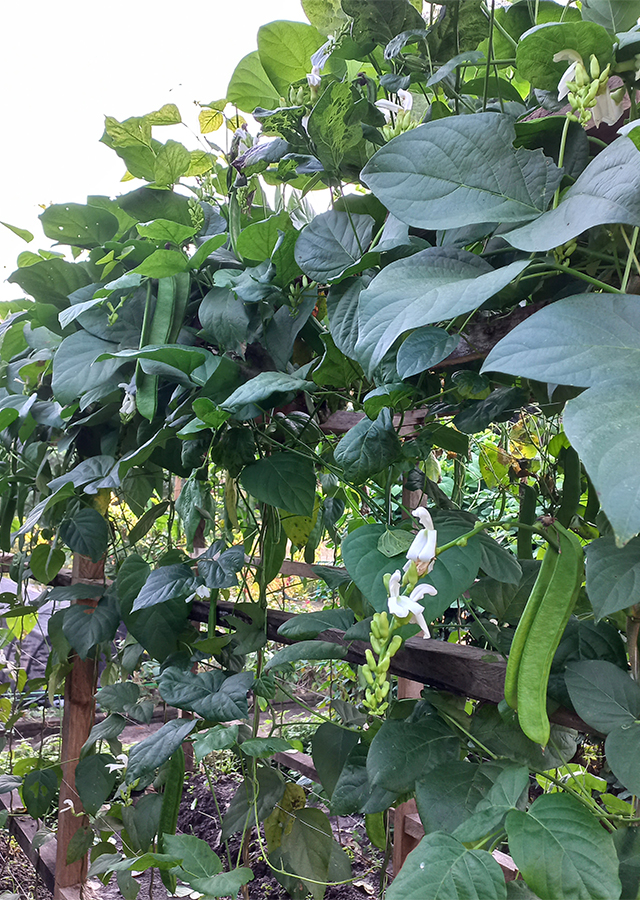
- Leaves alternate or scattered, green, thick, compound trifoliolate. Leaf blade broadly ovate or broadly elliptical, leaf tip blunt or rounded-short-tapering, base blunt, asymmetric on the lateral leaflets, smooth leaf margin, sparsely hairy on both surfaces.
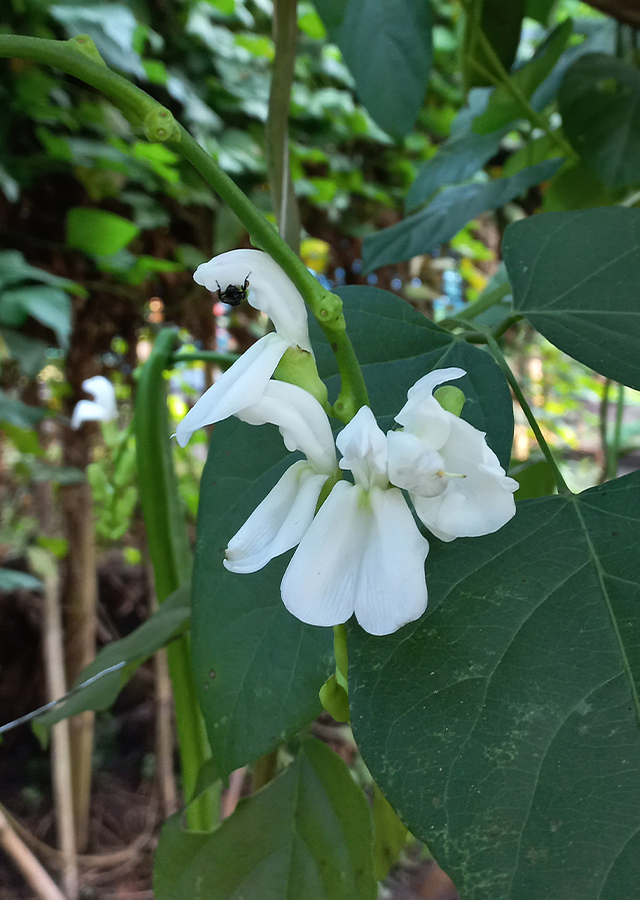
- Flowers pale purple, sometimes white, found on axillary racemes with swollen nodes, clustered between 1-3 flowers at swollen nodes along the rachis. Calyx green, cone-shaped, 5-lobed, sparsely pubescent. Corolla standard round-shaped.
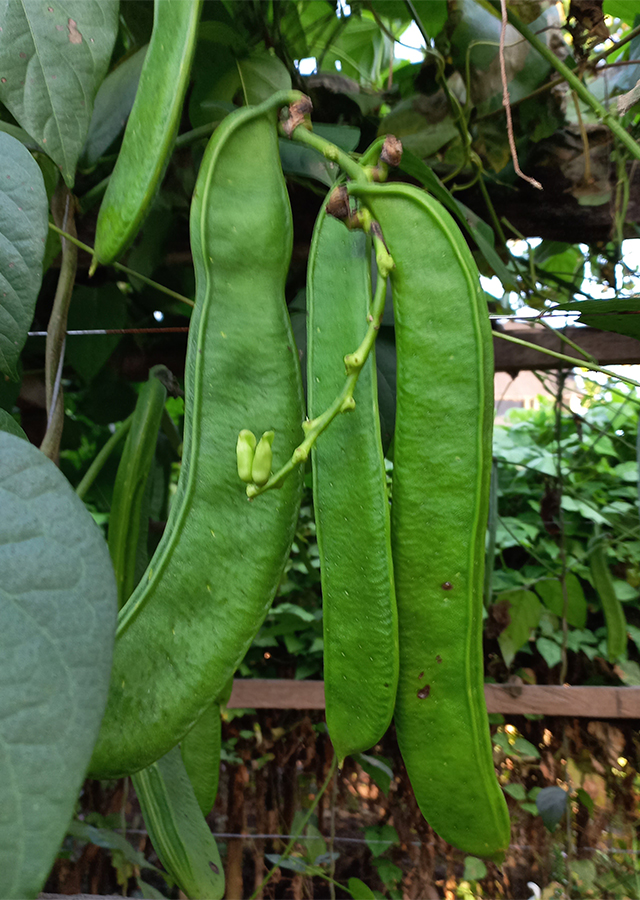
- Fruit a pod, large, long, linear, and flattened like a sword, slightly curved toward the tip, each pod containing 8-20 seeds.
- Seeds elliptical shape, up to 3 cm long, white or cream, hilum less than half the seed length, hilum brown.
Cultivation
- Propagation is done generatively with seeds.
- Direct seed planting in the field without a nursery, with 2 seeds per hole.
- The planting spacing that can be used is 40 cm x 50 cm or 40 cm x 75 cm.
- Green pods can be harvested after 80-120 days, and mature seeds after 180-300 days after planting.
Chemical Content
Lectins (concanavalin A and B), tannin, trigonelline, canavanine.
Benefits
An immunomodulator for cancer therapy, treats boils, strengthens the kidneys. Has antibiotic and antiseptic activity.
Simplisia
- Prepare white-flowered jack bean seeds, wash clean with running water then drain.
- Dry under sunlight or with an oven at 40 °C until moisture content reaches 10%.
- Blend into powder and sieve with a 60-mesh sieve.
- Store in a clean, airtight place.
Local Names
Koro dongkrak, Kacang parang, Koro bedog, Kacang mekah, Koro bendo, Krandang (Central Java), Koang (West Java), Koro wedung (Madura), Kacang kayu (West Sumatra).
Traditional Recipes
The following recipes reflect traditional knowledge passed down through generations, not a substitute for professional medical diagnosis or advice. Consult a healthcare provider before use.
1. Boils
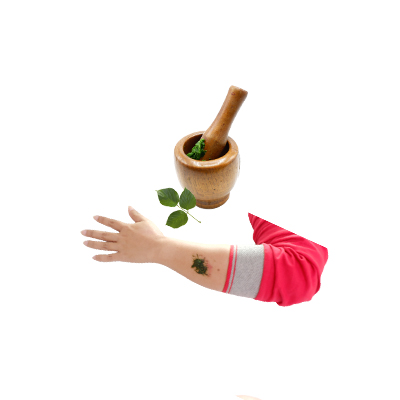
- Prepare kacang pedang putih leaves and wash until clean.
- Mash into a paste.
- Apply the leaf paste to the boil.
2. Strengthening the kidneys
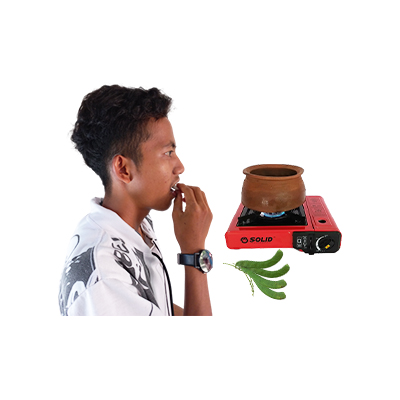
- Take kacang pedang putih seeds and wash until clean.
- Boil the seeds until soft.
- Eat to strengthen the kidneys.
Reference Sources
- Royal Botanic Gardens. 2021. Plants of the World Online: Canavalia ensiformis (L.) DC. http://www.plantsoftheworldonline.org/taxon/urn:lsid:ipni.org:names:1209500-2. 07-10-2021.
- PKHT IPB. 2018. KORO PEDANG (Canavalia ensiformis). https://pkht.ipb.ac.id/index.php/2018/04/23/koro-pedang-canavalia-ensiformis/. 07-10-2021.
- CAB International. 2021. Invasive Species Compendium: Canavalia ensiformis (jack bean). https://www.cabi.org/isc/datasheet/14486#toPictures. 07-10-2021.
- PROSEA. 2016. Canavalia ensiformis (PROSEA). https://uses.plantnet-project.org/en/Canavalia_ensiformis_(PROSEA). 07-10-2021.
- Useful Tropical Plants Database. 2021. Canavalia ensiformis. https://tropical.theferns.info/viewtropical.php?id=Canavalia+ensiformis. 07-10-2021.
- BALITKABI. 2016. Prospek Aneka Kacang Potensial: Koro Pedang sebagai Pengganti Kedelai. https://balitkabi.litbang.pertanian.go.id/infotek/prospek-aneka-kacang-potensial-koro-pedang-sebagai-pengganti-kedelai/. 07-10-2021.
- BALITKABI. 2021. Perbandingan Dua Spesies Canavalia dari Aras Kromosom. https://balitkabi.litbang.pertanian.go.id/infotek/perbandingan-dua-spesies-canavalia-dari-aras-kromosom/. 07-10-2021.
- Pugalenthi M., Doss A., Rajendrakumaran D., Vadivel V. 2010. Antibacterial activity of Canavalia ensiformis L.DC seeds due to solvent extract and fraction method. Indian Journal of Science and Technology 3(1).: 94-95.