Centratherum punctatum Cass.
Summary
Bunga kancing lurah (Centratherum punctatum) is a herb 10-50 cm tall of the Asteraceae family, thought to originate from South and Central America, now naturalized as far as Australia and the Pacific Islands. Although considered a weed, its leaf extract has proven antimicrobial and antiproliferative properties, with potential as a supplement for cancer patients. Bunga kancing lurah is traditionally believed to heal wounds and boost libido.
Agroecology
Centratherum punctatum is a weed commonly found growing in tropical regions especially in grasslands, disturbed areas, along roadsides, forests, forest edges, from sea level up to elevations of 1,200 m above sea level. Prefers environments with rainfall ranging between 500-1,900 mm/year. Very suitable for planting in open places with high sunlight intensity and has strong tolerance in dry areas or dry environments.
Morphology
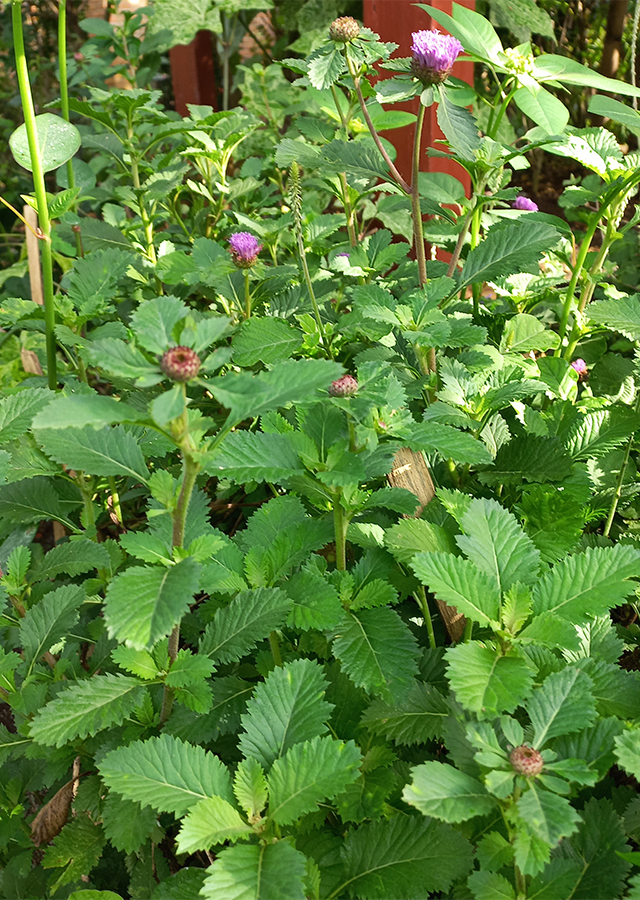
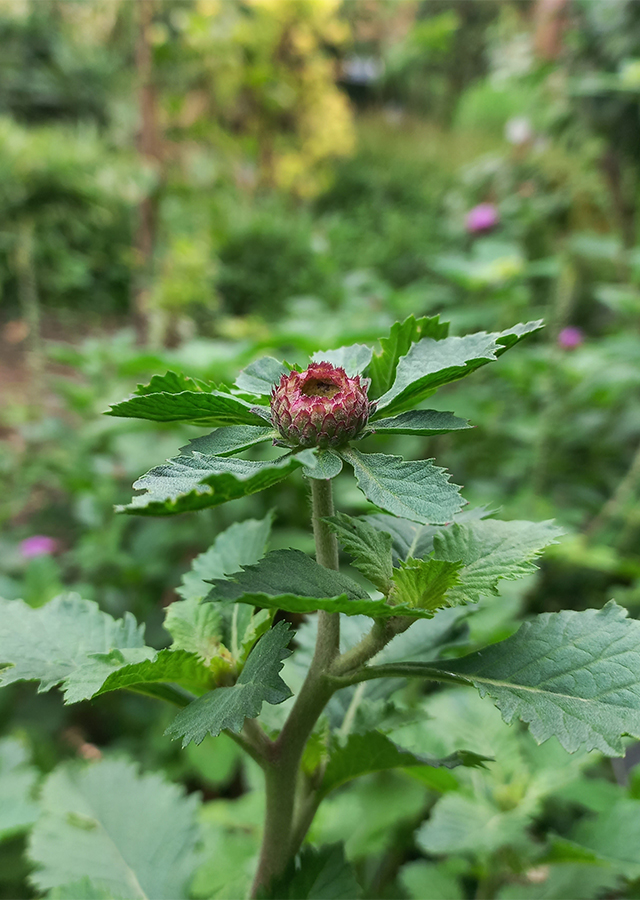
- Stem upright and puberulent, round shaped, brownish in color, rough and hairy stem surface.
- Leaves single, lance-ovate shaped, tapering leaf tip, tapering leaf base, sharply serrated leaf edges, light green in color, refreshing pineapple aroma, sessile or short-stalked leaves, alternate leaf arrangement, pinnate leaf veins.
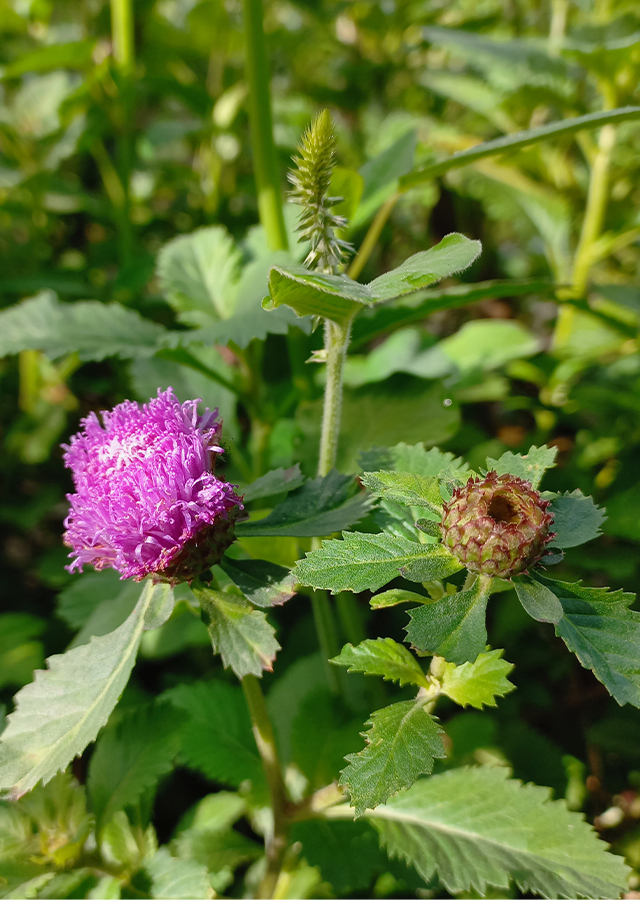
- Flowers compound, has a disc-shaped head with many florets, consisting of ray florets and disc florets with purple petals, fragrant. Outer florets longer than inner florets. Corolla tube narrowly cylindrical shaped and widening slightly at the top, corolla tube glandular. Corolla lobes numbering 5, linear. Stamens numbering 5. Anther filaments thread-like, white, and attached to the corolla. Inflorescence a single head shape.
- Fruit an achene, cylindrical, 8-10 ribbed, brown in color, hairless.
- Seeds small in size (1-2 mm).
Cultivation
Propagated generatively using seed.
Chemical Content
Kaempferol-3-glucuronide, chlorogenic acid, kaempferide, isorhamnetin-3-0-rutinoside, farnesol, cyanidin-3,5-di-0-glucoside, biochanin-1, 5-Hydroxy-4'-methoxy-7-methylflavones, ergocornine, kaempferol, feritidin, 3,4-dicaffeoylquinic acid, 7-0-methylwogonin, asiaticoside, qingyangshengenin, germacranolide derivatives, essential oil consisting of sesquiterpene hydrocarbon (β-caryophyllene, cyclosativene, α-copaene, trans-α-bergamotene, (Z)-β-farnesene, α-humulene, germacrene D, bicyclogermacrene, and δ-cadinene), oxygenated sesquiterpene (spathulenol, viridiflorol, caryophyllene oxide, globulol, sesquisabinene, β-selinene, β-eudesmol, bicyclogermacrene, elemol), and 1,8-cineole.
Benefits
Heals wounds, skin whitening and anti-aging agent, boosts libido, reduces pain, antidote for snake and tiger bites, addresses hypertension. Has antimicrobial, antioxidant, anti-inflammatory, antiproliferative, and anti-parasitic activity against Haemonchus placei.
Simplisia
- Prepare bunga kancing lurah leaves, wash thoroughly with running water.
- Cut the leaves into pieces so they dry easily.
- Dry in the sun or with an oven at 40°C until moisture content reaches 10%.
- Grind using a blender into powder.
- Store in a clean, airtight place.
Local Names
No information found. Further research needed.
Traditional Recipes
The following recipes reflect traditional knowledge passed down through generations, not a substitute for professional medical diagnosis or advice. Consult a healthcare provider before use.
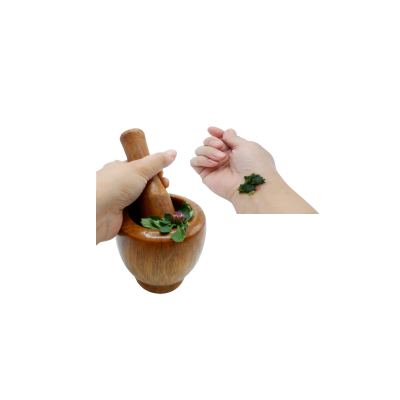
1. Antidote for snake bites
- Take bunga kancing lurah leaves as needed.
- Wash thoroughly with running water.
- Grind into a paste.
- Apply the paste to the wound caused by a snake bite.
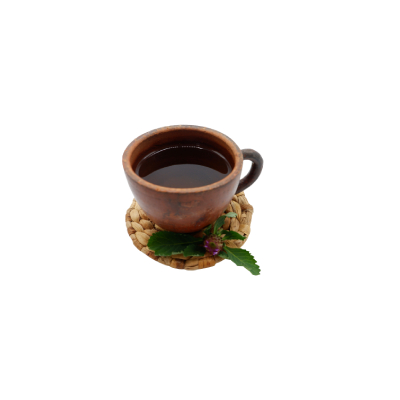
2. Hypertension
- Take bunga kancing lurah plant as needed then wash thoroughly.
- Boil the leaves until boiling.
- Let it become warm/cool.
- Strain the decoction then drink.
Reference Sources
- Royal Botanical Garden. 2021. Plant of the Warld Online: Centratherum punctatum Cass. hhttp://powo.science.kew.org/taxon/urn:lsid:ipni.org:names:51409-2. 05-09-2021.
- CAB International. 2021. Invasive Species Compendium: Centratherum punctatum (lark daisy). https://www.cabi.org/isc/datasheet/14608#tosummaryOfInvasiveness. 05-09-2021.
- Flora Fauna Web. 2020. Centratherum punctatum. https://www.nparks.gov.sg/florafaunaweb/flora/1/7/1798. 05-09-2021.
- Irsyam ASD dkk. 2020. Catatan Marga Centratherum (Asteraceae: Vernonieae) di Pulau Jawa. Al-Hayat: Journal of Biology and Applied Biology 3(2):75-84. DOI. 10.21580/ah.v3i2.6426.
- Chitra B, Brindh P. Vijayakumar ABS. 2016. PROTEASE ACTIVITY OF FLORAL EXTRACTS OF CENTRATHERUM PUNCTATUM CASS. A WOUND HEALING HERB. World Journal of Pharmaceutical Research 5(6):1079-1083.
- Ardianingsih D. 2015. Keanekaragaman Famili Asteraceae di Kawasan Kampus IPB Darmaga, Bogor. [Skripsi]. Institut Pertanian Bogor.
- Gbolade AA et al. 2009. ESSENTIAL OIL COMPOSITION OF Centratherum punctatum FROM NIGERIA. Chemistry of Natural Compounds 45(1):118-119.