Cereus repandus (L.) Mill.
Summary
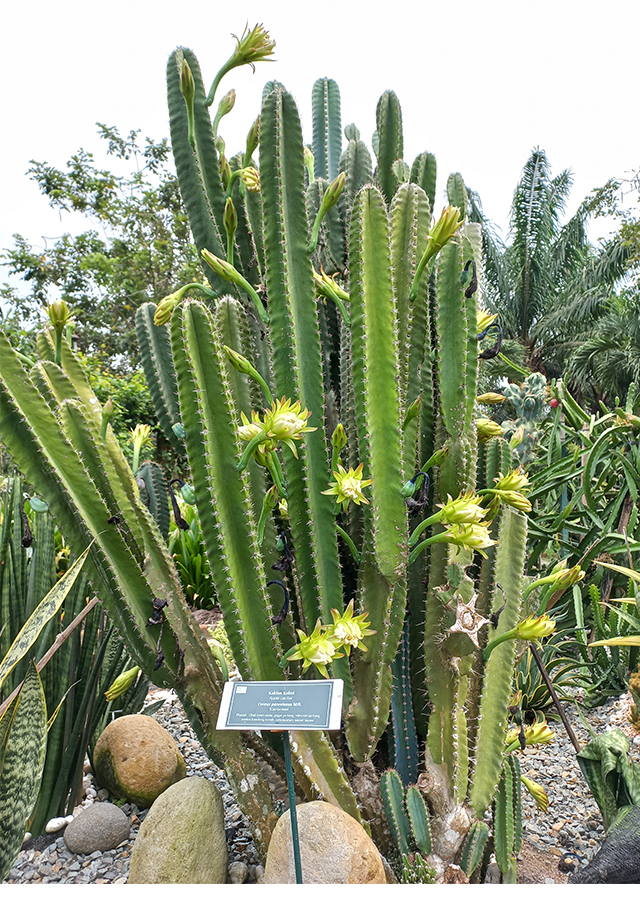
Cadushi cactus or 'Queen of the Night' (Cereus repandus) is a succulent up to 10 meters tall from the Cactaceae family native to the Southern Caribbean through Colombia, nicknamed as such because its flowers bloom only at night. Its sweet fruit can be eaten fresh, while its flesh is used to make soap and shampoo. Cadushi cactus is traditionally used to treat intestinal problems and acts as an anti-ulcer agent.
Agroecology
Cadushi cactus is a plant of drier regions in the tropics. This plant will withstand very high temperatures, but is not very frost-hardy, perhaps able to withstand a few degrees of frost. Prefers a position in full sun and well-drained soil. Prefers a pH lower than 6.
Morphology
- Stem has a woody skeleton to support its tall stature. The stem cross-section is angular, allowing its shape to swell when fully filled with water.
- Leaves reduced to sharp spines, though photosynthesis can still take place on its succulent stem.
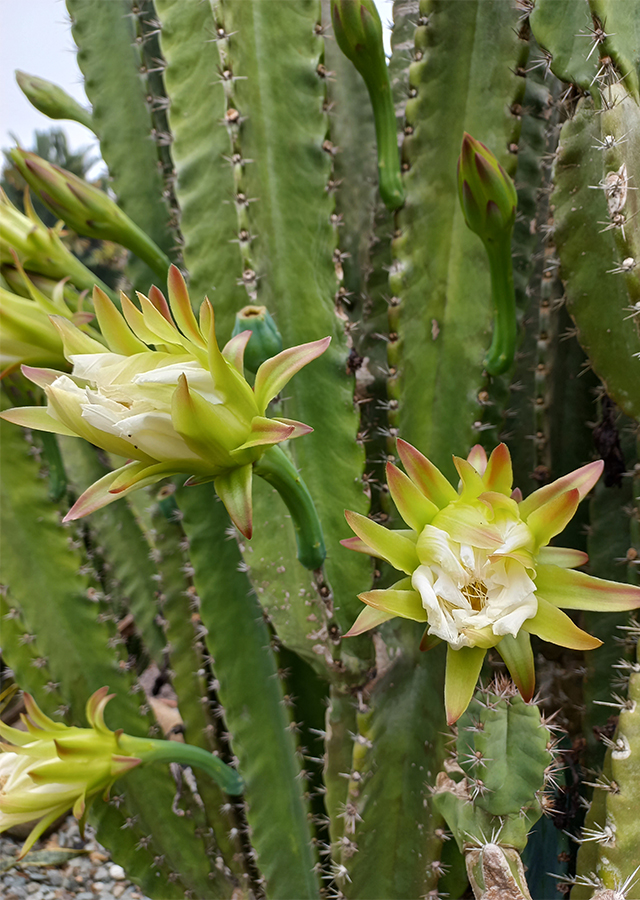
- Flowers large, white and fragrant, attracting bats or moths to pollinate it.
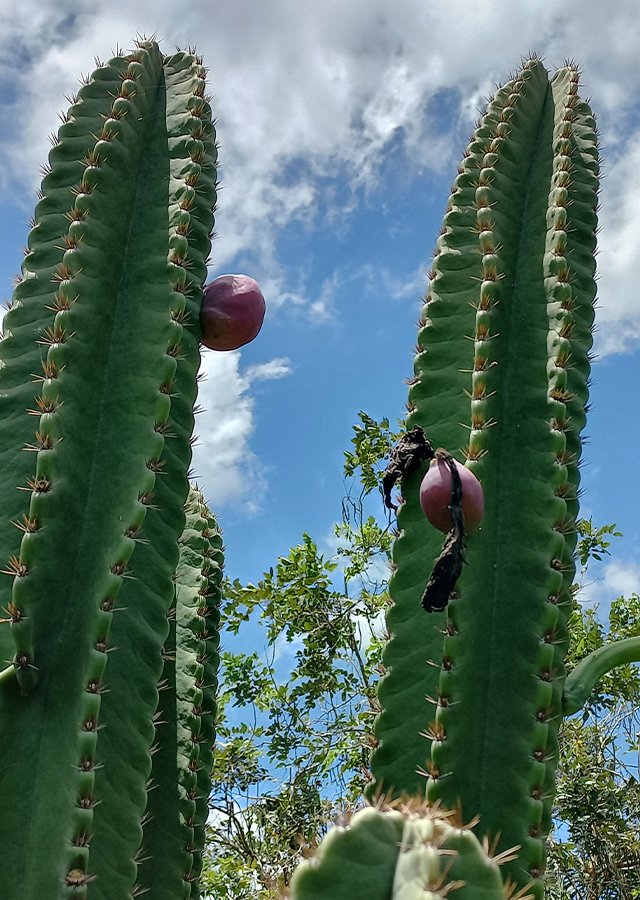
- Fruit red with white flesh with a sweet taste, resembling a dragon fruit in shape, oblong, 3-4 cm long.
Cultivation
Propagation can be done generatively through seed or vegetatively through stem cuttings.
Chemical Content
Hordenine, tyramine, polysaccharides, arabinogalactan.
Benefits
Treats intestinal problems, has anti-ulcer properties and can be used for phytotherapy.
Simplisia
- Take a stem of the cadushi cactus plant and wash until clean.
- Peel and take the flesh, then slice thinly.
- Dry without direct sunlight exposure or using an oven until the sliced stem flesh is dry.
- Store the dried cadushi cactus flesh in a clean, covered, airtight container.
Local Names
Kaktus koboi.
Traditional Recipes
The following recipes reflect traditional knowledge passed down through generations, not a substitute for professional medical diagnosis or advice. Consult a healthcare provider before use.
1. Treats intestinal problems
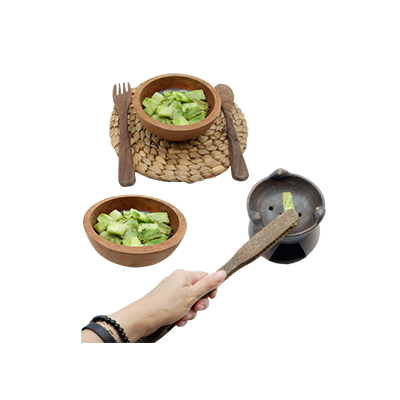
- Prepare cadushi cactus flesh.
- Dry over a fire and then eat.
- Beneficial for treating intestinal problems.
Reference Sources
- Royal Botanic Gardens. 2021. Cereus repandus (L.) Mill.. https://powo.science.kew.org/taxon/urn:lsid:ipni.org:names:130627-1. 24-1-2022.
- Useful Tropical Plants. 2021. Cereus repandus. http://tropical.theferns.info/viewtropical.php?id=Cereus+repandus
- Planter and Forester. 2019. Tanaman Hias Kaktus Cereus repandus (L.) Mill. https://www.planterandforester.com/2019/11/cereus-repandus-l-mill.html. 24-1-2022.
- Weberseeds. 2022. Cereus peruvianus, Peruvian Apple. https://weberseeds.nl/eshop/en/Cacti/Cereus-peruvianus-Peruvian-Apple::174.html. 24-1-2022.
- Julia F. Morton. 1967. Cadushi (Cereus repandus Mill.), a Useful Cactus of Curacao. Economic Botany Vol. 21, No. 2 (Apr. - Jun., 1967), pp. 185-191 (7 pages). Published By: Springer. https://dokumen.tips/documents/cadushi-cereus-repandus-mill-a-useful-cactus-of-curacao.html. 24-1-2022.
- Mizrahi Yozef. 2014. Cereus peruvianus (Koubo) new cactus fruit for the world. SciELO - Scientific Electronic Library Online. https://www.scielo.br/j/rbf/a/qNFSNbCFVbGj79Tg7RRDcYP/?lang=en#. 24-1-2022.