Chlorophytum comosum (Thunb.) Jacques
Summary
Chlorophytum comosum or spider plant lily is native to Central and Southern Africa, stretching from Liberia and Nigeria to Ethiopia and South Africa, and is now widely naturalized on various continents—even considered invasive in Australia. This plant is popular as a hanging or indoor ornamental, while in Chinese tradition its root is used to treat bronchitis, burns, and broken bones.
Agroecology
Chlorophytum comosum grows in various environments from sea level to 1,000 m asl and on sedimentary or volcanic soil, derived from granite, dolerite, shale, and sandstone parent rock with a pH of 5.5-7.5. In its native area, mean annual rainfall is between 500 and 2,000 mm. Chlorophytum comosum requires a shaded location or protection from direct sunlight as its growing environment.
Morphology
- Roots have a dense root system consisting of elongated white fleshy, thickened tubers and fine roots. The tubers are conical at both ends, 5 to 10 cm long and 0.5 to 1 cm in diameter.
- Stolons grow sideways. From each stolon, a spider-like plantlet forms leaves and roots. With these "spiders" the plant spreads vegetatively, providing an easy way to propagate spider plant lily.
- Stem vegetative, short and stout with very short internodes, while the flower stalk is stiff, thin, and slightly scabrous.
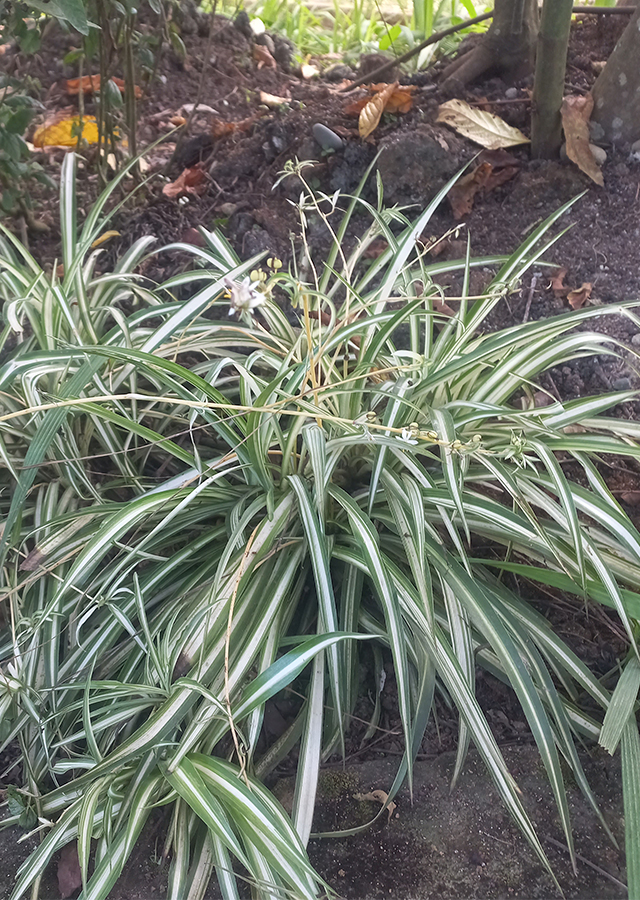
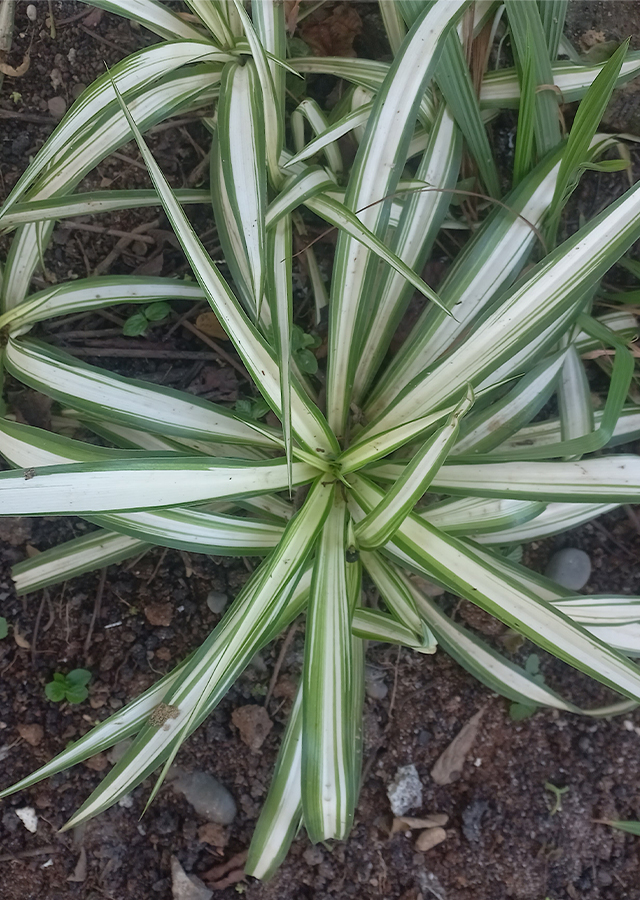
- Leaves emerge directly from the rhizome to form a rosette. Leaves simple, without a petiole, linear-lanceolate, alternate arrangement, and dark green in color. The blade is flat, with parallel ribs, entire or slightly wavy margin, tapering to a pointed tip. Leaf dimensions vary in length between 20 and 45 cm and width between 0.6 and 2.5 cm. In the wild species the leaves are green, but variegated white or yellow forms are widely known.
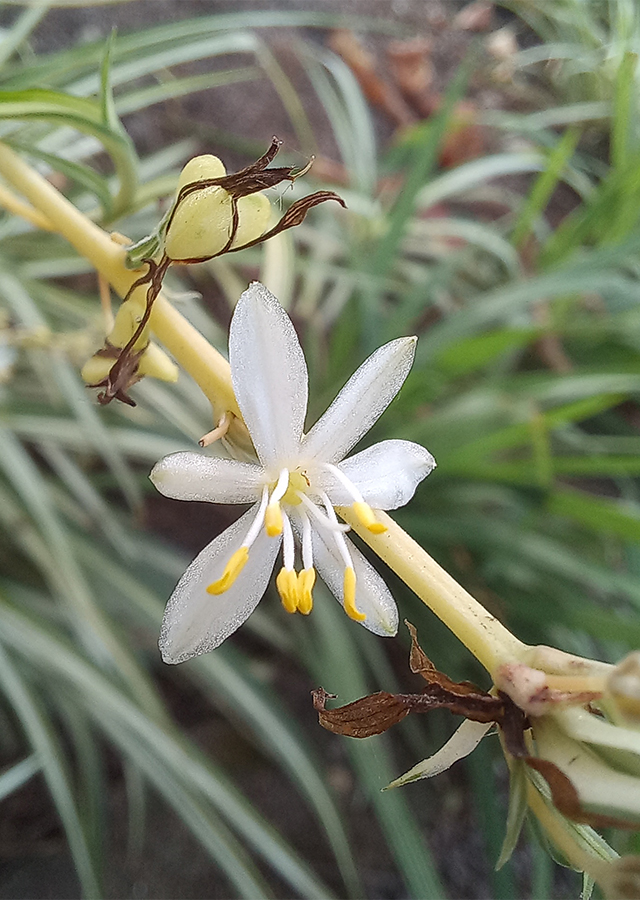
- Flowers monoecious (hermaphroditic) and complete their biological cycle within a few hours. They are grouped 1 to 6 on clustered inflorescences, an axis initially upright, but in full growth curving into an arc 30 to 75 cm (11-30 in) long. Where the inflorescence touches the ground, a leafy plantlet and roots are produced. Each individual flower is star-shaped, 1.8 to 2 cm (0.7-0.8 in) in diameter and consists of 3 elongated sepals and 3 petals 0.6 to 1 cm (0.23-0.4 in) long. Stamens number 6, with slender filaments 0.3 to 0.5 cm (0.11-0.2 in) long, with anthers 0.3 to 0.35 cm (0.11-0.14 in) long. The style is short and slender with a small, capitate stigma.
- Fruit a three-celled capsule containing 9 to 45 seeds.
- Seeds black, smooth, glossy, and flat.
Cultivation
Spider plant lily is propagated by division of rhizomes and from plantlets.
Chemical Content
Several fatty acids, isoprenoid and steroid compounds, 4'-methylphenyl-1C-sulfonyl-β-D-galactoside.
Benefits
Keeps the liver healthy, heals bronchitis, cough and colds, a potential prebiotic, used in bone healing and burns. Has anticancer activity.
Local Names
Tanaman laba-laba (Melayu).
Traditional Recipes
The following recipes reflect traditional knowledge passed down through generations, not a substitute for professional medical diagnosis or advice. Consult a healthcare provider before use.
1. Cough
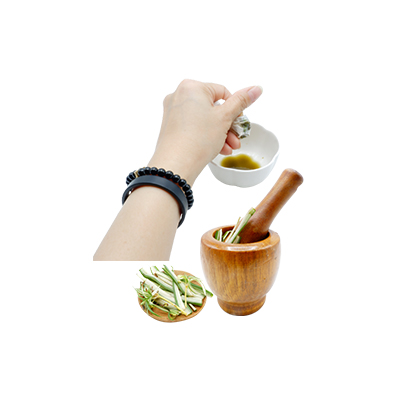
- Take an adequate amount of fresh spider plant lily leaves and wash until clean.
- Grind until it becomes a paste.
- Squeeze the paste to collect the liquid.
- Drink.
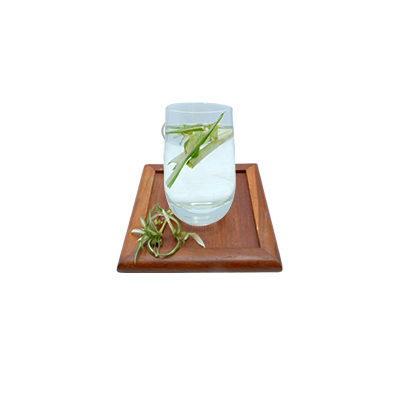
2. Laxative remedy
- Pick an adequate amount of fresh spider plant lily leaves and wash until clean.
- Soak in water and wait for a while.
- Strain then drink.
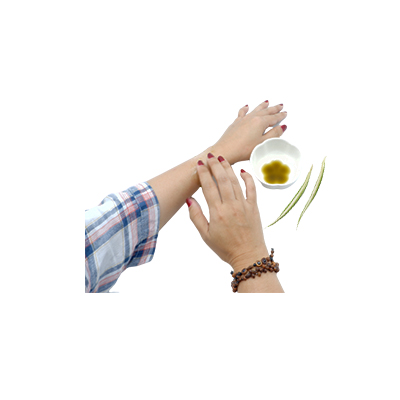
3. Burns
- Take an adequate amount of fresh spider plant lily leaves and wash until clean.
- Grind until it becomes a paste.
- Squeeze the paste to collect the liquid.
- Apply to the burn.
Reference Sources
- Royal Botanic Gardens, Kew. Plants of the World Online: Chlorophytum comosum (Thunb.) Jacques. https://powo.science.kew.org/taxon/urn:lsid:ipni.org:names:532810-1#synonyms. 25-08-2022.
- Kalliergeia. Spider Plant (Chlorophytum comosum) - Description and Uses.https://www.kalliergeia.com/en/spider-plant-chlorophytum-comosum-description-uses/. 25-08-2022.
- BALAI PENELITIAN TANAMAN HIAS. 2019. CHLOROPHYTUM COMOSUM THUNB JACQUES. http://balithi.litbang.pertanian.go.id/berita-697-chlorophytum-comosum-thunb-jacques.html. 25-08-2022.
- Igor V Rzhepakovsky. dkk. 2022. Phytochemical Characterization, Antioxidant Activity, and Cytotoxicity of Methanolic Leaf Extract of Chlorophytum Comosum (Green Type) (Thunb.) Jacq. Molecules 2022, 27, 762. https://doi.org/10.3390/molecules27030762.
- Health benefit times. Health benefits of Spider Plant: Spider Plant Chlorophytum comosum. https://www.healthbenefitstimes.com/spider-plant/. 25-08-2022.