Christia vespertilionis (L.f.) Bakh.f.
Summary
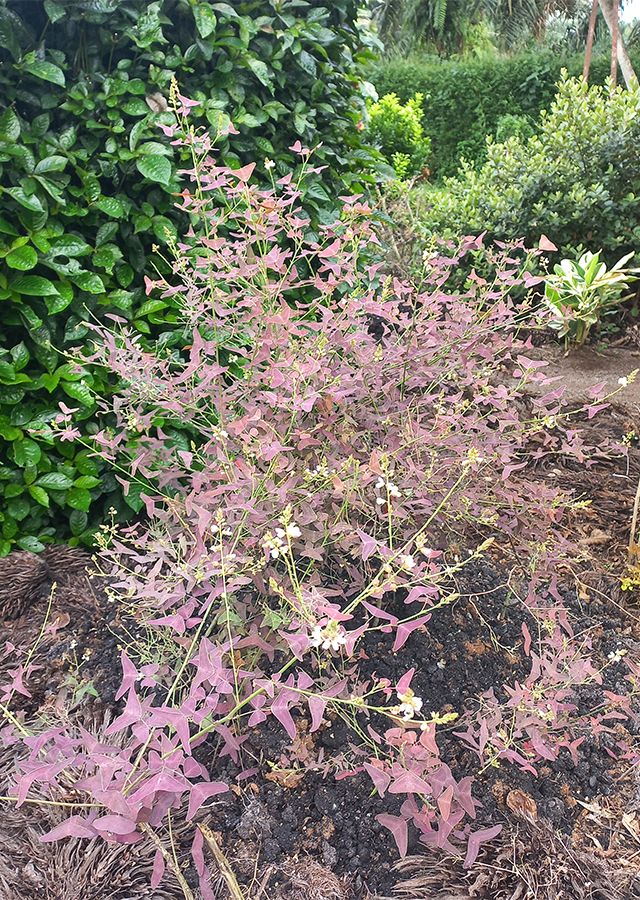
Kupu-kupu merah (Christia vespertilionis) is a herb 60-120 cm tall from the Fabaceae family that originates from the East Indies, widely spread throughout Southeast Asia. Its unique leaf shape resembling a butterfly makes it a popular ornamental. In Malaysia, kupu-kupu merah is recognized as one of the best traditional cancer remedies and has been commercialized as tea.
Agroecology
The kupu-kupu merah plant can be found along roadsides, inhabiting dry and grassy areas as well as sandy soil. This species has drought tolerance and nitrogen-fixing ability. Grows well in well-drained loamy soil, and in partial shade zones, with high humidity, and moist media at temperatures from 21 °C.
Morphology
- Roots taproot, branched, cylindrical, dark yellow colored, small lateral roots also present.
- Stem upright, green, cylindrical, slender, and hairy.
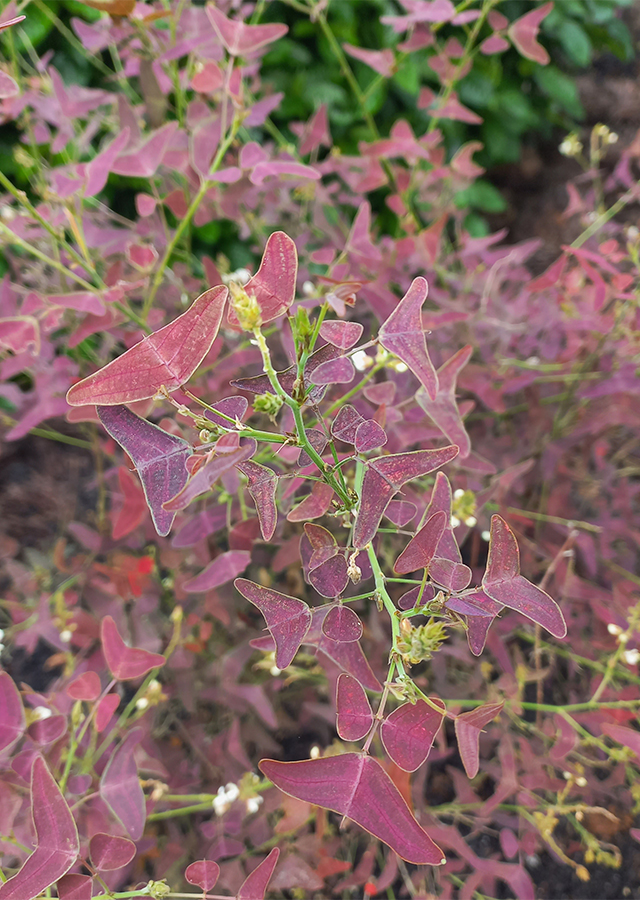
- Leaves compound, trifoliate, hairy, shaped resembling butterfly wings, smooth leaf margin, tip tapering, base heart-shaped (cordate), juvenile leaves have a purplish-red color while mature ones are dark green with pale green stripes with prominent veins. Large leaf blade consists of two lateral leaflets, terminal leaflet boomerang-shaped. Leaves curve downward when night falls. Petiole long, thin, grooved, hairy, greenish colored with a reddish tinge.
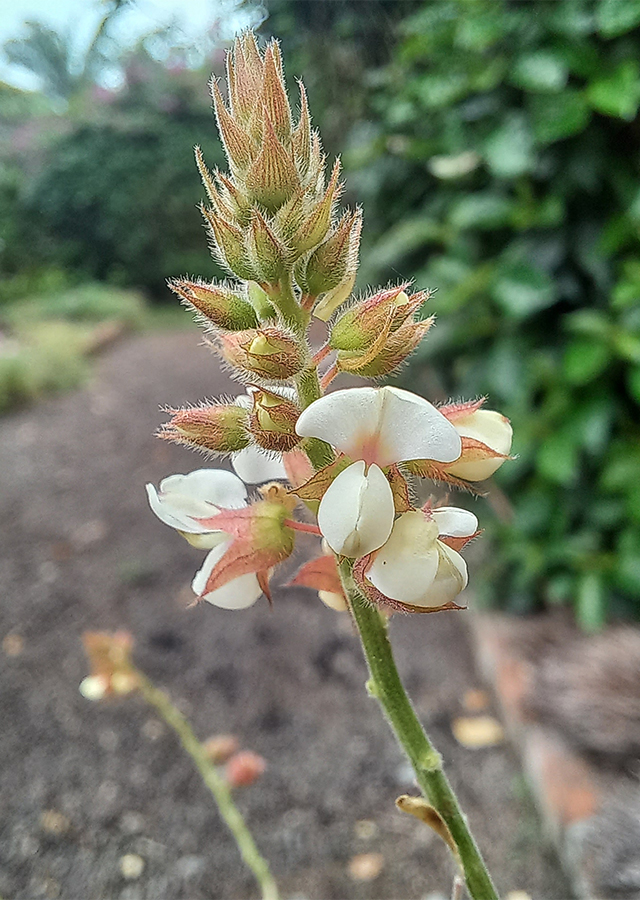
- Flowers pale white, small, about 6 mm in diameter. Calyx is reticulate-veined, 2 upper calyx lobes fused or connate and the lower lobe nearly the length of the tube.
- Fruit a pod, has 4 or 5 chambers.
- Seeds mature dark brown, hairless and entirely covered by the calyx.
Cultivation
Plant propagation is done generatively (seeds) as well as vegetatively (stem cuttings).
Chemical Content
Phenol, sterol, sesquiterpenoid, alkaloid, polyphenol, fatty acid, flavonoid glycosides, flavonol (quercetin, kaempferol), triterpene, denbinobin, 5,7-dihydroxy-chromone, rhein, sanleng acid, wedelolactone, phytol, 10-undecenoic acid, 6-methylheptyl-2-propenoate, 2-(2-benzothiazolylthio)-1-(3,5-dimethylpyrazolyl)-ethanone, tetrahydro-2-methyl-thiophene, coumarin, tannin, quinine.
Benefits
Treats tuberculosis, snake bites, bronchitis, colds, chills, muscle weakness, inflamed tonsils, improves blood circulation, topical treatment in healing broken bones and scabies. Has anticancer, antitumor, antiplasmodial, antiproliferative, antidiabetic and antioxidant activity.
Local Names
No information found. Further research needed.
Traditional Recipes
The following recipes reflect traditional knowledge passed down through generations, not a substitute for professional medical diagnosis or advice. Consult a healthcare provider before use.
1. Healing broken bones
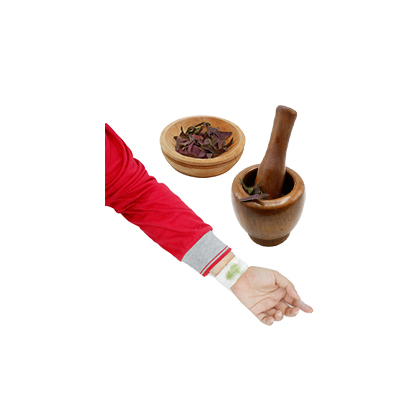
- Prepare fresh kupu-kupu merah leaves as needed and wash until clean.
- Mash into a paste.
- Apply to the affected area.
- Wrap with gauze.
2. Treating tuberculosis
- Prepare the whole fresh kupu-kupu merah plant as needed and wash until clean.
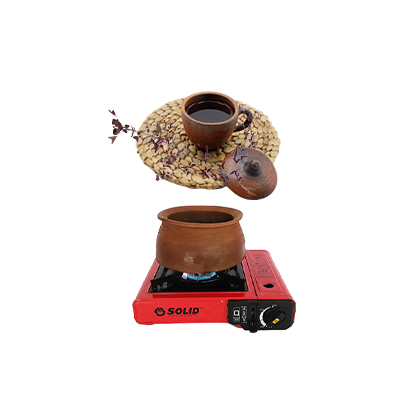
- Boil until boiling.
- Let stand until warm/cool.
- Strain, then drink to treat tuberculosis.
Reference Sources
- Royal Botanic Gardens. 2021. Plants of the World Online: Christia vespertilionis (L.f.) Bakh.f. http://www.plantsoftheworldonline.org/taxon/urn:lsid:ipni.org:names:486281-1. 11-11-2021.
- Useful Tropical Plants Database. 2021. Christia vespertilionis. http://tropical.theferns.info/viewtropical.php?id=Christia+vespertilionis. 11-11-2021.
- Flora Fauna Web. 2021. Christia vespertilionis.https://www.nparks.gov.sg/florafaunaweb/flora/1/8/1811. 11-11-2021.
- Murugesu S. et.al. 2020. A Review on Christia vespertilionis: A New Emerging Medicinal Plant. FABAD J. Pharm. Sci., 45(3): 269-277.
- Lee J. J. et. al. 2020. Cytotoxic Activity of Christia vespertilionis Root and Leaf Extracts and Fractions against Breast Cancer Cell Lines. Molecules 25: 2610. doi:10.3390/molecules25112610.
- Smitha S., Jain R. 2019. Anatomical Profiling and Phytochemical Analysis of Christia Vespertilionis (L.F.) Bakh. F. International Journal of Pharmacy and Biological Sciences 9(1): 40-50.