Cleome houtteana Schltdl.
Summary
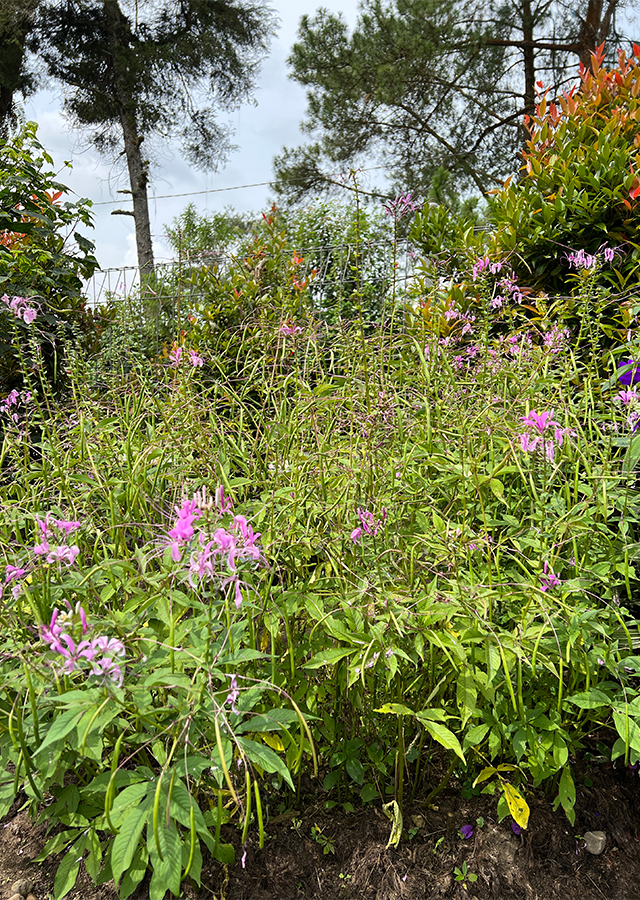
Cleome houtteana or mamang empat, also known as the spider flower, is native to southeastern South America, including Argentina, Paraguay, and Uruguay. Its unique, beautiful flower clusters make it a popular ornamental for hedges, gardens, and indoor use, while traditionally this plant is also used as a natural remedy for bruises and rheumatism.
Agroecology
The plant prefers a sunny (full sun) or partially shaded (semi shade) location in fresh to moist soil. The substrate should be fertile sandy or sandy loam soil. Has good soil drainage. The plant tolerates temperatures only above at least 1°C and is drought-resistant.
Morphology
- Stem upright, up to 1.5 m, usually unbranched, densely glandular-hairy and with some cobweb-like puberulence on it, with spiny stipules at the base of each petiole.
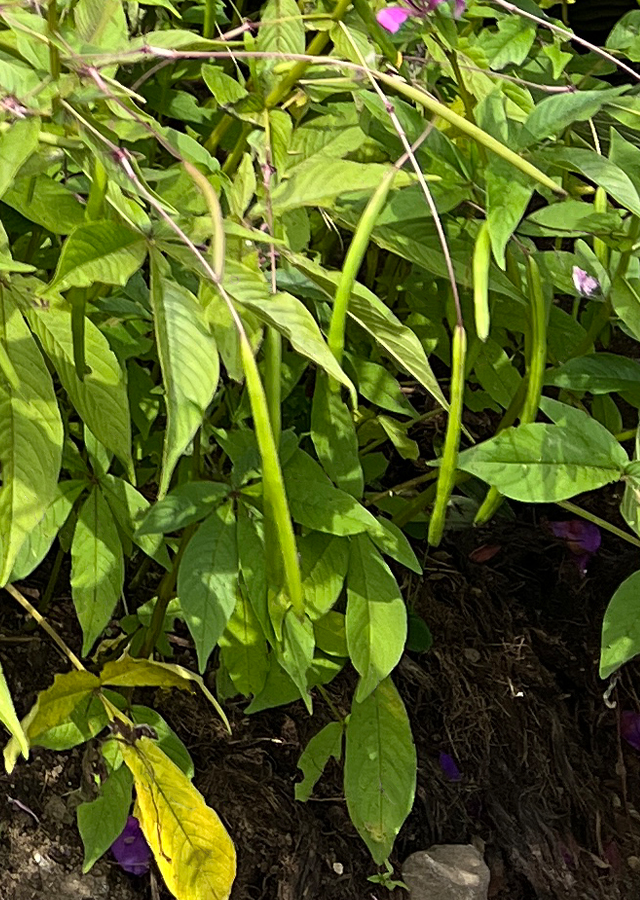
- Leaves alternate, petiolate, palmately 5-7 compound. Stipules spiny, golden-brown, relatively sturdy, 1-4 mm long. Petiole 6-15 cm long, adaxially grooved, hairy and glandular. Leaflets 3-10 cm long, 4 cm wide, oblong to elliptic, pointed to tapering, base tapering, margin entire or shallowly toothed, upper surface glandular puberulent, lower surface sparsely puberulent and with spines along the midrib. Petiolule up to 4 mm.
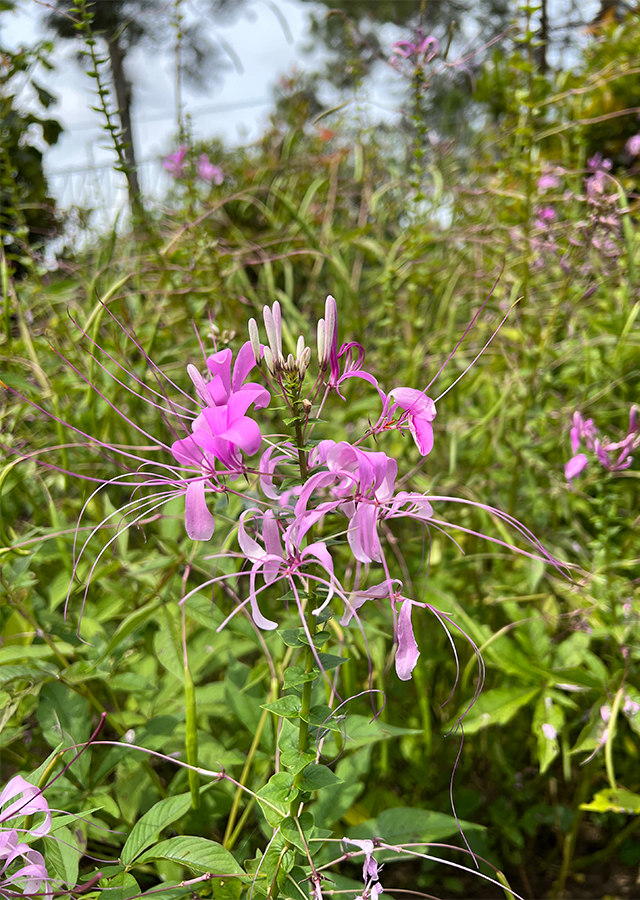
- Flowers inflorescence in a dense terminal raceme up to 35 cm. Pedicel 4-6 cm long, densely glandular, elongating in fruit. Bracts 1-4 cm long, 0.5-2.0 cm wide, simple, short-stalked to nearly sessile, ovate, heart-shaped, tapering to a pointed tip, densely glandular, with spines at the base.
- Flowers sepals basically fused, 6-7 mm long, narrowly lanceolate, reflexed but with an upturned tip, densely glandular and sometimes also sparsely hairy. Petals 4, all oriented to one side of the flower, similar in size and shape, 18-28 mm long, 6-8 mm wide, with a basal claw 6-12 mm long, pink to purple, rarely white. Glandular disc fleshy, cone-shaped, 1-3 mm long. Stamens with filaments 3-4 cm long, anthers 7-9 mm long, linear. Gynophore relatively short at flowering (0.5-0.9 cm) but elongating rapidly as the fruit matures to 3-8 cm long. Stamens 6, upright to spreading. Filaments 1 cm long, hairless, pink. Anthers 1 cm long, yellow-orange. Ovary green, 4 mm long, hairless.
- Fruit a capsule 2-7 cm long, 3-4 mm wide, linear, 2-valved, with a persistent stigma, usually slightly constricted between the seeds, hairless.
- Seeds numerous, 1.6-2.0 mm in diameter, surface appearing wrinkled or warty, dark brown with lighter-colored warts and faint concentric lines. Placenta parietal.
Cultivation
- Plant propagation through seed.
- Prune side shoots for a tall, slender plant; remove the central shoot when the plant is 30 cm tall for a shorter, bushier shape. Deadhead spent flowers to prolong flowering.
Chemical Content
Cyanidin 3-(2''-(6'''-caffeoyl-β-glucopyranosyl)-6''-(E-p-coumaroyl)-β-glucopyranoside)-5-β-glucopyranoside, cyanidin 3-(2''-(6'''-E-sinapoyl-β-glucopyranosyl)-6''-(E-p-coumaroyl)-β-glucopyranoside)-5-β-glucopyranoside, cyanidin 3-(2''-(6'''-feruloyl-β-glucopyranosyl)-6''-(E-p-coumaroyl)-β-glucopyranoside)-5-β-glucopyranoside, pelargonidin 3-(2''-(6'''-E-sinapoyl-β-glucopyranosyl)-6''-(E-p-coumaroyl)-β-glucopyranoside)-5-β-glucopyranoside, pelargonidin 3-(2''-(6'''-E-p-coumaroyl-β-glucopyranosyl)-6''-(E-p-coumaroyl)-β-glucopyranoside)-5-β-glucopyranoside.
Benefits
One of the benefits of mamang empat mentioned is that it can address bruises from blows and treat rheumatism.
Local Names
Bunga laba-laba.
Traditional Recipes
The following recipes reflect traditional knowledge passed down through generations, not a substitute for professional medical diagnosis or advice. Consult a healthcare provider before use.
1. Addresses bruises from blows
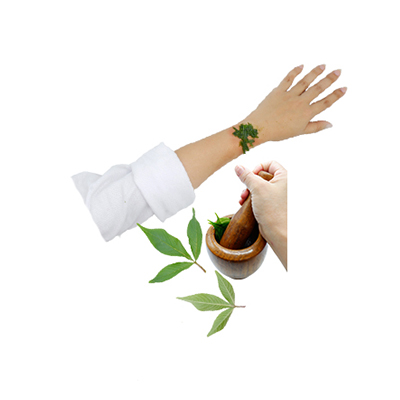
- Take an adequate amount of mamang empat leaves and wash until clean.
- Grind until it becomes a paste.
- Apply the leaf paste as a poultice on the wound or bruise.
Reference Sources
- Flora Fauna Web. Cleome hassleriana Chodat. https://www.nparks.gov.sg/florafaunaweb/flora/3/3/3313. 07-03-2022.
- Royal Botanic Gardens. Plants of the World Online: Cleome houtteana Schltdl.. 07-03-2022.https://powo.science.kew.org/taxon/urn:lsid:ipni.org:names:147105-1#descriptions.
- Missouri Plants. Cleome hassleriana Chodat, Spider Flower. http://www.missouriplants.com/Cleome_hassleriana_page.html. 07-03-2022.
- Plantamor. 2022. PINK QUEEN (Cleome hassleriana). ://plantamor.com/species/info/cleome/hassleriana. 07-03-2022.
- Threebouqets. 2021. Bentuknya Unik, Begini Cara Menanam Bunga Cleome. https://threebouquets.com/blogs/article/bentuknya-unik-begini-cara-menanam-bunga-cleome. 07-03-2022.
- María del Carmen Juárez-Vázquez and María Adelina Jiménez-Arellanes. 2019. Phytochemical investigation, anti-inflammatory and antinociceptive activities from some species of Cleomaceae family: A systematic review. Advancement in Medicinal Plant Research Vol. 7(4), pp. 107-128, December 2019. DOI: 10.30918/AMPR.74.19.039. ISSN: 2354-2152.