Clerodendrum chinense (Osbeck) Mabb.
Summary
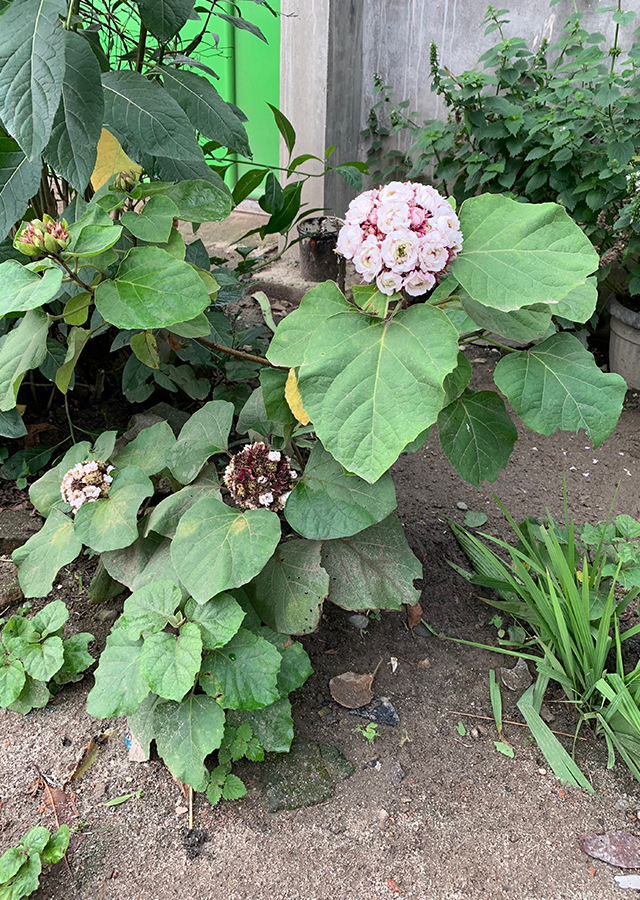
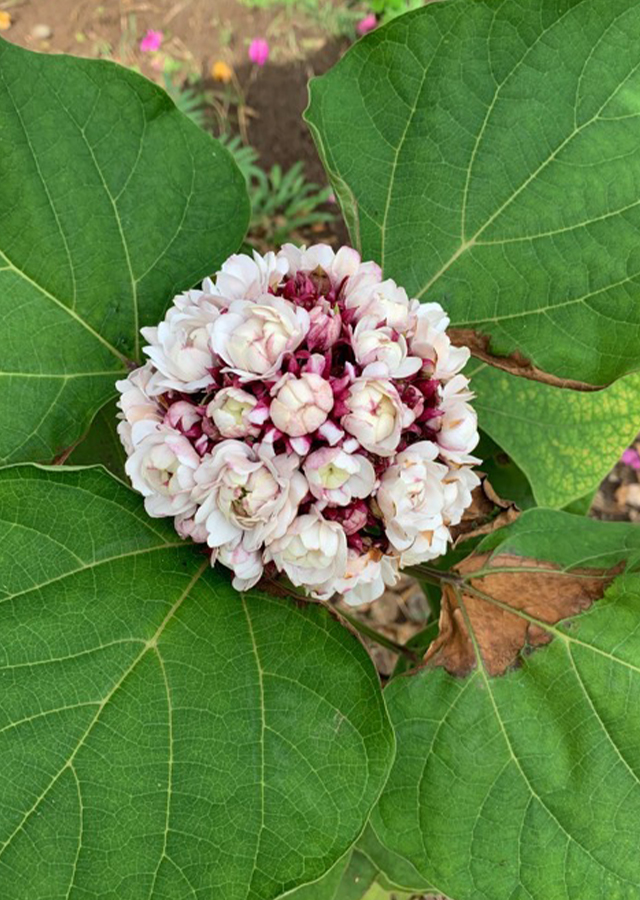
Melati susun papua (Clerodendrum chinense) is a shrub up to 2.5-3 meters tall of the Lamiaceae family, likely native to China and Vietnam, now distributed as far as Florida and South America. Its layered, fragrant flowers make it a favorite decorative ornamental. Its root and leaves have long been used in traditional Chinese medicine, shown to have antidiabetic and pain-relieving activity.
Agroecology
Grows in grasslands, roadsides, riverbanks, thickets, and secondary forests up to elevations of 1,200-2,000 m above sea level. Grows well in full sunlight, but still tolerant of shade.
Morphology
- Stem and branches have a square shape.
- Leaves ovate-shaped, tapering at the tip and blunt at the base. Leaves arranged opposite.
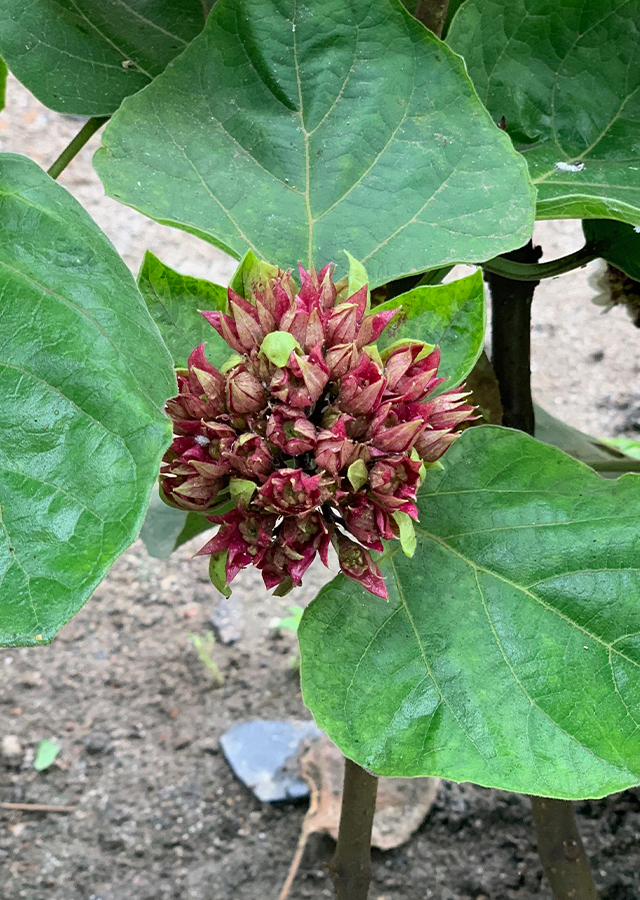
- Flowers short-stalked, have a fragrant smell with purple or red sepals about 10-15 mm in size, sometimes with white spots. Corolla white to pinkish-white.
- Fruit rarely formed.
Cultivation
- Propagated generatively (seed), as well as vegetatively (root cuttings).
- Germination occurs over 20-60 days at 20°C, once large enough, separate the seedlings and plant each in a pot.
- Vegetative (root cuttings) by cutting roots 6-8 cm then planting and offset separation).
Chemical Content
Phenolic, steroid, flavonoid, terpene, essential oil, verbascoside, isoverbascoside, decaffeoylverbascoside, hispidulin, lupeol, icariside B5, cornoside, rengyolone.
Benefits
Treats asthma, rheumatism, skin disease, lower back pain, jaundice, cough, malaria, sprains, fractures, has antioxidant, antiseptic, antidiuretic, anti-inflammatory activity.
Simplisia
- Pick melati susun papua leaves. Wash thoroughly then drain.
- Arrange the leaves on a tray then dry in the sun for 7 days.
- Once dry, pack in an airtight container.
Local Names
Information not yet available.
Traditional Recipes
The following recipes reflect traditional knowledge passed down through generations, not a substitute for professional medical diagnosis or advice. Consult a healthcare provider before use.
1. Sprains and fractures
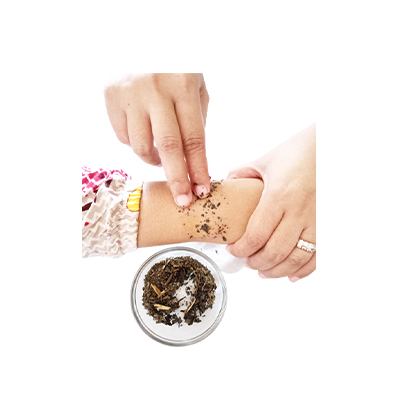
- Prepare 10-20 g melati susun leaves and stem. Clean and wash then dry.
- Grind/mash the material and add virgin coconut oil as needed.
- Apply to the affected area.
Reference Sources
- Tropical Plants Database, Ken Fern. tropical.theferns.info. Clerodendrum chinense. http://tropical.theferns.info/viewtropical.php?id=Clerodendrum+chinense 03-02-2021
- Tandfonline. Chemical and biological investigation of some Clerodendrum species cultivated in Egypt. https://www.tandfonline.com/doi/full/10.3109/13880209.2010.494674 20-01-2021.
- CABI. Invasive Species Compendium. Clerodendrum chinense (Chinese glory bower). https://www.cabi.org/isc/datasheet/113371 20-01-2021
- National Parks. Clerodendrum chinense. https://www.nparks.gov.sg/florafaunaweb/flora/1/8/1820 20-01-2021
- Kar P, Goyal AK, Das AP Sen A. 2014. Antioxidant and pharmaceutical potential of Clerodendrum L.: An overview. International Journal of Green Pharmacy 8(4): 210-216