Coffea canephora Pierre ex A.Froehner
Summary
Kopi robusta (Coffea canephora) is a shrub or small tree up to 12 meters tall from the Rubiaceae family that originates from the northern forests of Ethiopia, first introduced to Java in 1900 from the Congo. Indonesia is now one of the largest producers, with over 90% of its national coffee area planted with robusta, rich in caffeine and antioxidant polyphenols. Roasted coffee is traditionally used in Southeast Asia to relieve stomach ache and diarrhea.
Agroecology
Robusta coffee is often found in open or dense rainforest, forest edges, and desert areas. This plant can grow optimally at elevations of 500-700 m asl. Suitable rainfall for robusta coffee growth ranges between 1,500-2,500 mm per year, with an average dry period of 1-3 months and average air temperature of 15-25 °C. Prefers fertile, loose loamy soil rich in organic matter, well-drained, with neutral to slightly acidic soil acidity (pH) (5.5-6.5) and does not prefer alkaline soil; this plant is also resistant to temporary waterlogging. Generally coffee does not like large amounts of direct sunlight, but requires regular sunlight.
Morphology
- Roots taproot shorter than arabica coffee, has a shallow root system.
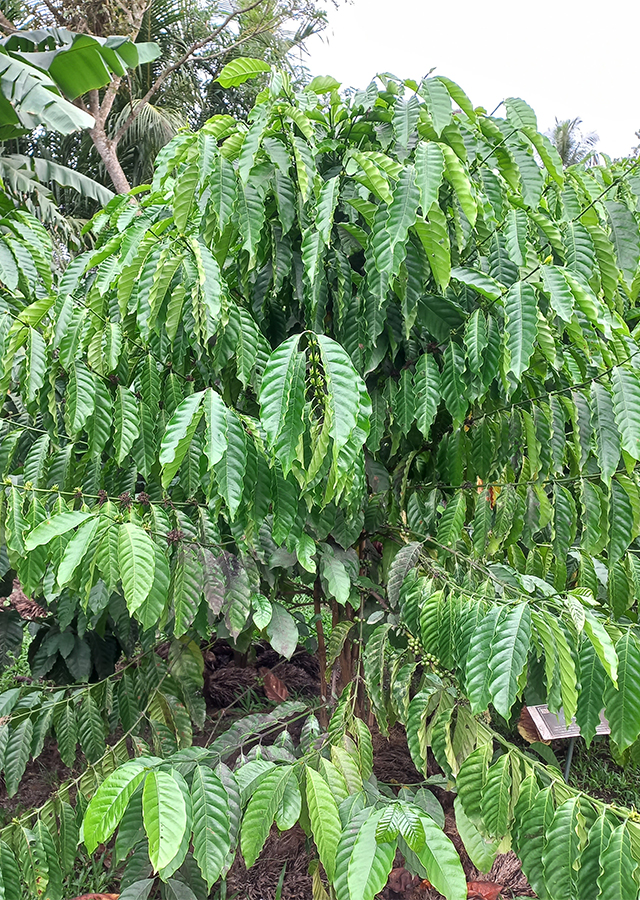
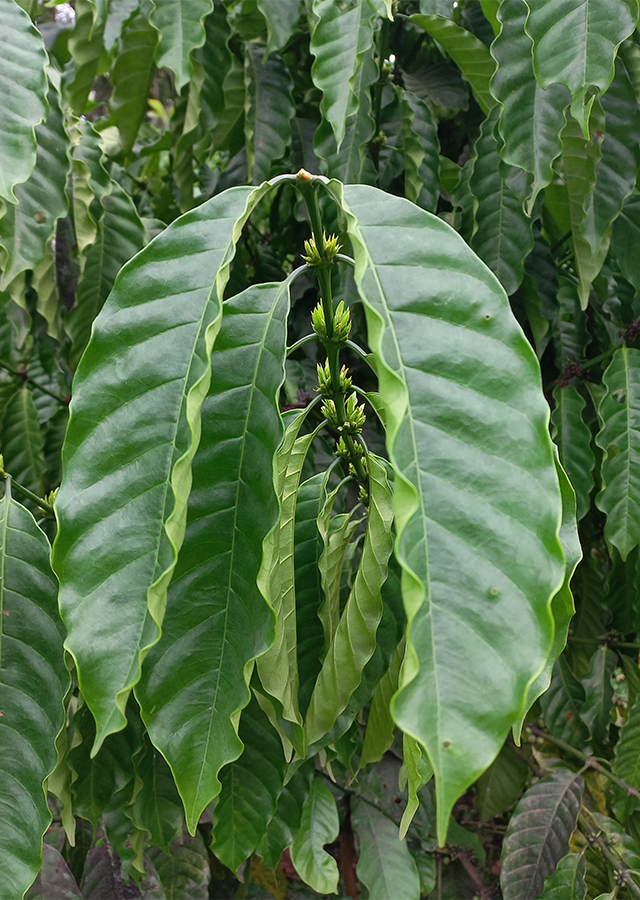
- Leaves bright green, glossy, elliptical-oblong or ovate-oblong shape with wavy leaf margin, pointed tip, wrinkled leaf texture, hairless on both surfaces, leaf blade wider and thicker than arabica coffee.
- Flowers white to pink, funnel-shaped, flower tube star-shaped with 5 lobes. Petals numbering 5-7, spatula to narrowly elliptical shape, blunt to rounded. Inflorescence with 1-3 cymes in each leaf axil, each cyme consisting of 3-6 florets.
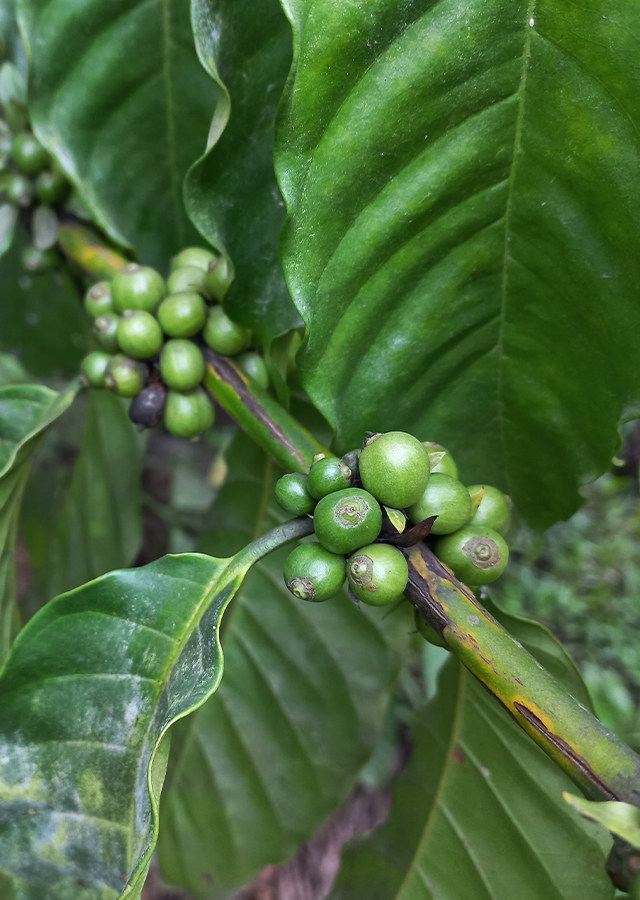
- Fruit green when young and turning red when mature, glossy, round, smooth, hairless.
- Seeds somewhat round with a thicker curve compared to arabica coffee, the center line from top to bottom is nearly flat, consisting of a seed coat and embryo.
Cultivation
- Propagation is done vegetatively (grafting, cuttings, tissue culture) or generatively (seeds).
- Cuttings: coffee cutting material used should still be green and flexible, not too young or old, at nodes 2-4 from the shoot tip. Cutting the cutting material into one segment 6-8 cm long, a pair of trimmed leaves, the base cut diagonally in one direction. Prepared cuttings are planted by inserting the stem into growing media so the leaves touch the media surface then covered with plastic. Cuttings are planted with a spacing of 5-10 cm. After the cuttings are ± 3 months old, adjustment is made by gradually opening the cover, and at ± 4 months old the cuttings are moved to the nursery. Cutting seedlings are ready to plant in the field after ± 7 months in the nursery.
- Grafting: the rootstock seedlings used are plants aged 5-6 months and the criteria for seedlings ready for grafting is a rootstock size the size of a pencil. Grafting is done by cutting the lower part of the seedling stem (height 15-20 cm) and leaving 1-3 pairs of leaves on the rootstock, then slicing the middle part of the stem 2-3 cm long, to connect the scion of the upper stem (the upper stem has its leaves removed and the base of the scion sliced on both sides forming a V) then tying the graft.
Chemical Content
Alkaloids (caffeine), flavonoids, saponins, tannins, terpenoids, phenolic compounds (feruloylquinic acids (3-, 4- and 5-FQA), monoester isomers (3-, 4- and 5-CQA) and diester (3,4-, 3,5- and 4,5-diCQA) CQAs.
Benefits
Relieves stomach ache and diarrhea, increases blood pressure, addresses back pain, measles, cough, jaundice, anorexia (eating disorder marked by weight loss), antidote for poison, has diuretic, analgesic, aphrodisiac, galactagogue (stimulating breast milk production), calming, and antioxidant properties.
Simplisia
- Prepare robusta coffee cherries and separate the red and green fruits.
- Dry under direct sunlight for several days or with an oven at 40 °C until moisture content reaches 10%.
- Once dry, peel the fruit skin and take the beans.
- Store the coffee beans in a clean, airtight container.
Local Names
No information found. Further research needed.
Traditional Recipes
The following recipes reflect traditional knowledge passed down through generations, not a substitute for professional medical diagnosis or advice. Consult a healthcare provider before use.
1. Calming
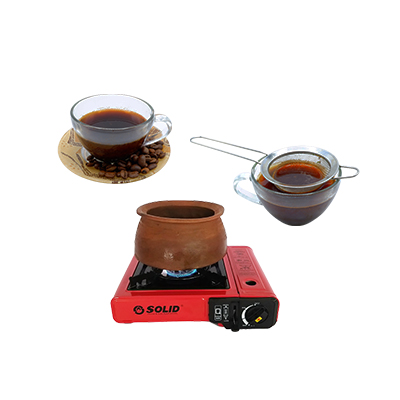
- Take robusta coffee beans as needed that have been dried and ground into powder.
- Boil the coffee powder.
- Strain, then drink while warm.
Reference Sources
- Flora Fauna Web. 2020. Coffea canephora. https://www.nparks.gov.sg/florafaunaweb/flora/2/8/2819. 02-10-2021.
- Royal Botanic Gardens. 2021. Plants of the World Online: Coffea canephora Pierre ex A.Froehner. http://powo.science.kew.org/taxon/urn:lsid:ipni.org:names:747068-1. 02-10-2021.
- Prastowo B dkk. 2010. Budidaya dan Pasca Panen: Kopi. Pusat Penelitian dan Pengembangan Perkebunan.
- PROSEA. 2019. Coffea (PROSEA). https://uses.plantnet-project.org/en/Coffea_(PROSEA). 02-10-2021.
- Novi Fajar Utami, Nhadira Nhestricia, Sri Maryanti, Tien Tisya, Siti Maysaroh. 2018. UJI AKTIVITAS ANTIOKSIDAN DARI BIJI KOPI ROBUSTA (Coffea canephora P.) BERDASARKAN PERBEDAAN EKOLOGI DATARAN TINGGI DI PULAU JAWA. Fitofarmaka Jurnal Ilmiah Farmasi 8(1): 67-72. DOI : 10.33751/jf.v8i1.1173.
- Healthbenefitstimes. 2021. Facts about Robusta Coffee. https://www.healthbenefitstimes.com/robusta-coffee/. 02-10-2021.