Cotylelobium melanoxylon (Hook.f.) Pierre
Summary
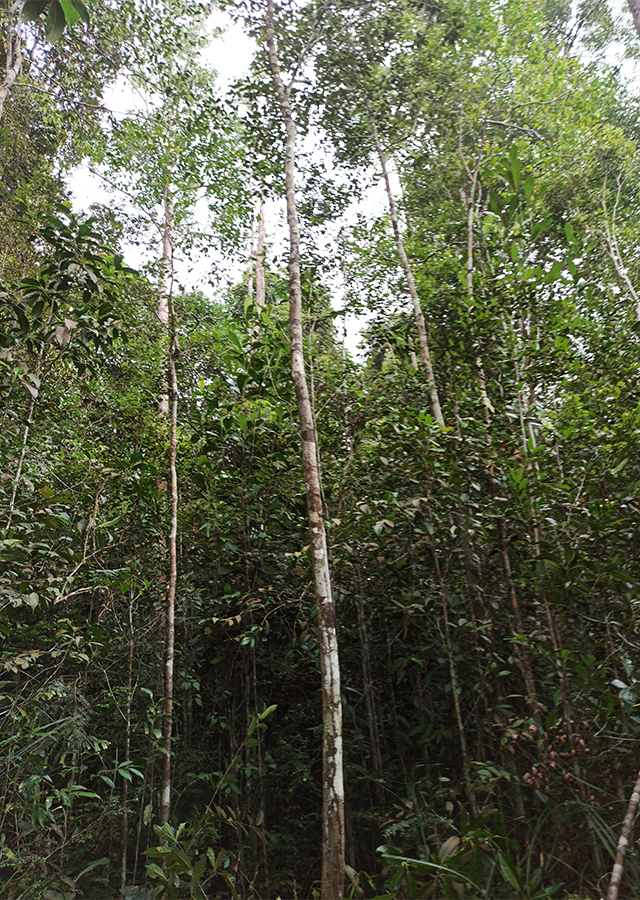
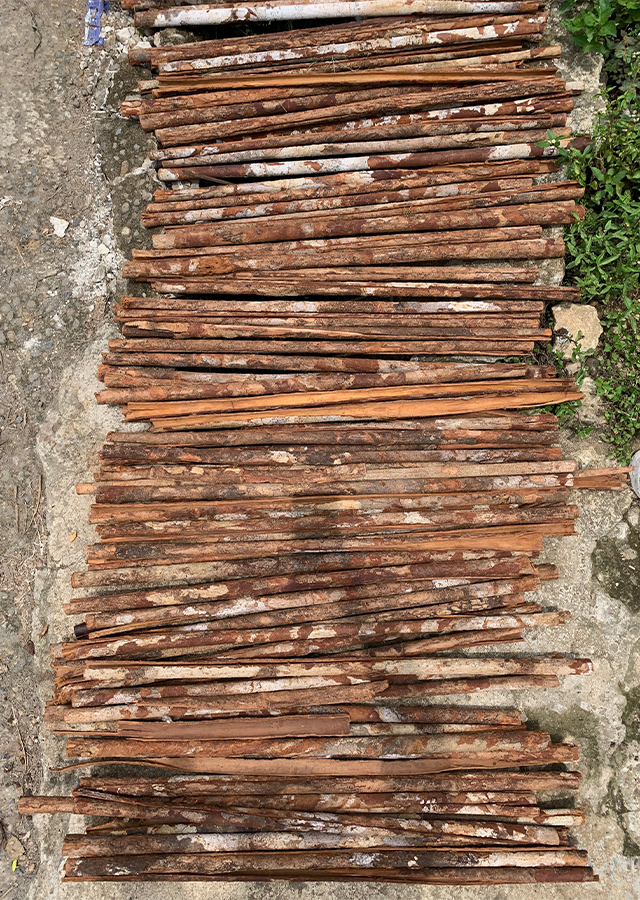
Kayu raru (Cotylelobium melanoxylon) is a giant tree up to 50 meters tall of the Dipterocarpaceae family, distributed across Thailand, Malaysia, and Indonesia, especially Sumatra and Kalimantan, now classified as nearly extinct due to continued harvesting from the wild. Its bark has long been used by the Karo people as a mixture in making tuak as well as traditional medicine, with a sample recorded as found by the Socfindo Conservation team in Aceh Singkil. Kayu raru is believed to be antidiabetic and help the blood clotting process in wounds.
Agroecology
This lowland tropical plant can be found up to elevations of 300 m above sea level and grows in humid to wet areas. The required rainfall averages between 2,100-2,700 mm/year, pH 4-4.5. Prefers full sunlight conditions, and dry or sandy soil.
Morphology
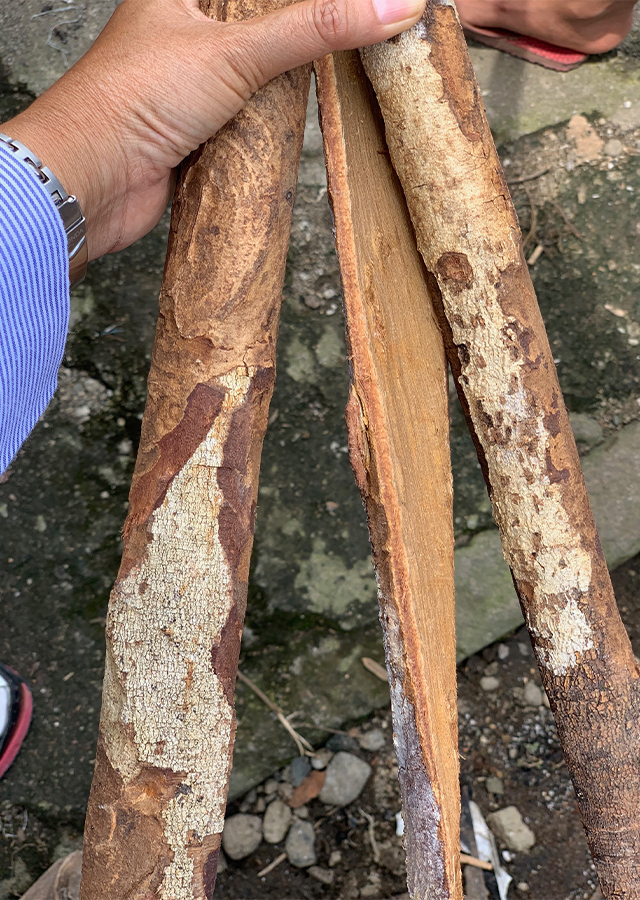
- Stem bark greenish-white in color with a bark thickness of around 0.6-1 cm, wood yellowish-brown in color.
- Leaves oval shaped, wedge-shaped base, tapering tip, secondary veins, consisting of 5-7 pairs, panicle up to 9 cm long. Leaf stalk 10-18 mm long.
- Sap releases a very strong odor, its sap characteristics are sometimes white and soft, sometimes yellow and bright orange.
Cultivation
Propagated generatively (by seed) and vegetatively (tip cuttings).
Chemical Content
Triterpenoid, flavonoid, tannin and β-sitosterol, stilbene dimer (ampelopsin, isoampelopsin F, epsilon-viniferin), aliphatic compounds.
Benefits
Treats wounds, has antidiabetic activity, astringent (reduces secretion in skin care), antilaxative (prevents constipation), antibacterial, antiseptic, antidiarrheal, and blood-clotting properties.
Simplisia
- Prepare fresh kayu raru bark.
- Dry using an oven at 40 °C.
- Once the bark is dry, grind and sift to produce 40-60 mesh powder.
- Store the dried material in an airtight plastic/container.
Local Names
Rasak, Resak daun lebar (Sumatra), Awing, Damat resak, Gagil, Resak (Kalimantan).
Traditional Recipes
The following recipes reflect traditional knowledge passed down through generations, not a substitute for professional medical diagnosis or advice. Consult a healthcare provider before use.
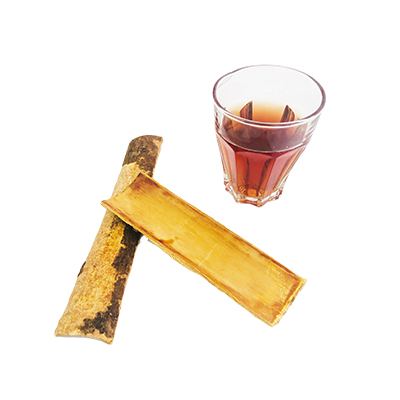
1. Diabetes Remedy
- Take a piece of raru bark 30 cm long and 5 cm wide, then cut into pieces measuring 3 cm x 3 cm, then wash thoroughly.
- Boil in 1 liter of water until 1/2 liter of water remains.
- Strain, then drink (the water when cold) after lunch and before bed.
Reference Sources
- Silalahi M. 2015. The Phytochemistry profile of Raru (Vatica pauciflora and Cotylelobium melanoxylon) and its potential as diabetes mellitus drugs. In: Conference On lnternational Biodiversity with a theme "Advancing Biodiversity for Sustainable Food Security", 26-17 Juli 2015, Denpasar.
- Susilowati A, Rachmat HH, Elfiati D, Kholibrina CR, Kusuma YS, Siregar H. 2019. Population structure of Cotylelobium melanoxylon within vegetation community in Bona Lumban Forest, Central Tapanuli, North Sumatra, Indonesia. Biodiversitas J. Biol. Diversity 20(6): 1681-1687.
- Susilowati A, Rachmat HH, Elfiati D, Kholibrina CR, Kusuma YS, Siregar H, Hartini KS, Elfiati D, Rachmat HH, Kusuma YS, Sinaga MZE, Suhartati T. 2020. Conservation of tropical tree biodiversity through macropropagation by shoot cutting of raru (Cotylelobium melanoxylon), a highly utilized dipterocarp in North Sumatra, Indonesia. Biodiversitas J. Biol. Diversity 21(2): 724-730. 100(12): 2478-2484 15(3): 186-193. 192. Melati ganda
- Pasaribu GT. 2009. Zat Ekstraktif Kayu Raru dan Pengaruhnya terhadap Penurunan Kadar Gula Darah secara In Vitro. Sekolah Pasca Sarjana IPB, Bogor.
- Tropical Plants Database, Ken Fern. tropical.theferns.info. Cotylelobium melanoxylon. http://tropical.theferns.info/viewtropical.php?id=Cotylelobium+melanoxylon 02-02- 2021
- Researchgate. Antidiabetogenic Constituents from the Thai Traditional Medicine Cotylelobium melanoxylon. https://www.researchgate.net/publication/24406831_Antidiabetogenic_Constituents_from_the_Thai_Traditional_Medicine_Cotylelobium_melanoxylon, 20-01-2021.
- Flora Malesiana. Cotylelobium melanoxylon. http://portal.cybertaxonomy.org/flora-malesiana/node/5817