Cucurbita moschata Duchesne
Summary
Labu madu 'Butternut' (Cucurbita moschata) is a creeping annual herb from the Cucurbitaceae family thought to originate from Central and South America. Its ripe fruit is a popular dish in Africa, while in Southeast Asia it is processed into sweets and desserts. In Thailand and China, crushed honey squash seeds are traditionally used as a worm remedy.
Agroecology
Honey squash is grown in tropical regions up to an elevation of about 1,800 m asl. Optimal growth requires high daytime temperatures, above 20 °C and nighttime temperatures above 14 °C. This plant is almost insensitive to photoperiod or shows little short-day reaction, and can grow year-round, although it usually grows during the rainy season without any irrigation. Able to tolerate some shade. Honey squash is not too demanding regarding soil conditions and can be cultivated in almost any reasonably fertile, well-drained soil with a neutral or slightly acidic reaction (pH 5.5-6.8). Fairly drought-tolerant, but sensitive to frost and waterlogging. Excessive humidity during the rainy season stimulates the development of fungal and bacterial diseases that cause leaf rot, wilt and fruit rot.
Morphology
- Stem laterally climbing, herbaceous, round or bluntly five-angled shape equipped with 3-4 branched spiraling tendrils, strongly branching, elongated, initially pubescent, often rooting at the nodes.
- Leaves alternate, simple, without stipules; petiole 9-24 cm long, grooved; blade broadly ovate in outline, shallowly palmate 5-7 lobed, 20-35 cm diameter, deeply heart-shaped at the base, toothed margin, softly hairy, sometimes with white markings disappearing with aging, 3-veined from the base.
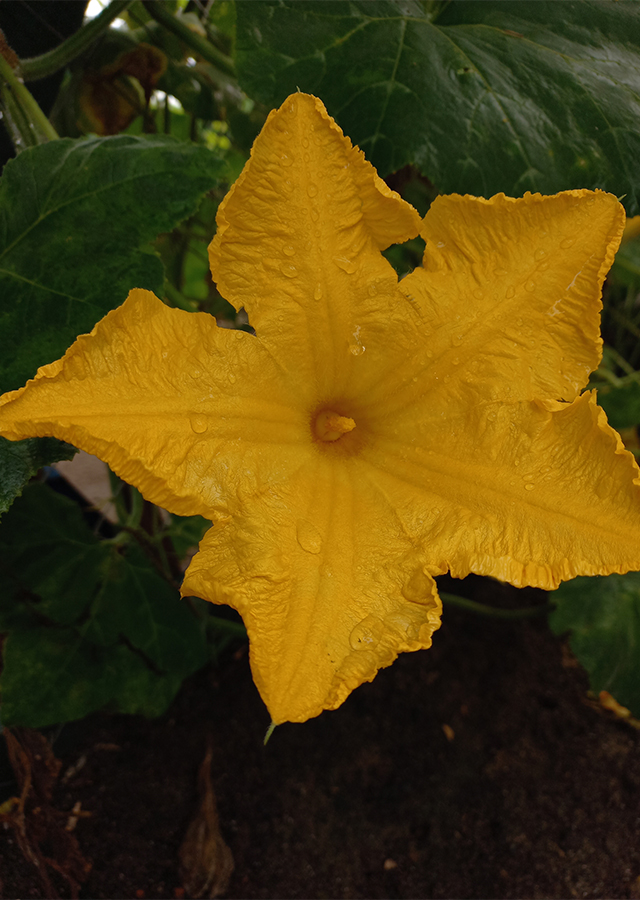
- Flowers solitary, unisexual, regular, 5-merous, large, 10-20 cm diameter, lemon-yellow to dark orange; sepals free, subulate to linear, 1-3 cm long; corolla campanulate, with widely spreading lobes; male flowers long-stalked (up to 16 cm), with 3 stamens, filaments free, anthers usually branching into a long curved body; female flowers short-stalked (up to 3.5 cm), with inferior, ellipsoid, 1-celled ovary, thick style, 3 stigmas, 2-lobed.
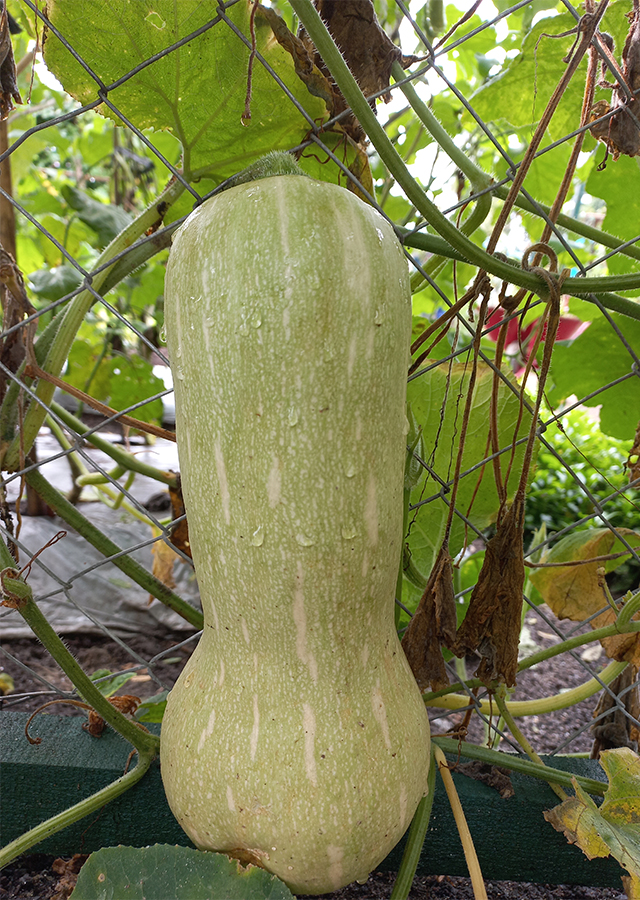
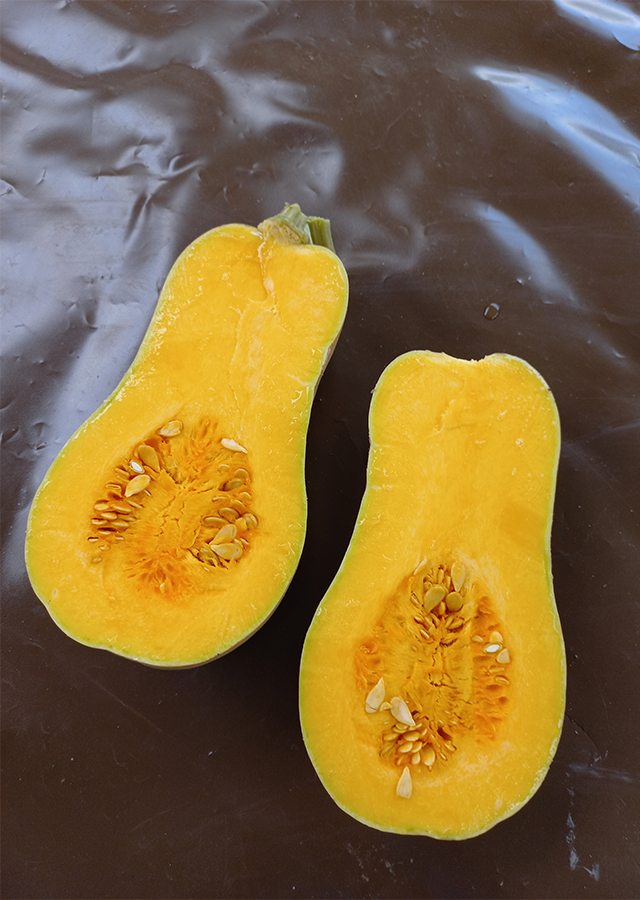
- Fruit a large berry, having a guitar-shaped (dumbbell) form, flesh yellow to orange, many-seeded, fruit stalk enlarged at the apex.
- Seeds ovate, flattened, 1-2 cm × 0.5-1 cm, usually white or brownish-yellow, sometimes dark colored, surface smooth to somewhat rough, margin prominent.
Cultivation
- Propagation generatively (seeds). Farmers sow seeds in planting holes in flat ground or beds, 2-4 seeds per hill. Seeds can be sown in containers and seedlings transplanted to the field when about 10 cm tall, but direct sowing is generally practiced. Common planting spacing is 2 m × 2 m, giving a plant population of 2,500 hills/ha. Seed requirement is 2-3 kg/ha.
- Since it roots at the nodes, it may be possible to grow from cuttings, but this method is not practiced except for research purposes.
Chemical Content
Flavonoids (catechin, hyperoside (quercetin-3-O-galactoside), rutin, luteolin-7-O-glucoside, quercetrin (quercetin-3-O-rhamnoside), naringin, apigenin-7-O-glucoside, quercetin, kaempferol, apigenin, luteolin, cirsiliol, cirsilineol, acacetin), phenolic acids (quinic acid, protocatechuic acid, 4-O-caffeoylquinic acid, caffeic acid, syringic acid, p-coumaric acid, trans-ferulic acid, O-coumaric acid, 4,5-di-O-caffeoylquinic acid, trans-cinnamic acid).
Benefits
Seeds are emollient, laxative and vermifuge, relieve stomach cramps and distension from worms, a safe and effective remedy for tapeworm, cream for removing redness marks, galactagogue, treats bleeding, jaundice, as a poultice, treats headaches, treats ophthalmia, and for all types of tumors.
Local Names
Labu susu.
Traditional Recipes
The following recipes reflect traditional knowledge passed down through generations, not a substitute for professional medical diagnosis or advice. Consult a healthcare provider before use.
1. Relieving stomach cramps
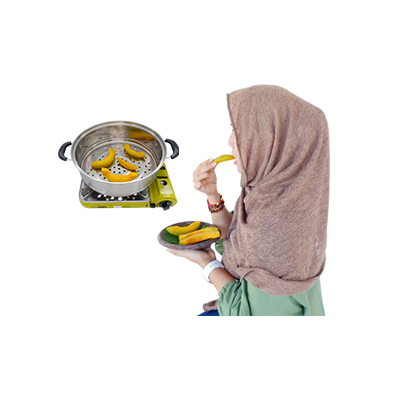
- Take honey squash fruit and wash until clean then cut into pieces.
- Steam or bake the fruit until soft.
- Let cool then eat.
Reference Sources
- Royal Botanic Gardens. 2017. Plant of the World Online : Cucurbita moschata Duchesne. http://www.plantsoftheworldonline.org/taxon/urn:lsid:ipni.org:names:320034-2. 21-10-2021.
- Useful Tropical Plants. 2021. Cucurbita moschata. http://tropical.theferns.info/viewtropical.php?id=Cucurbita+moschata. 21-10-2021.
- PROTA. 2018. Cucurbita moschata (PROTA). https://uses.plantnet-project.org/en/Cucurbita_moschata_(PROTA). 21-10-2021.
- S. Enneba, S. Drinea, M. Baguesa, T. Trikia, F. Boussoraa, F. Guasmia, K. Nagaza,A. Ferchich. 2020. Phytochemical proï¬les and nutritional composition of squash (Cucurbitamoschata D.) from Tunisia. South African Journal of Botany 130 (2020) 165-171. https://www.sciencedirect.com/science/article/abs/pii/S0254629919316722?via%3Dihub. 21-10-2021.
- Nopianasanti H., Daryono B. S. 2018. Kestabilan Fenotip Tanaman Labu Susu (Cucurbita moschata (Duchesne) Poir
“Butternut”) Hasil Budidaya di Sleman D.I Yogyakarta. Biogenesis, 6(2): 115-123.