Cyathula prostrata (L.) Blume
Summary
Rumput jarang-jarang (Cyathula prostrata) is an annual or perennial upright herb 30-50 cm tall of the Amaranthaceae family, widely distributed from Africa to Papua and the Pacific. In Gabon and Zaire, its leaves are eaten as a vegetable, while in Ayurvedic medicine the whole plant is processed into a fever-reducing infusion. Rumput jarang-jarang is also believed to be hemostatic and to help heal fractures.
Agroecology
Rumput jarang-jarang usually grows wild and is found in forests, plantations, rough grasslands, along roadsides, and wet areas such as swamps and rivers. Prefers moist places, loamy and sandy soil, light to dense shade, at elevations of 1,650 m above sea level.
Morphology
- Root emerges at the stem nodes.
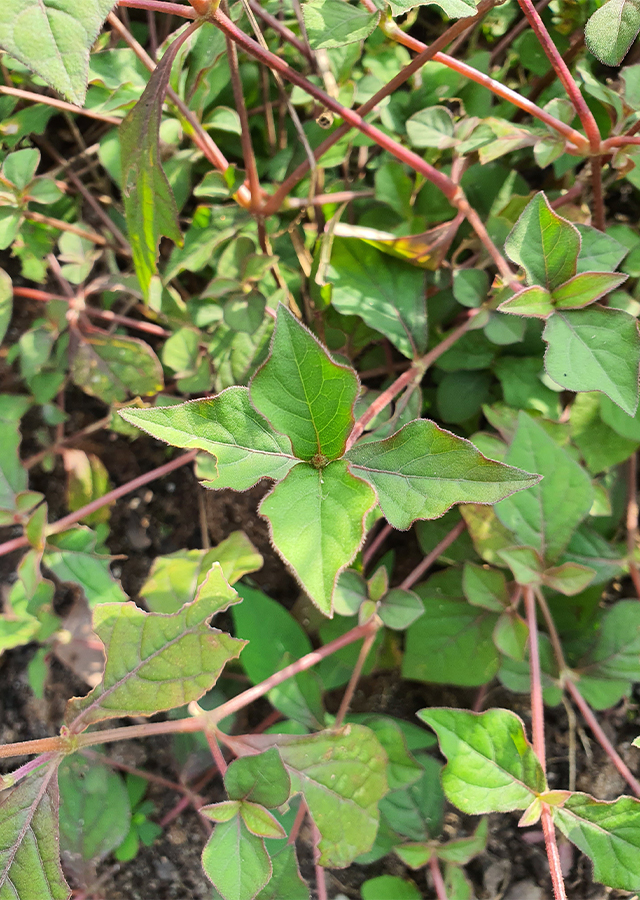
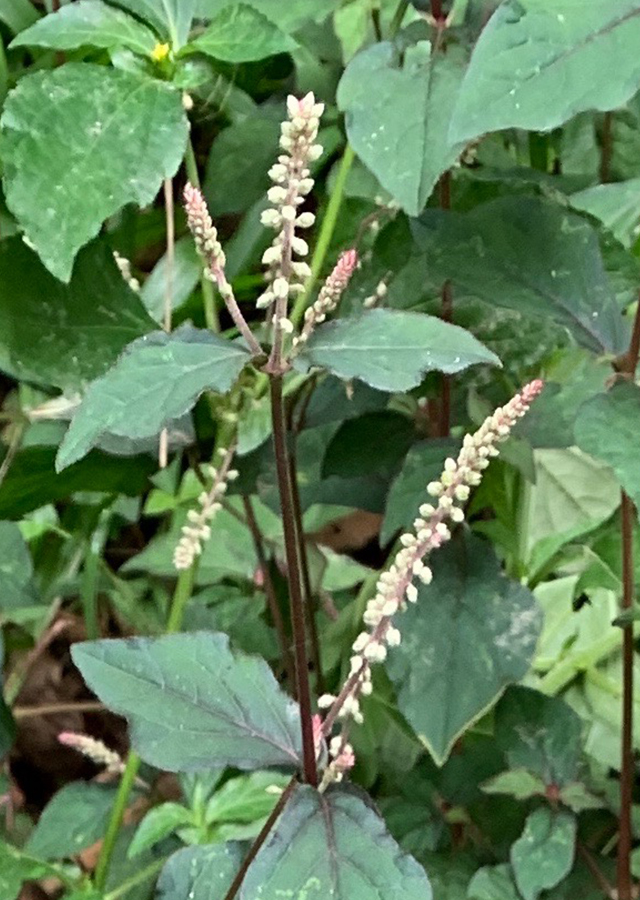
- Stem bluntly square-shaped, thickened above the leaf node, often covered with fine red hair.
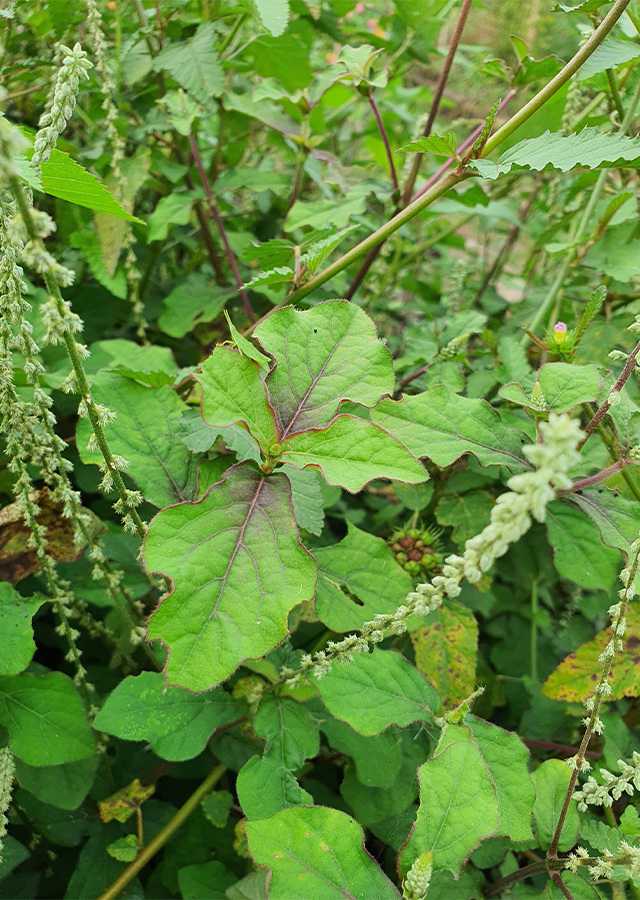
- Leaves arranged opposite, single, rhombus-shaped, edges and veins red.
- Flowers an upright, long raceme, located at the stem tip or in the uppermost leaf axils.
- Fruit elliptical shape, 1.5-2 mm long, single-seeded.
- Seeds ovate-shaped, glossy brown in color.
Cultivation
- Propagated by seed, stem cuttings.
- Seed dispersal is often aided by bees and wind.
Chemical Content
Saponin, tannin, flavonoid, alkaloid, steroid, essential oil, cardiac glycosides, terpenoids, anthraquinones, glycosides, phlobatannin.
Benefits
Remedy for cough, headache, fever, dysentery, worm infections, cholera, scabies, anti-inflammatory, hemostatic (stops bleeding), remedy for wounds, burns, fractures, antiseptic, ear drops/otitis remedy.
Simplisia
- Prepare the whole rumput jarang-jarang plant. Separate the leaves, stem and root. Wash thoroughly with running water.
- Air-dry the simplisia material for 2 weeks.
- Store the simplisia in a closed, airtight container.
Local Names
Ranggitan, Kendiran, Upan-upan, Rendit banyu (Java), Rai-rai fotoheka (Ternate).
Traditional Recipes
The following recipes reflect traditional knowledge passed down through generations, not a substitute for professional medical diagnosis or advice. Consult a healthcare provider before use.

1. Traditional concoction
1. Remedy for wounds, burns and fractures
- Prepare the rumput jarang-jarang plant, wash thoroughly then grind finely.
- Apply as a poultice on wounds, burns and fractures.
2. Headache
- Grind root as needed into a paste.
- Apply to the forehead.
Reference Sources
- Motaleb Mohammad Abdul. 2013. Commonly Used Medicinal Herbs and Shrubs by Traditional Herbal Practitioners. International Union for Conservation of Nature and Natural Resources
- Tropical Plants Database, Ken Fern. tropical.theferns.info. Cyathula prostrata. http://tropical.theferns.info/viewtropical.php?id=Cyathula+prostrata 31-08-2020
- Researchgate. Cyathula prostrata: A Potential Herbal Hope for Hypertensives, an Animal Model Study and Its Secondary Metabolites Assessment via GC-MS. https://www.researchgate.net/publication/301346297_Cyathula_prostrata_A_Potential_Herbal_Hope_for_Hypertensives_an_Animal_Model_Study_and_Its_Secondary_Metabolites_Assessment_via_GC-MS 03-02-2021