Elaeocarpus sphaericus (Gaertn.) K.Schum.
Summary
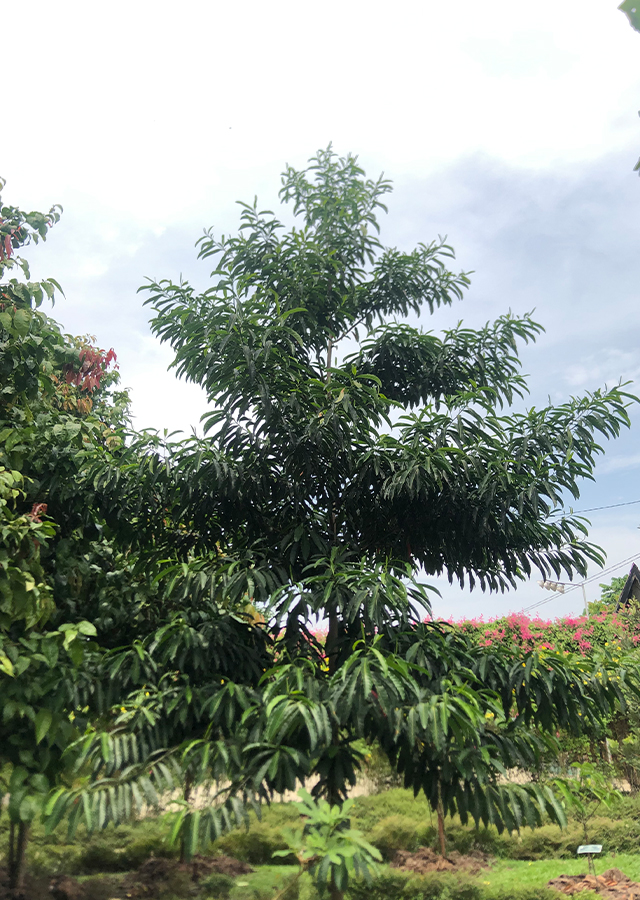
Elaeocarpus sphaericus or ganitri is a native Indonesian tree distributed across Southeast Asia, with about 70% of its roughly 350 species found in the archipelago, especially Central Java, Sumatra, Kalimantan, Bali, and Timor. In Hinduism, ganitri is considered a sacred tree belonging to Lord Shiva and a connector between heaven and earth, while its dried seeds are popularly made into rosary and prayer beads. Since prehistoric times, ganitri has been used to treat anxiety, depression, hypertension, and migraine, with modern research also confirming various pharmacological activities such as anticonvulsant and anti-inflammatory effects.
Agroecology
Ganitri is a moist tropical and subtropical plant. Generally found in secondary forests, mountain rainforests, and broadleaf valleys at elevations of 400-1,300 m asl. In the Himalayas, ganitri thrives at elevations of 2,000 m asl. Meanwhile in Java, ganitri is found at elevations less than 1,200 m asl (especially 500-1,000 m asl). Grows best in areas where annual daytime temperature is in the range of 18-28°C, but can tolerate 8-38°C, with mean annual rainfall in the range of 1,500-3,000 mm, but can tolerate 1,000-3,500 mm. Prefers a full sun position but can tolerate slight shade. Also grows well in fertile, humus-rich, well-drained soil, with a soil pH range of 5.5-6.5, but can tolerate 4.5-7.5. Ganitri is drought-resistant and can grow well in open and disturbed locations.
Morphology
- Roots buttress roots. Roots can rise high near the trunk and spread out along the ground surface.
- Trunk cylindrical, rough textured, fissured with grayish white to brown bark, with grayish brown branches. Small branches villous and yellowish brown.
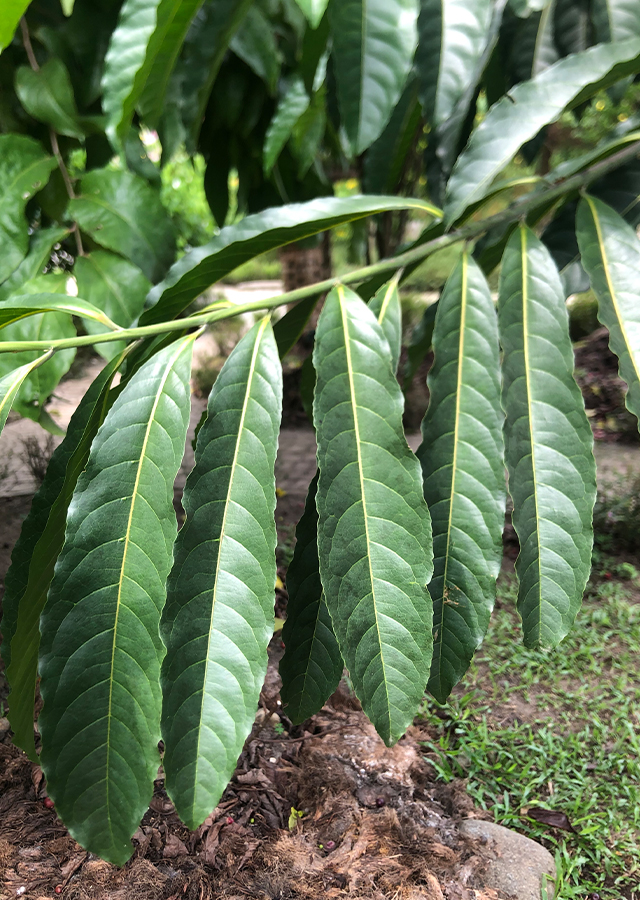
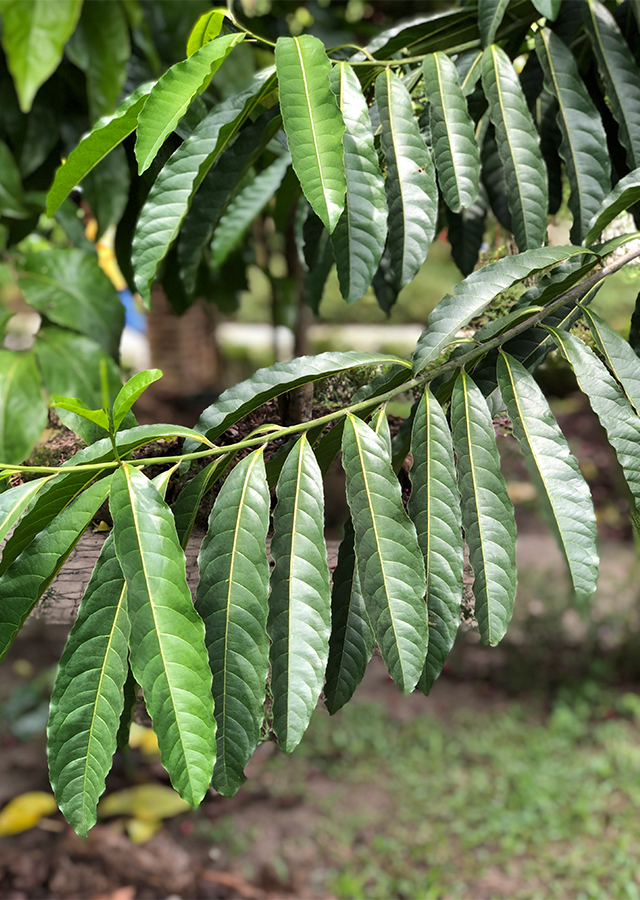
- Leaves alternately arranged, dark green, glossy, ovate-oblong to oblong-lanceolate shaped, asymmetric, base broadly cuneate, tip sharp or blunt, margin toothed, petiole about 1-1.5 cm. Old leaves turn red before falling, both surfaces villous when young, smooth when mature, lateral veins 10-13 per side, somewhat prominent abaxially. Has a somewhat bitter taste and is odorless.
- Flowers white, petals 5, borne on axillary inflorescences about 2-4 cm long, petals divided at the tip into 4 or 5 lobes, stamens 25-50 and hairy at the tip, ovary hairy.
- Fruit seeded, round shaped, green when young then turning bluish purple and mealy when ripe. The fruit consists of five or six carpels, each carpel having one large seed.
- Seeds elliptic to round shaped, 1 seed per locule or carpel, covered by a hard woody shell, with a nearly translucent hole in the center. The entire seed surface is pitted and grooved in a spiral pattern as if eaten by worms, giving it a beautiful, carved appearance.
Cultivation
- Plant propagation through seed and branch cuttings, although the cutting method is not always successful.
- Ganitri seed has a hard shell coat. Burying the seed in soil and heating it with fire on top, or cracking it (very carefully so as not to damage the seed) to allow moisture penetration can help speed up germination. Sow seed in a shaded container. Generally will germinate after 3-4 months. Seedlings germinating at the 2 or 3 leaf stage are ready to be planted in the field after about 8 months.
- Nursery beds prefer clay or loam media, slightly acidic (6.0-6.3) to neutral (6.3-7.8) and well-drained soil. Shaded conditions are also needed to provide an optimal environment for seed germination since the gestation period can vary from a minimum of 45 days to more than a year; dense canopy cover is preferred for ganitri seedling growth.
- Planting is done by making planting holes 30 x 30 x 30 cm. The recommended planting spacing is 6 x 6 m, considered sufficient for crown development.
Chemical Content
Steroids, saponin glycosides, flavonoids, tannins (e.g., geraniin and 8,4,B-trimethoxy geraniin), phenolic compounds, alkaloids (elaeocanine A, C, and D, (+)-elaeocarpine, elaeocarpenine, isoelaeocarpine, grandisine B, isoelaeocarpiline, grandisine D, elaeocarpidine, isoelaeocarpicine, grandisine F, grandisine A, grandisine C, grandisine E, habbemine B, habbemine A, grandisine G), indolizidine alkaloids (karpusinine A, karpusinine B, karpusinine C, epikarpusinine C, karpusinine D, karpusinine E, karpusidine), pyrrolidine alkaloids (karpusinine F and epikarpusinine F).
Benefits
Treats enlarged spleen, hypertension and heart disease, epilepsy, migraine, stomachache, asthma, cough, bronchitis, neuralgia (nerve pain), anorexia (eating disorder), joint inflammation, liver disease, chest and shoulder pain. Addresses stress, depression, and various mental illnesses. Has anticonvulsant, antihypertensive, antiepileptic, anticonvulsive, anticancer, antimicrobial, antidiabetic, antidepressant, analgesic, immunostimulant, anti-inflammatory, and antioxidant activity.
Local Names
Katulampa, Mata siwa (Bogor), Sambung susu (Jawa), Klitri (Madura), Biji mala (Bali), Biji sima (Sulawesi Selatan), Genitri, Ambit, Jenitri, Rijaksa, Mata dewa.
Reference Sources
- USDA Plants Database
- Blue marble tree, Elaeocarpus angustifolius, Blue fig/ Alternative Medicine (stuartxchange.com)
- Elaeocarpus angustifolius - Useful Tropical Plants (theferns.info)
- Rudraksha Cilacap: GANITRI (Elaecocarpus sphaericus Schum) (rudrakshacilacapselatan.blogspot.com)
- Kumar, G., Karthik, L. and Rao, K.V.B., 2014. A review on medicinal properties of Elaeocarpus ganitrus Roxb. ex G. Don.(Elaeocarpaceae). Research Journal of Pharmacy and technology, 7(10), pp.1184-1186.
- Lal, P.M.T.A., 2013. Elaeocarpus sphaericus: A tree with curative powers: an overview. Research Journal of Medicinal Plant, 7(1), pp.23-31.
- Aryal, P., 2021. Medicinal value of Elaeocarpus sphaericus: A review. Asian Journal of Pharmacognosy, 6(3), pp.15-21.