Elephantopus mollis Kunth
Summary
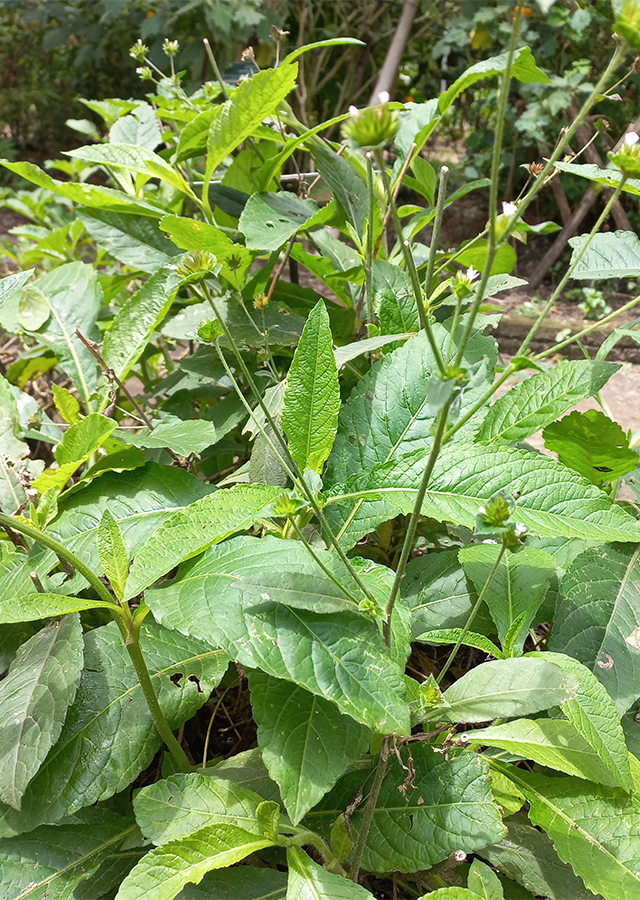
Tapak liman putih (Elephantopus mollis) is a herb up to 1 meter tall from the Asteraceae family that originates from Central and South America, now an invasive weed in many African and Asian countries. In Brazil, its leaves are used to treat bronchitis and influenza, while in Burma it is used to address irregular menstruation. In China, tapak liman putih is even eaten as a salad.
Agroecology
Tapak liman putih can be found growing in open areas in grasslands, plantations, forest edges, roadsides, and disturbed or swampy areas, at elevations up to 2,000 m asl. This plant prefers areas with high rainfall, fertile, humid tropical conditions, and requires full sunlight for optimal growth, supported by fertile soil conditions, though it can tolerate less fertile soil.
Morphology
- Roots fibrous.
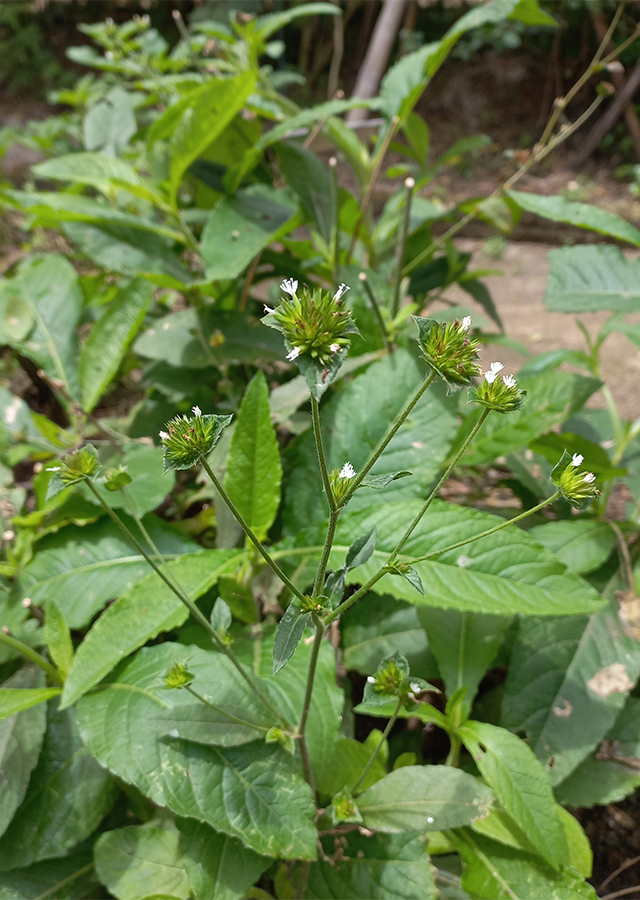
- Stem mostly solitary, unbranched except for the inflorescence, striated, hairy.
- Leaves scattered along the stem, single, ovate to lanceolate, pointed at both ends, blunt-toothed to serrated margins, pinnate venation, green in color. Leaf surface finely hairy. Lower surface dotted with glands and resin. Petiole winged. Leaves concentrated at the base.
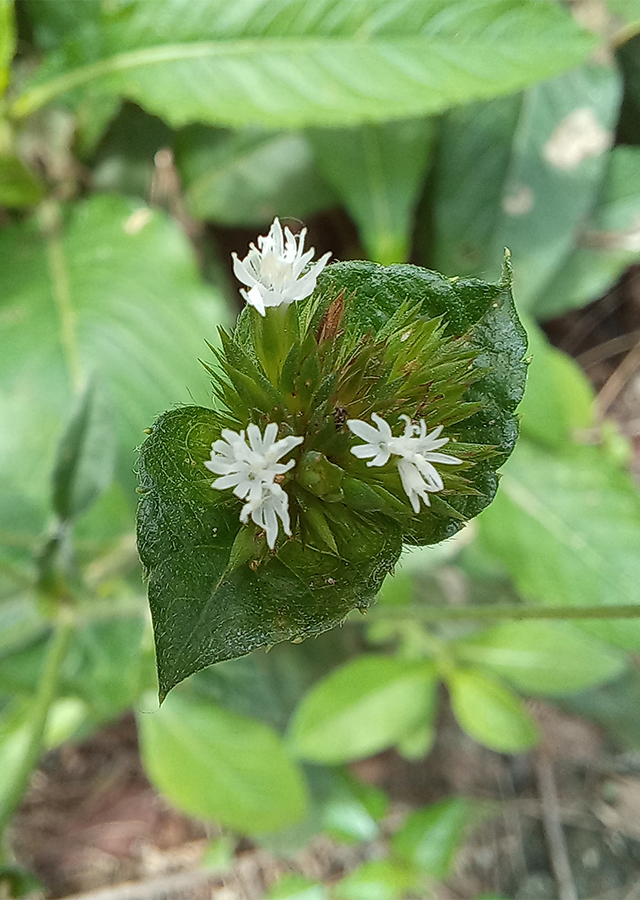
- Flowers have a white or purple corolla, consisting of a slender tube and a short deeply-lobed limb, glabrous (hairless), with a deep slit on one side. Surrounded by 3 leaf-like bracts about 1 cm long, ovate to oblong and heart-shaped at the base. Flower heads clustered in each cyme, each head usually with 4 florets.
- Fruit long, narrow turbinate cylindrical, ribbed. Pappus consists of 5 elements, short and scale-like at the base and abruptly tapering to a long point.
- Seeds black, densely covered with fine short hairs, at the tip consisting of 5 white bristles 3-4.5 mm long.
Cultivation
Propagation is done generatively using seeds.
Chemical Content
Sesquiterpene lactone, deoxyelephantopin, caffeic acid, dicaffeoylquinic acid, dihydroxy-cinnamic acid methyl ester, molephantin, molephantinin, 2-de-ethoxy-2-hydroxyphantomolin, 2-de-ethoxy-2-methoxyphantomolin, stigmasterol, α-amyrin fatty acid ester and lupeol fatty acid ester, epifriedelinol.
Benefits
Treats bronchitis, coughs and influenza, reduces fever, treats itching, treats wounds, addresses irregular menstruation, hemorrhoids, fatigue and joint inflammation, helps heal broken bones, leishmaniasis (a disease caused by Leishmania parasite infection), dysentery, bruises, elephantiasis, has emollient properties (moisturizing and softening the skin), hemostasis (stopping bleeding), diaphoretic (inducing sweating), antioxidant, diuretic (promoting urination).
Local Names
Sawi hutan.
Traditional Recipes
The following recipes reflect traditional knowledge passed down through generations, not a substitute for professional medical diagnosis or advice. Consult a healthcare provider before use.
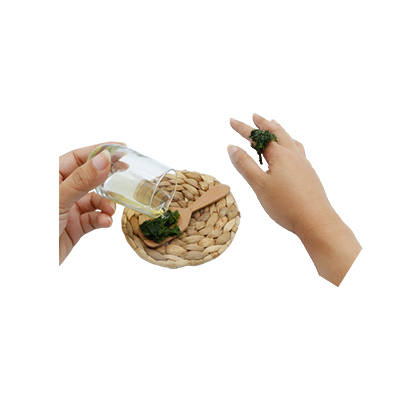
1. Healing wounds
- Prepare tapak liman leaves and wash until clean.
- Mash the leaves into a paste then add oil.
- Apply to the wound.
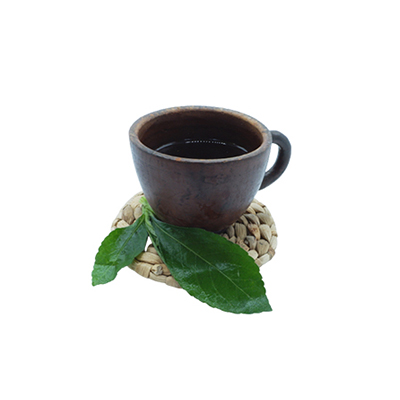
2. Fever
- Wash tapak liman leaves until clean.
- Boil until boiling.
- Wait until cool, then strain.
- Drink.
Reference Sources
- Royal Botanical Garden. 2021. Plant of the World Online: Elephantopus mollis Kunth. http://www.plantsoftheworldonline.org/taxon/urn:lsid:ipni.org:names:202942-1. 17-09-2021.
- Useful Tropical Plant Database. 2021. Elephantopus mollis. http://tropical.theferns.info/viewtropical.php?id=Elephantopus+mollis. 17-09-2021.
- Stuartxchange. 2018. Philippine Medicinal Plants: Malatabako. http://www.stuartxchange.org/Malatabako.html. 17-09-2021.
- CAB International. 2021. Invasive Species Compendium: Elephantopus mollis (elephant's foot). https://www.cabi.org/isc/datasheet/114063#todescription. 17-09-2021.