Epiphyllum phyllanthus (L.) Haw.
Summary
Epiphyllum phyllanthus or wijaya kusuma is a flowering succulent distributed from southern Mexico to Paraguay, Argentina, and Brazil. In Indonesia, this plant carries a mystical air, believed in Javanese mythology to be 'sacred' and capable of reviving the dead, though in reality its sweet, mucilaginous fruit can simply be eaten directly. Traditionally, wijaya kusuma is also used to treat broken bones, rheumatism, and speed up tuberculosis recovery.
Agroecology
Epiphyllum phyllanthus is usually found growing mainly in seasonally dry tropical biomes and in moist or wet forests as an epiphyte. Grows near sea level up to at least 1,300 m asl. E. phyllanthus can grow in full sun, but thrives in partial shade conditions. Extra light in early spring will stimulate shoots. E. phyllanthus prefers environmental conditions with nighttime temperatures no colder than 12°C, especially in winter, and can tolerate temperatures up to 45°C, and brief frost periods, but prolonged cold will damage or kill the plant. E. phyllanthus can usually live in various soil types, but due to its epiphytic nature, this plant is recommended to be grown in a well-drained soil mix consisting mostly of organic matter, such as peat or sphagnum moss. E. phyllanthus can also live in soil with a pH of 5.0 to 9. However, this species prefers soil with a higher alkaline pH of 6.2 to 7.0. E. phyllanthus can withstand moderate to high humidity levels. In fact, this species requires moderate to high humidity for its growth.
Morphology
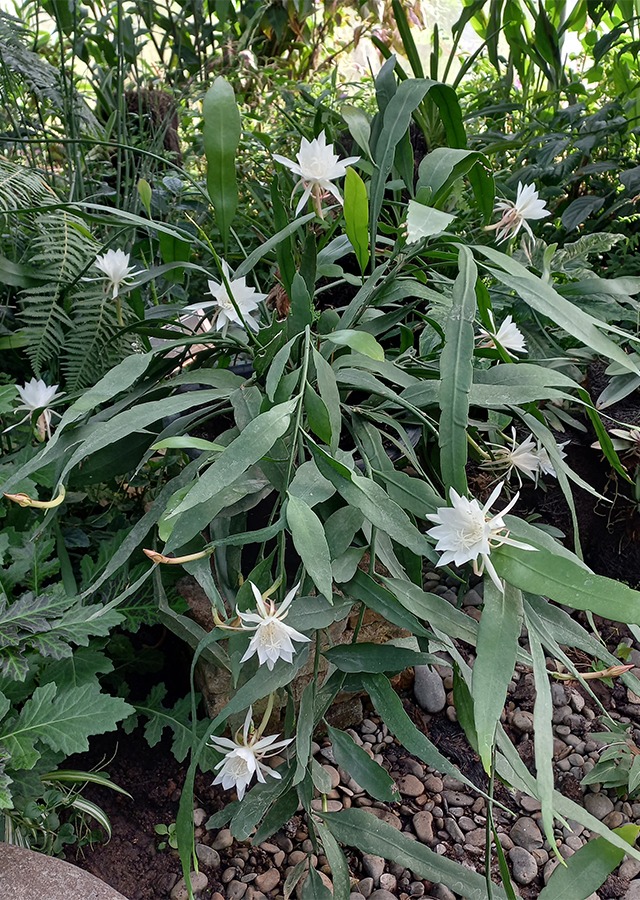
- Primary stem round elongated, terete in cross-section or 3-angled/winged below, 50-100 cm long or more, often branching, later becoming flattened or thin (leaf-like) up to 100 cm long. Secondary stems arise from the flattened part of the primary stem, round in cross-section to three-angled at the base, then flattened and linear, about 25-50 cm long and 3-10 cm wide, green with a very distinct purple margin, stiff to flexible, with a prominent midrib, margin slightly lobed and toothed, teeth blunt. Aerial roots present on the stem.
- Leaves absent.
- Areoles small, located along the branch margin, sometimes hairy, usually only wool-like and cream colored.
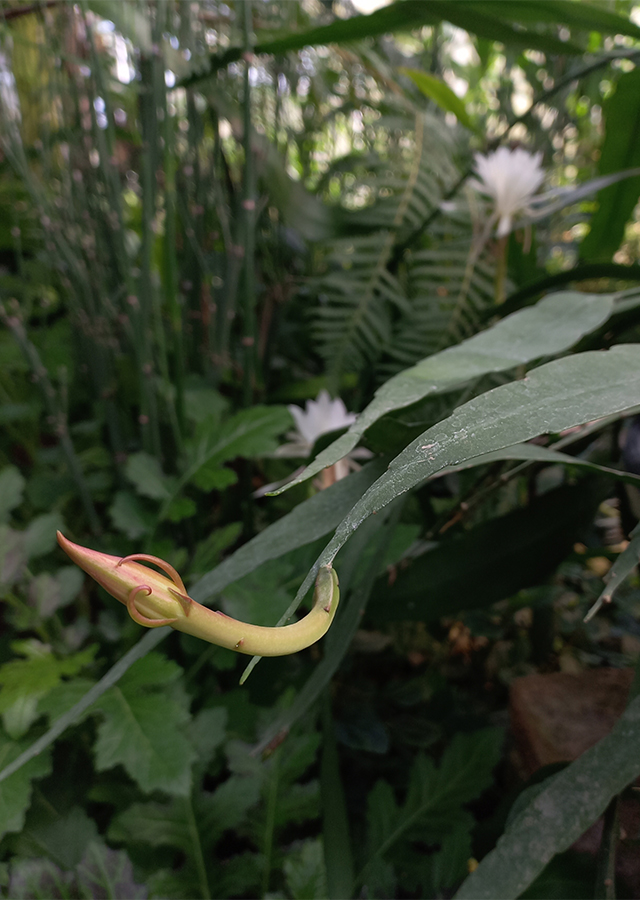
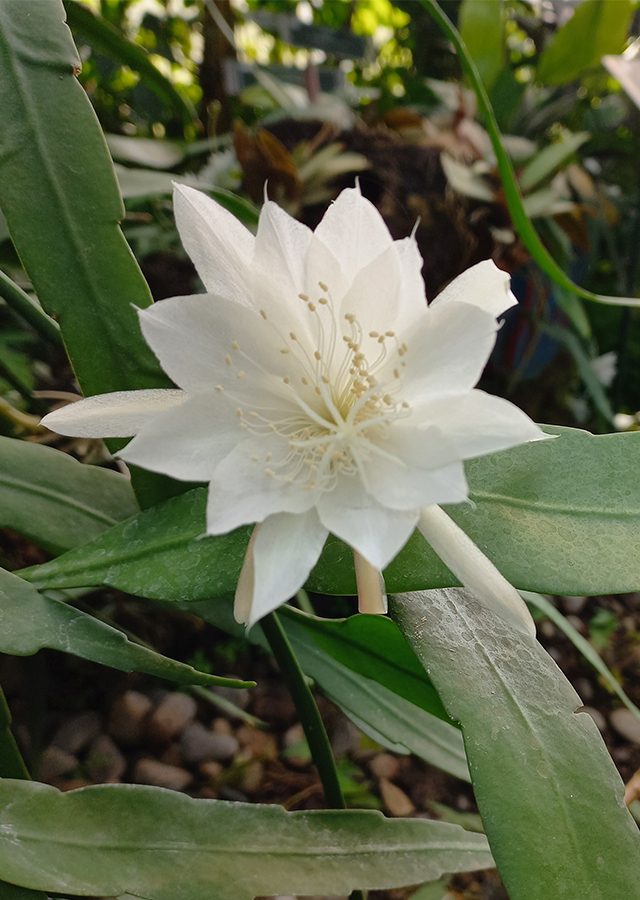
- Flowers fragrant, up to 30 cm long, located at the margin of the flattened stem part. Perianth tube slender, much longer than the branch, straight on upright stems, and strongly curved on hanging stems. Outer perianth segments greenish yellow tinged red, while the inner perianth segments narrow, 2.5-10 mm wide, white to cream colored. Scales on the flower tube few, scattered. Filaments short and white while the anthers are light brown. Style long, slender, pink or white in color. Stigma lobes about 10, short, white. Flowers open at night (nocturnal) and have a strong aroma emitted at night. Bloom lasts only briefly for 1 night.
- Fruit pink-purple when ripe, with white, mucilaginous flesh and a sweet taste.
- Seeds large, black, and numerous.
Cultivation
- Plant propagation is mostly done through leaf-like stem cuttings or through seed (rarely) in spring.
- Seed should be sown in a well-drained seedbed medium and can germinate within 14 to 28 days at temperatures of 18 to 21°C.
- By cuttings, cut the leaf-like stem 15-23 cm (6-9 inches) long and let it callus (dry) for several days in a warm location. Fill a pot one-third full with compost and cover with a layer of sand. Insert the cutting 3-5 cm deep. Keep the compost moist and maintain a temperature of 18-24°C. This plant can root within three to six weeks and flower the following year.
- Wijaya kusuma plants easily drop their buds if moved. Therefore, once flower buds have formed, do not move the plant, as slight environmental changes can cause the buds to fall off.
Chemical Content
Information not found. Further research is needed.
Benefits
Treats broken bones, rheumatism, speeds up recovery from TB (tuberculosis), whooping cough, cough and colds, lower back pain, and acts as a laxative.
Local Names
Bunga sri rejeki.
Traditional Recipes
The following recipes reflect traditional knowledge passed down through generations, not a substitute for professional medical diagnosis or advice. Consult a healthcare provider before use.
1. Speeds up recovery from TB (tuberculosis)
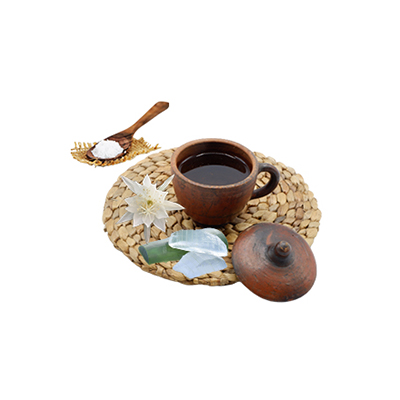
- Prepare 3-5 wijaya kusuma flower blooms, 75 g aloe vera gel, 15 g sugar, 800 ml water.
- Boil all ingredients until it boils and is judged fully cooked.
- Strain then drink while warm.
- Drink this decoction regularly every day for the best results.
Reference Sources
- Royal Botanic Gardens. Plants of the World Online: Epiphyllum phyllanthus (L.) Haw.. https://powo.science.kew.org/taxon/urn:lsid:ipni.org:names:132939-1. 23-09-2022.
- LLIFLE - Encyclopedia of living forms. 2022. Epiphyllum phyllanthus. http://www.llifle.com/Encyclopedia/CACTI/Family/Cactaceae/8523/Epiphyllum_phyllanthus. 23-09-2022.
- Almeida O. J. G., Paoli A. A. S., Souza L. A. 2010. Flower morpho-anatomy in Epiphyllum phyllanthus (Cactaceae). Revista Mexicana de Biodiversidad 81: 65- 80.
- Arnason et al. 2022. A review of ethnobotany and ethnopharmacology of traditional medicines used by Q’eqchi’ Maya Healers of Xna’ajeb’ aj Ralch’o’och’, Belize. Botany 100: 219–230.
- PlantingMan. Climbing cactus (Epiphyllum phyllanthus). https://plantingman.com/climbing-cactus-epiphyllum-phyllanthus/. 2309-2022.