Euphorbia grantii Oliv.
Summary
Euphorbia grantii or African milk bush is native to tropical East Africa, including Congo, Uganda, Kenya, Tanzania, and northern Zambia. This plant is commonly used as a living hedge, arrow poison material, and even a traditional grave marker in Central Kenya, but its poisonous sap can seriously irritate skin and eyes. Even so, if used properly, its sap is believed by communities to help blood clotting in wounds and address worm infections.
Agroecology
Euphorbia grantii can be found growing in sandy or rocky soil, in open forests, and on rocky hillsides, up to elevations of 1,750 m asl. Its growth prefers a position in full sun. This species is fairly drought-tolerant. However, it is not very frost-hardy and dislikes waterlogging. Grows well at temperatures down to 5°F (15°C).
Morphology
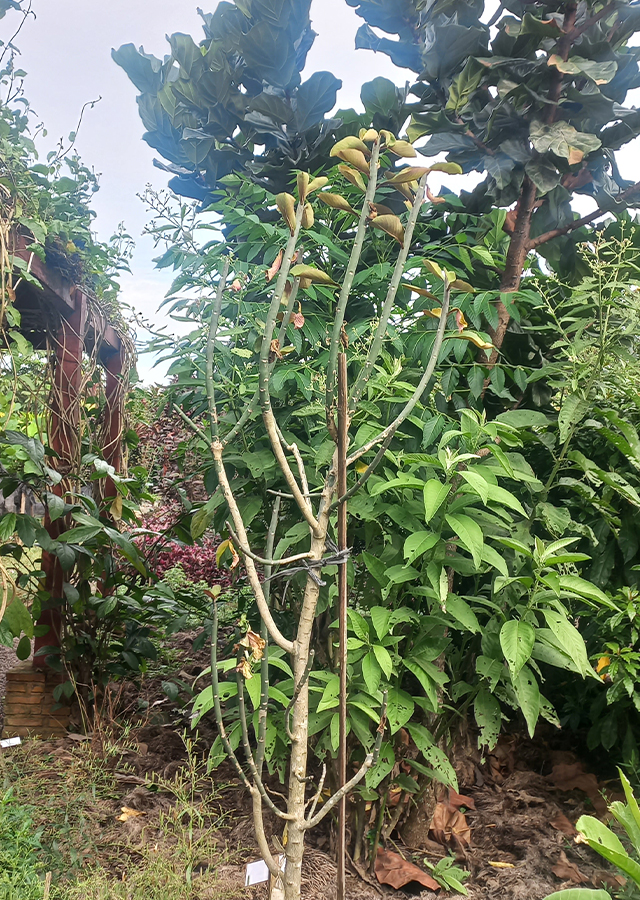
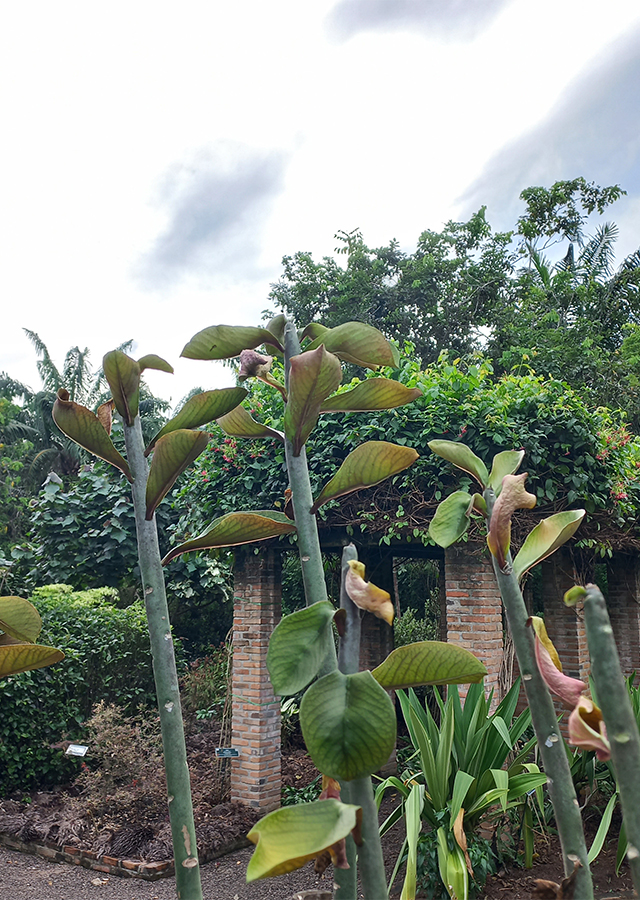
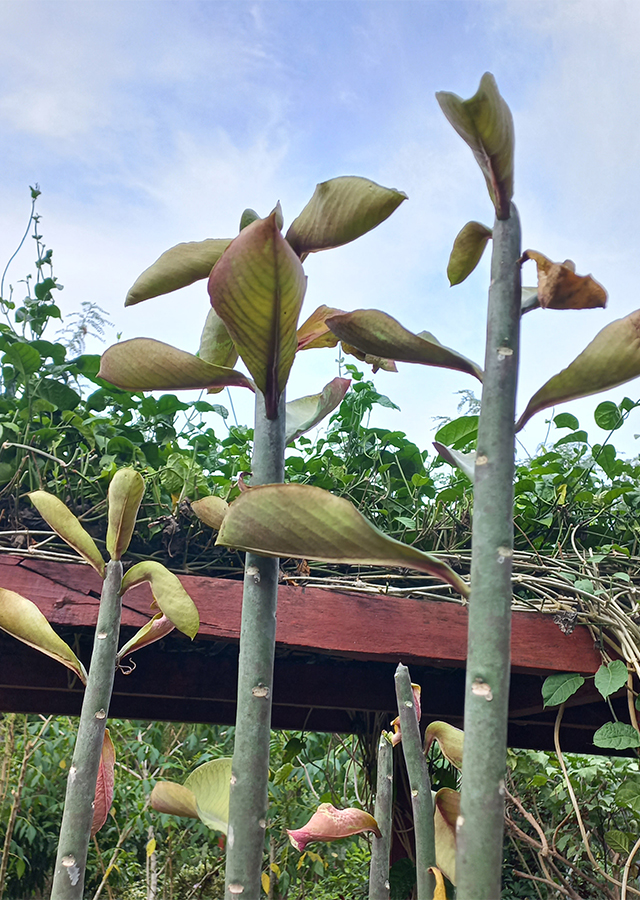
- Stem with smooth bark, gray, horizontally grooved, semi-succulent branches, with prominent large leaf scars, exuding abundant latex, base of the stem fleshy.
- Leaves alternate, simple, sessile, hairless, pale green and slightly grayish. Leaf blade linear to lanceolate-linear, base rounded, tip pointed, midrib prominent on the lower surface.
- Flowers unisexual. Male flowers have many bracteoles, fan-shaped, deeply divided, bracteoles hairy at the tip, stamens about 15 mm long. Female flowers with a curved pedicel 1.5 cm long in fruit, perianth distinct below the ovary, ovary superior, short-haired, 3-celled. Inflorescence a short-haired umbel, 3-branched, consisting of flower clusters, each cluster called a 'cyathium,' peduncle up to 10(-15) cm. Bracts sessile, deltoid, base slightly heart-shaped, tip long-tapering, lower surface slightly puberulent at least toward the base, bracts below the umbel larger and longer. Cyathia on stalks 1 cm long, c. 1 x 3 cm, with a barrel-shaped involucre, all parts slightly puberulent except the upper glandular surface. Each involucre contains 1 female flower surrounded by many male flowers.
- Fruit an almost round capsule, hairless when ripe, purplish, three-seeded.
- Seeds almost round, slightly laterally compressed and indistinctly 3-angled, surface somewhat rough, grayish brown.
Cultivation
Plant propagation through stem cuttings.
Chemical Content
Diterpenes (toxic), 3-O-methylquercetin, and several 3-methoxyflavones.
Benefits
Applied to wounds to promote blood clotting and tissue healing, an ear-drop remedy (treating earache), a laxative, treats tapeworm and other intestinal worm infections, leprosy sores, gonorrhea, constipation, the common cold, ringworm, boils, warts, an emetic remedy (treating epilepsy, poisoning, and snake bites), a recreational stimulant, a postpartum tonic. Has antiviral and anti-inflammatory activity.
Local Names
Informasi tidak ditemukan. Butuh penelusuran lebih lanjut.
Traditional Recipes
The following recipes reflect traditional knowledge passed down through generations, not a substitute for professional medical diagnosis or advice. Consult a healthcare provider before use.
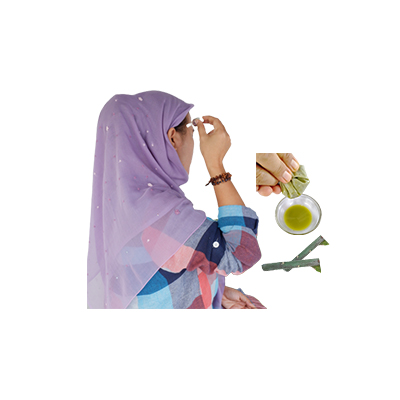
1. Treats earache
- Take a fresh African milk bush branch and remove the bark.
- Pound finely and squeeze.
- Use the liquid and drip it into the affected ear canal.
- Use 2-3 drops, and do this 4-6 times a day.
Reference Sources
- Royal Botanic Gardens. Plants of the World Online: Euphorbia grantii Oliv. https://powo.science.kew.org/taxon/urn:lsid:ipni.org:names:346682-1. 02-06-2022.
- Plant Resources of Tropical Africa. 2014. Euphorbia grantii (PROTA). https://uses.plantnet-project.org/en/Euphorbia_grantii_(PROTA)#Euphorbia_monteiri. 02-06-2022.
- Tropical Plants Database, Ken Fern. 2021. Euphorbia grantii. http://tropical.theferns.info/viewtropical.php?id=Euphorbia+grantii. 02-06-2022.
- EOL. Euphorbia grantii Oliv.. https://eol.org/pages/1144779/articles. 02-06-2022.
- Succulent City. 2020. Euphorbia grantii Care, Propagation & More. https://succulentcity.com/euphorbia-grantii/. 02-06-2022.