Euphorbia lactea Haw.
Summary
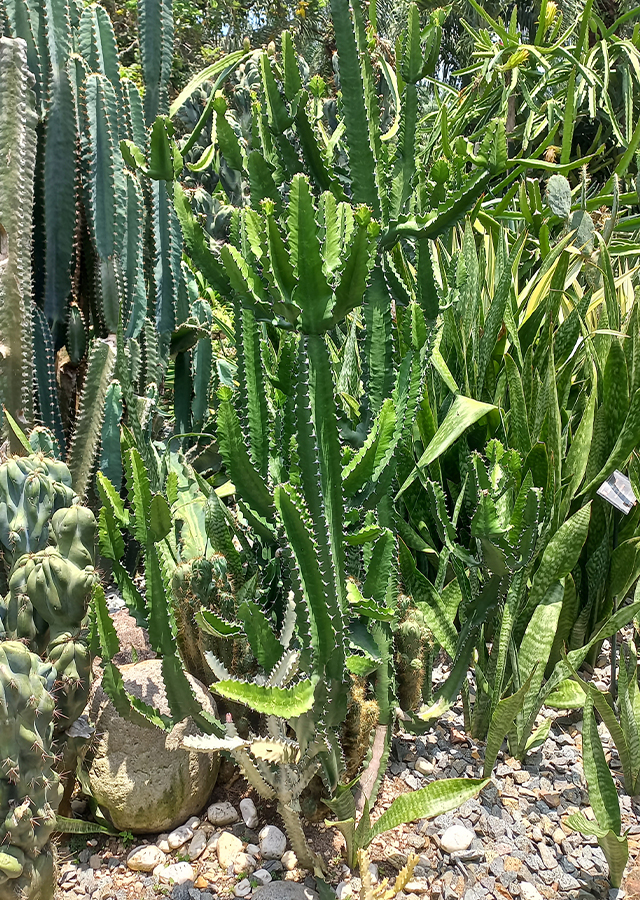
Euphorbia lactea or dragon bone cactus is native to Sri Lanka and is now cultivated and widely naturalized across tropical and subtropical regions of the world. Its unique, spiny shape makes it favored as an ornamental as well as a protective hedge, while its sap is traditionally used in India and Africa to treat warts—though its use requires extra caution due to its skin-irritating properties and danger if it gets into the eyes.
Agroecology
E. lactea mostly grows in dry deciduous forests, dry disturbed sites, abandoned gardens, waste areas, roadsides, and dry and semi-dry environments. E. lactea is also an abundant weed in coastal areas and sand dunes along the seashore. This species prefers locations with partial to full sun exposure, in sandy and sandy loam soil with a pH ranging from 6.1 to 7.8, well-drained and able to grow in nutrient-poor soil. Mean annual temperature ranges between 17-35°C, mean annual rainfall 750-2,000 mm. This species adapts well to dry areas and water-scarce habitats, and has succulent stems and water-storage tissue.
Morphology
- Roots fibrous.
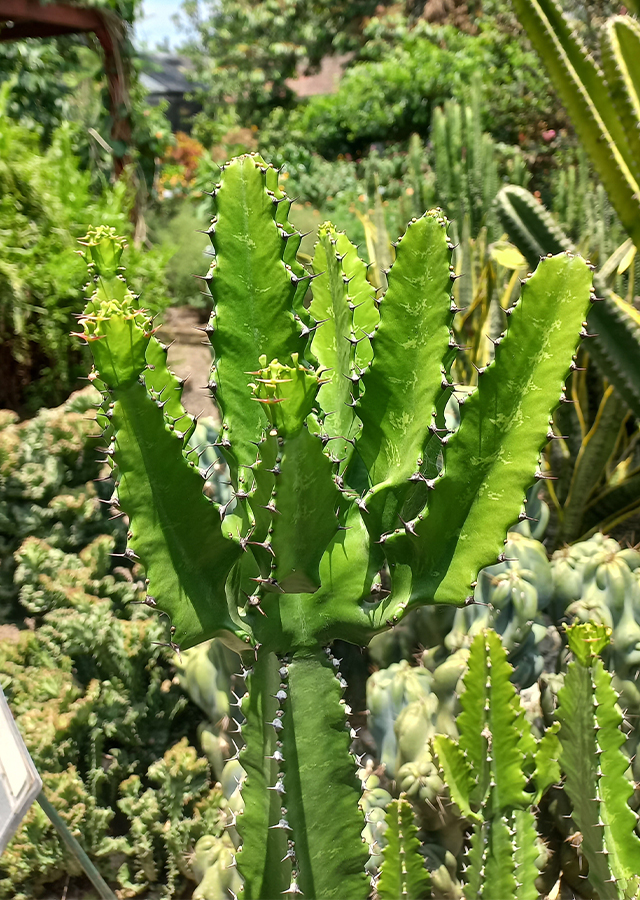
- Stem fleshy or succulent, much-branched, hairless, producing abundant milky sap when injured, short brown to black spines. The stem has a ring of branches nearly to the base, but on large plants sheds the spiny tissue and develops a round, cracked brown trunk. Branches 3-angled (sometimes 4-angled). Dark green, somewhat glossy, with yellowish or whitish streaks in the axial groove between the angles.
- Leaves few, scattered, alternate, sessile, round, green, slightly glossy, succulent, somewhat thick and falling off early, or absent.
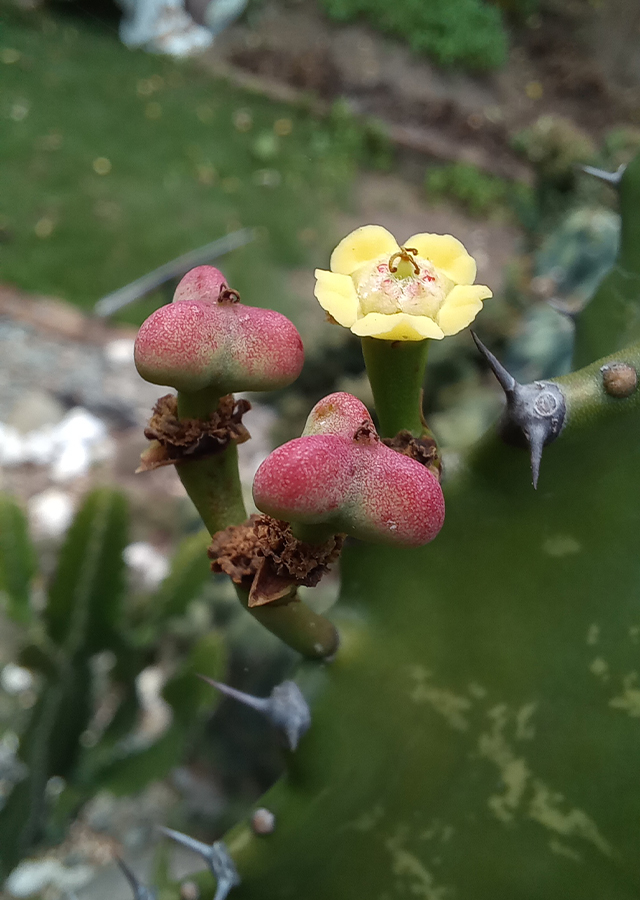
- Flowers small, yellowish green, appearing alternately in small clusters along the stem margins.
- Fruit a 3-lobed capsule, rare or absent in cultivation.
Cultivation
Plant propagation is generative through seed and vegetative with cuttings and stem sections.
Chemical Content
12-Deoxy-4β-hydroxyphorbol-13-dodecanoate-20-acetate-24-methylene cycloartenol, euphorbol hexacosanoate, tinyatoxin, ingenol triacetate, resiniferonol-9,13,14-orthophenylacetate, and 12-deoxyphorbol-13/2-methyl/butyrate-20-acetate.
Benefits
Treats skin diseases, warts.
Local Names
Kaktus karang.
Traditional Recipes
The following recipes reflect traditional knowledge passed down through generations, not a substitute for professional medical diagnosis or advice. Consult a healthcare provider before use.
1. Treats skin diseases
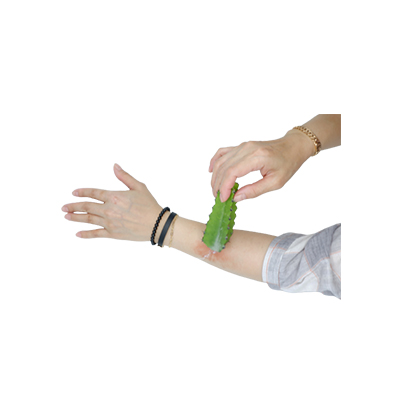
- Take one dragon bone cactus stem.
- Slice and collect the sap.
- Apply to the skin.
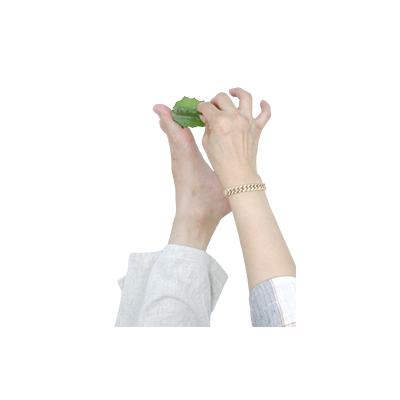
2. Warts
- Prepare an adequate amount of dragon bone cactus.
- Slice and collect the sap.
- Apply to the wart.
Reference Sources
- Royal Botanic Gardens, Kew. Plants of the World Online: Euphorbia lactea Haw. https://powo.science.kew.org/taxon/urn:lsid:ipni.org:names:347035-1. 14-08-2022.
- CAB International. 2022. Invasive Species Compendium: Euphorbia lactea (mottled spurge). https://www.cabi.org/isc/datasheet/119812#tosummaryOfInvasiveness. 14-08-2022.
- Flora Fauna Web. 2022. Euphorbia lactea 'Cristata'. https://www.nparks.gov.sg/florafaunaweb/flora/2/0/2004. 14-08-2022.
- Baslas, R.K., Gupta, N.C. 1984. Chemical constituents of Euphorbia lactea. Herba Hungarica 23(1-2): 85-88. https://eurekamag.com/research/004/937/004937258.php. 14-08-2022.