Euphorbia tithymaloides L.
Summary
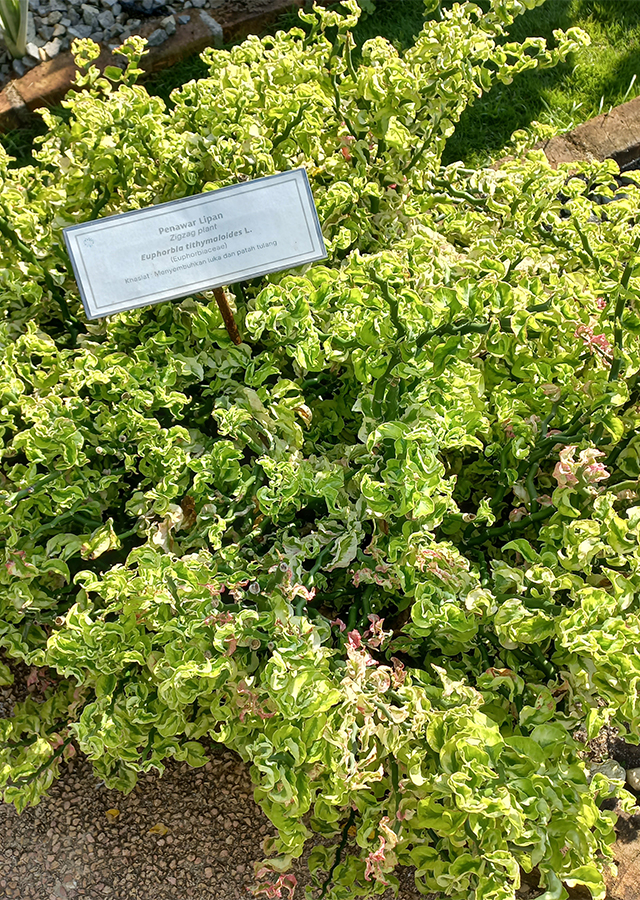
Pohon zigzag (Euphorbia tithymaloides) is a succulent 0.4-0.7 meters tall from the Euphorbiaceae family that originates from Florida to northern South America. Its unique zigzag-shaped stem makes it a popular ornamental and hedge plant, though its sap is toxic and requires careful handling. In traditional Chinese medicine, pohon zigzag is used to treat traumatic injuries and broken bones.
Agroecology
Pohon zigzag can be found growing in various habitats including dry thickets, coastal savannas, deserts, hillsides, along roadsides in rocky soil, at elevations from sea level up to 1,200 m asl. This plant prefers dry, sunny conditions, but can tolerate moderate shade. Pohon zigzag is able to adapt to grow in almost any soil type with a soil acidity (pH) between 6.1-7.8, and well-drained. Its growth prefers areas with average rainfall ranging between 700-1,800 mm/year and is highly drought-tolerant.
Morphology
- Roots taproot with few branches, many small lateral roots, light brown, outer roots smooth and slightly aromatic in smell.
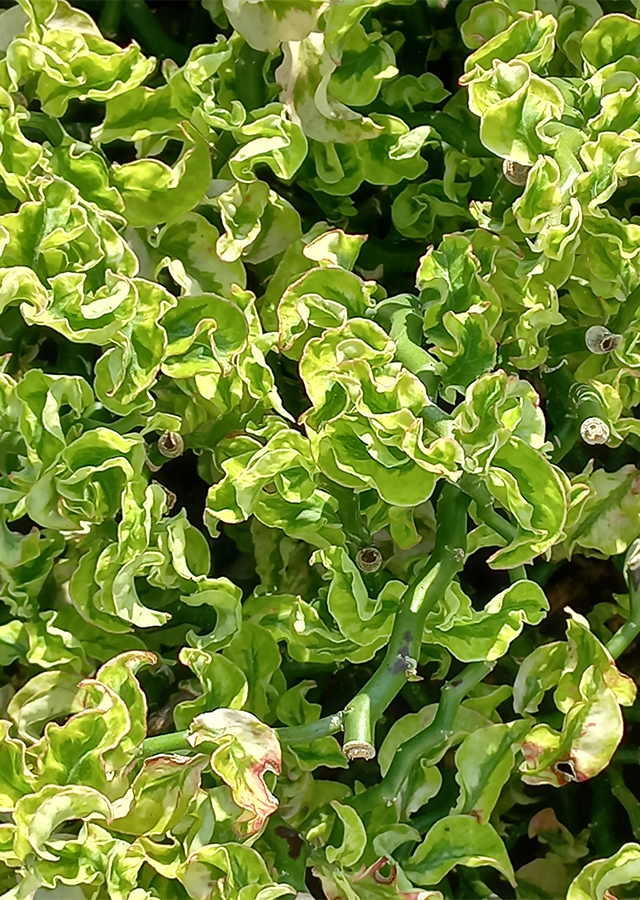
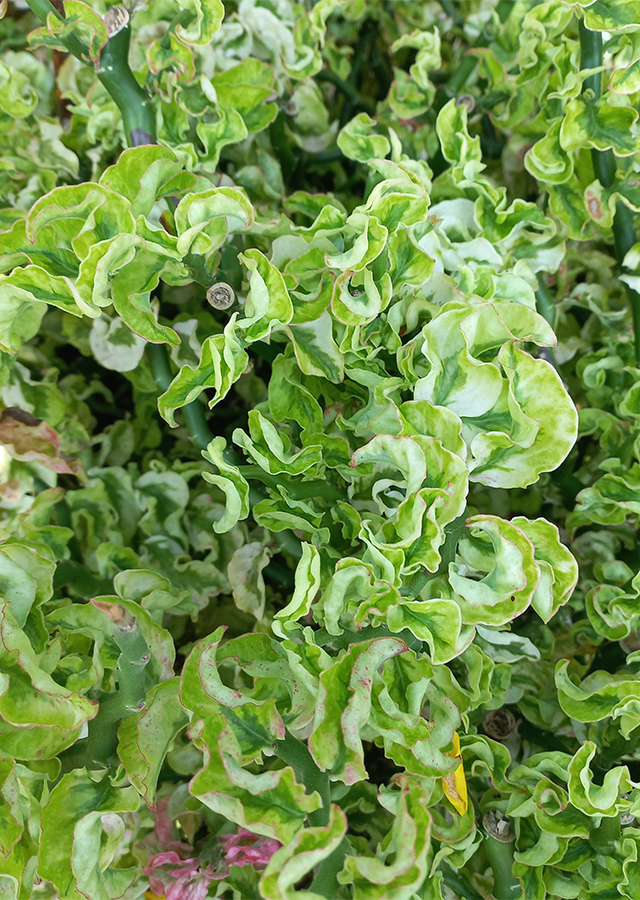
- Stem sturdy, upright, succulent, round, slightly fleshy, very flexible, hairless or pubescent when young, green, has a zigzag shape, exudes milky sap when broken, and has a slightly aromatic smell.
- Leaves ovate or elongated-ovate shape, fleshy, both surfaces pubescent, hairless, smooth and glossy, base rounded or blunt, tip tapering, leaf margin smooth to slightly wavy, pinnate venation. Leaf arrangement alternating with one leaf per point along the stem on alternating sides.
- Flowers red, bird-shaped, clustered at the stem tip. Each cyathia (flower structure containing separate male and female parts) is supported by a stalk 3-8 mm long. Cyathia, bilateral symmetry, unscented, red-green tube below. Male flowers have slender, hairless, filament-like flower stalks; anther round, slightly shorter than the filament. Female flowers inserted in the middle of the involucre, oblique, emerging from the involucre, involucral bract shoe-shaped, dark red or purple-red, equilateral, hairless, apex nearly labiate, small lobe, oblong, 3-toothed at the apex, other lobe boat-shaped.
- Fruit a capsule, cube-shaped with a truncated tip, deeply 3-lobed.
- Seeds grayish-brown, somewhat round (subglobose) shape.
Cultivation
Propagation is done generatively (seeds) and vegetatively (stem cutting rooting).
Chemical Content
Euphorbol, beta-sitosterol, dammaronol A, dotriacontan-1-ol, friedelanol, hentriacontan-1-ol, cycloartenone, octacosanol, oxime, steroids, cardiac glycosides, kaempferol 3-O-β-D-glucopyranoside-6″-(3-hydroxy-3-methylglutarate), quercitrin, isoquercitrin, scopoletin, tannin, triterpenes, coumarins, saponin, ursolic acid, luteolin, azafrin, and phenolic compounds.
Benefits
Treats traumatic injuries and broken bones, heals wounds, boils, ulcers, antidote for insect or centipede bites, asthma, swelling and redness in the eyes, persistent cough, sore throat, canker sores, venereal disease, earache, swelling, calluses, warts, ringworm, skin cancer, toothache, umbilical hernia (protruding navel). Has anti-inflammatory, antioxidant, antimalarial, antituberculosis, antifungal, and antibacterial activity.
Local Names
Penawar lilin, Penawar lipan, Pokok lipan.
Traditional Recipes
The following recipes reflect traditional knowledge passed down through generations, not a substitute for professional medical diagnosis or advice. Consult a healthcare provider before use.
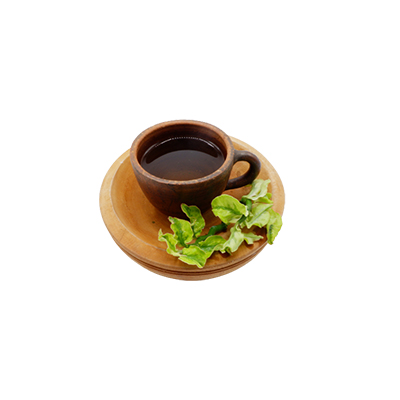
1. Swelling and redness in the eyes
- Wash 7 g of fresh pohon zigzag plant until clean.
- Boil with 4 glasses of water, until 2 glasses of water remain.
- Let cool then drink.
- Drink the decoction twice a day, 1 glass each.
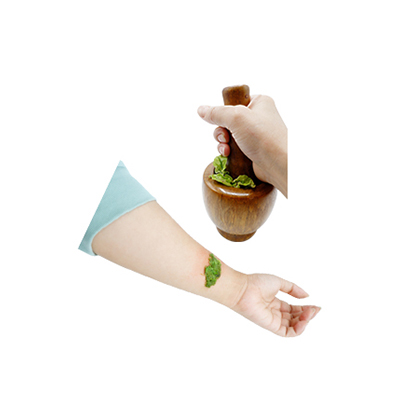
2. Boils and ulcers
- Take pohon zigzag plant as needed, then wash until clean.
- Grind the plant until smooth.
- Apply the ground material to the affected part of the body.
Reference Sources
- Royal Botanical Gardens. 2019. Plants of the World Online: Euphorbia tithymaloides L. http://powo.science.kew.org/taxon/urn:lsid:ipni.org:names:102036-2. 05-10-2021.
- CAB International. 2021. Euphorbia tithymaloides (devil's backbone). https://www.cabi.org/isc/datasheet/121886#tohabitat. 05-10-2021.
- Flora Fauna Web. 2020. Euphorbia tithymaloides L. https://www.nparks.gov.sg/florafaunaweb/flora/2/3/2307. 05-10-2021.
- Kumar T., Gupta A., Gidwani B., Kaur C.D., 2015. Phytochemical Screening and Evaluation of Anthelmintic Activity of Euphorbia tithymaloidus. International Journal of Biological Chemistry, 9: 295-301. DOI: 10.3923/ijbc.2015.295.301.
- Poudel R., Srivastava R., Tripathi A., 2019. Pharmacognostical & Physicochemical Studies of Euphorbia tithymaloides (L.) Poit. IOSR Journal Of Pharmacy And Biological Sciences (IOSR-JPBS) 14(6): 17-24.
- Srivastava R., Soni N. 2019. An updated review on phytopharmacological profile of Euphorbia tithymaloides (L.) Poit. The Pharma Innovation Journal, 8(5): 109-115.