Farfugium japonicum (L.) Kitam.
Summary
Farfugium japonicum or ligularia grows naturally in moist grasslands and riverbanks in Japan, China, and Korea, often harvested from the wild to be used as both food and traditional medicine. In Korea, this plant is used as a fever reducer, while recent research has found its essential oil has antioxidant and antimicrobial effects.
Agroecology
Ligularia grows naturally along rivers and coasts and in moist grasslands in Japan, China, and Korea. Also found growing in forests, valleys, and grasses in lowlands, rocky cliffs near the coast, grassy slopes, and very moist places. Best planted in fertile, organic-rich, loose, moist, well-drained soil. This plant also prefers wet soil conditions but cannot grow long in waterlogged soil. Its growth requires a sheltered or shaded position, either partial shade or full shade. Ligularia often wilts on sunny days if grown in a sunny location. This plant also prefers relatively warm environmental conditions, and is less tolerant of cold conditions.
Morphology
- Rhizome sturdy, up to 1.2 cm in diameter.
- Stem soft, green.
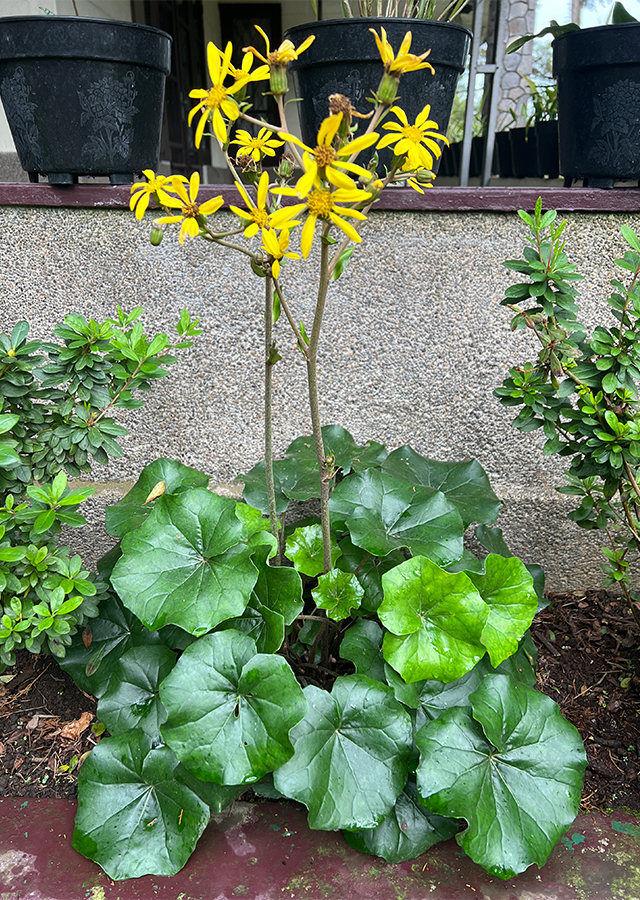
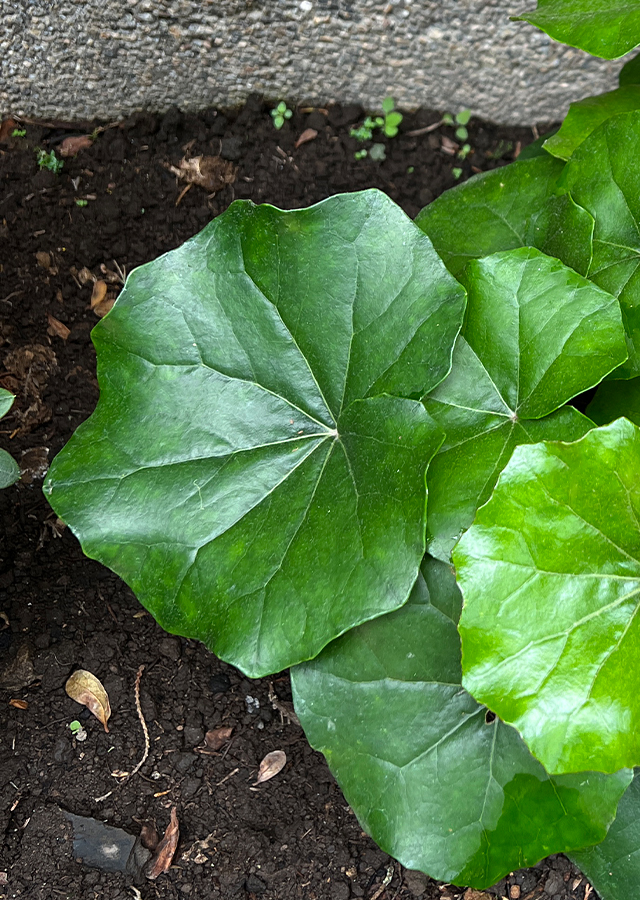
- Leaves simple, large, glossy, thick, tip rounded, base curved or reniform (kidney-shaped, short and broad, like a hibiscus leaf) and less wide, margin wavy, toothed or palmately lobed, dark green, veins palmate, leaf texture rough. Young leaves covered with grayish-brown hairs on both surfaces, later becoming hairless. Petiole long, densely puberulent when young, hairless, base of the sheath short and densely hairy inside the sheath.
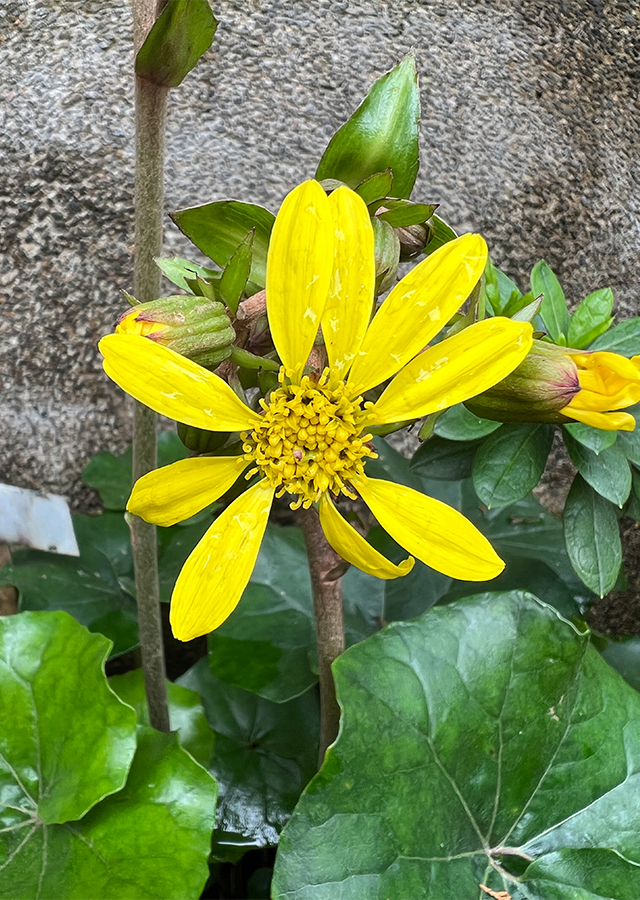
- Flowers yellow, aster-like (ligulate) in shape. Have 8-12 ligules, yellow, ligules oblong or oblong-spatulate shaped, tip rounded or pointed. Densely puberulent yellowish when young, more or less hairless, very densely puberulent at the base. Anthers caudate at the base. Flower heads spreading, 2-7, arranged on corymbiform, hairy stalks. Involucral bracts campanulate (bell-shaped), tip acuminate, back hairy, inner margin brownish.
- Fruit cylindrical, reaching about 7 mm long, longitudinally ribbed and covered with rows of short hairs.
Cultivation
Plant propagation through seed, rhizome, and offshoot division.
Chemical Content
Essential oil (1-undecene, 1-nonene, β-caryophyllene, α-copaene, γ-curcumene, germacrene D, 1-decene), trichloroacetic acid (dimethacrylic acid).
Benefits
Addresses cough, speeds up wound healing, bronchitis, diarrhea, irregular menstruation, bruises and mastitis (inflammation of breast tissue), an internal remedy for treating fish poisoning, and an external remedy for treating lacquer poisoning (caused by Toxicodendron species), also applied to pus-filled abscesses and smallpox. Has anti-inflammatory, antioxidant, antimicrobial, and antipyretic activity.
Local Names
Macan tutul, Cleopatra.
Traditional Recipes
The following recipes reflect traditional knowledge passed down through generations, not a substitute for professional medical diagnosis or advice. Consult a healthcare provider before use.
1. Smallpox
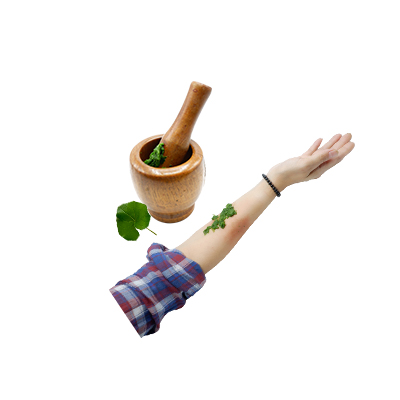
- Take an adequate amount of fresh ligularia leaves and wash until clean.
- Grind until it becomes a paste.
- Apply the leaf paste to smallpox.
Reference Sources
- Royal Botanic Gardens. Plants of the World Online: Farfugium japonicum (L.) Kitam.. https://powo.science.kew.org/taxon/urn:lsid:ipni.org:names:207632-1. 24-05-2022.
- Temperate Plants Database, Ken Fern. 2021. Farfugium japonicum.http://temperate.theferns.info/plant/Farfugium+japonicum. 24-05-2022.
- J-Y Kim, T-H Oh, B.J. Kim et al. 2008. Chemical Composition and Anti-inflammatory Effects of Essential Oil from Farfugium japonicum Flower. Journal of Oleo Science, 57(11): 623-628.
- Yeon Hong Yun, Hyuk Woo Kwon, Hong Seok Ahn, Seong Hwan Kim. 2015. First Report of Leaf Rust Caused by Puccinia caricis in Farfugium japonicum in Korea. Mycobiology, 43(3): 351-353. https://www.ncbi.nlm.nih.gov/pmc/articles/PMC4630445/. 24-05-2022.
- Direktorat Buah dan Florikultura. 2021. Informasi Teknis, Tanaman Hias Berdaun Indah. Kementrian Pertanian. Direktorat Jenderal Holtikultura.
- Raya Garden. 2020. Leopard Plant (Farfugium Japonicum) Profile: Info, Care & Growing Guide. https://www.rayagarden.com/garden-plants/leopard-plant-farfugium-japonicum-profile.html. 14-05-2022.
- Missouri Botanical Garden. Farfugium japonicum. https://www.missouribotanicalgarden.org/PlantFinder/PlantFinderDetails.aspx?taxonid=277321. 24-05-2022.