Gossypium barbadense L.
Summary
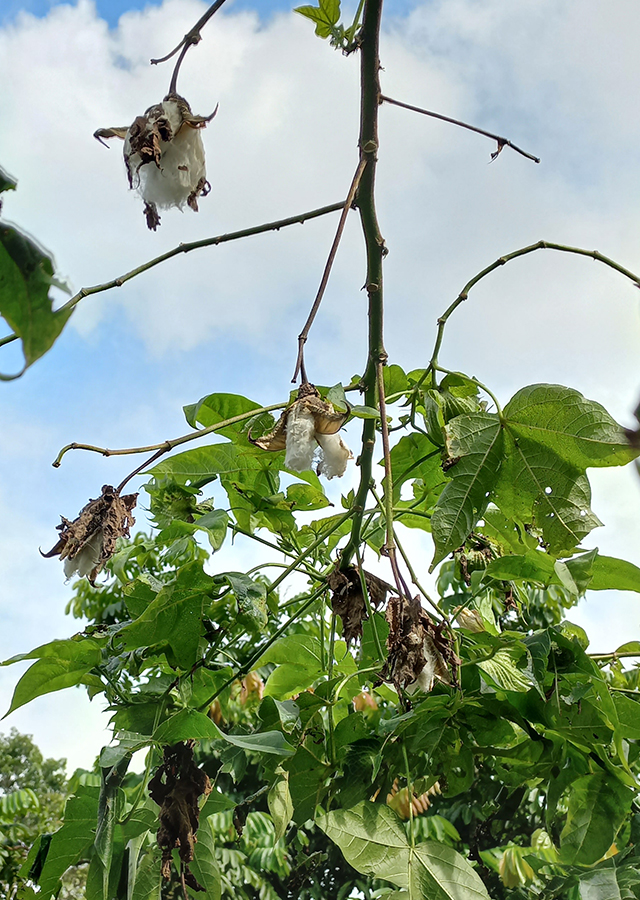
Kapas palembang (Gossypium barbadense) is a shrub up to 3 meters tall from the Malvaceae family native to the coasts of Peru and Ecuador, its cotton products used since around 2500 BC. Known as 'sea island cotton' after being introduced to the United States in 1785, its fiber is highly prized for luxury textiles. Kapas palembang is traditionally used in Africa to treat irregular menstruation and as a male contraceptive.
Agroecology
Kapas Palembang can be grown in dry to humid tropical and subtropical regions, where it is found at elevations up to 1,500 m asl. Commercial production requires a climate with a long, hot growing season with abundant moisture, followed by a drier period to harvest the seed lint. It grows best in areas where the mean annual daytime temperature is in the range of 22-32°C, but can tolerate 15-38°C. It prefers mean annual rainfall in the range of 750-1,250 mm, but tolerates 500-1,500 mm. Prefers a very sunny position in light, fertile soil. The plant can tolerate a range of well-drained soils, including moderate salinity. Prefers a pH in the range of 5.2-7.2, tolerating 5-8.5. Requires a position sheltered from strong winds.
Morphology
- Roots a strong taproot, often with four rows of lateral roots.
- Stem main stem monopodial with internodes decreasing from base upward; leaf-bearing nodes with axillary branches.
- Leaves spirally arranged, stipules linear, lanceolate or ovate, on flowering shoots often ovate to ovate and cordate at the base, 1-5 cm long; petiole half the length of the blade; blade ovate to broadly ovate, 8-20 cm in diameter, 3-7-lobed palmately with the middle segment largest, upper leaves sometimes unsegmented, lobes ovate to lanceolate, base heart-shaped, margin entire, 3-9-veined, with 1-3 central nectaries slightly above the base beneath.
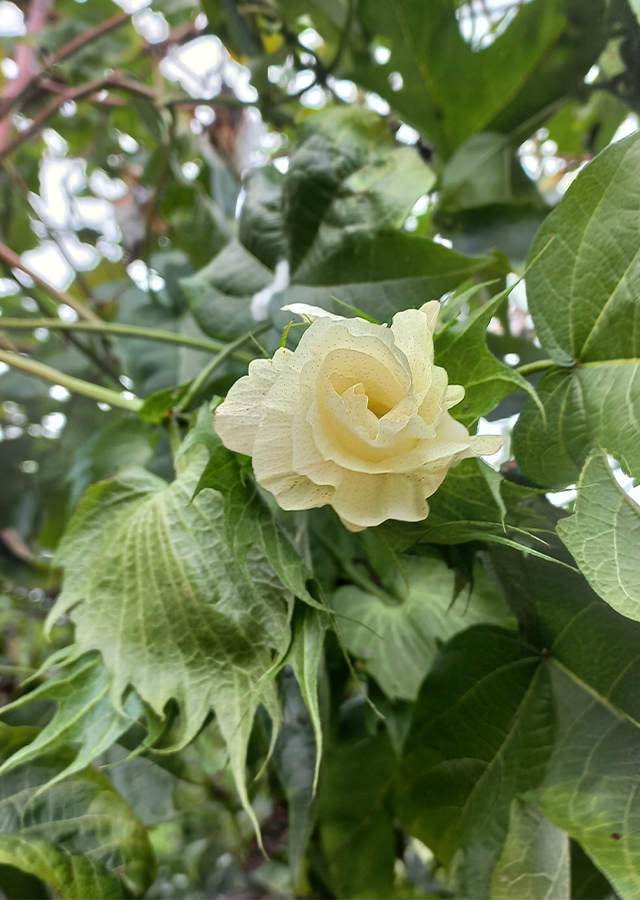
- Flowers solitary, usually on sympodial branches. Pedicel shorter than the petiole, not articulated, sharply triangular, usually bearing nectar below the insertion of the epicalyx segments. Epicalyx segments (bracteoles) 3, erect, attached to the corolla or fruit, orbicular to ovate, 4-6 cm long, at the base heart-shaped and strongly auriculate, with 5-17 pointed teeth, persistent; calyx cup-shaped, 8-10 mm long, with 5 short blunt teeth on a truncate apex, densely dotted, bearing 3 nectaries outside at the base, splitting after flowering. Corolla usually yellow with dark red or purple spots at the base, petals 5, imbricate, obovate, 5-8 cm long, truncate and emarginate at the apex. Stamens numerous, forming an erect column 2.5-4 cm long, filaments short, anthers 1-celled. Pistil with a 3-5-celled ovary and a short style with a stigma head, stigma 3-5-sulcate.
- Fruit ('boll') a capsule ovoid to fusiform 3.5-6 cm long, beaked, hairless, densely seeded, black, opening loculicidally, 3-celled with several seeds per cell.
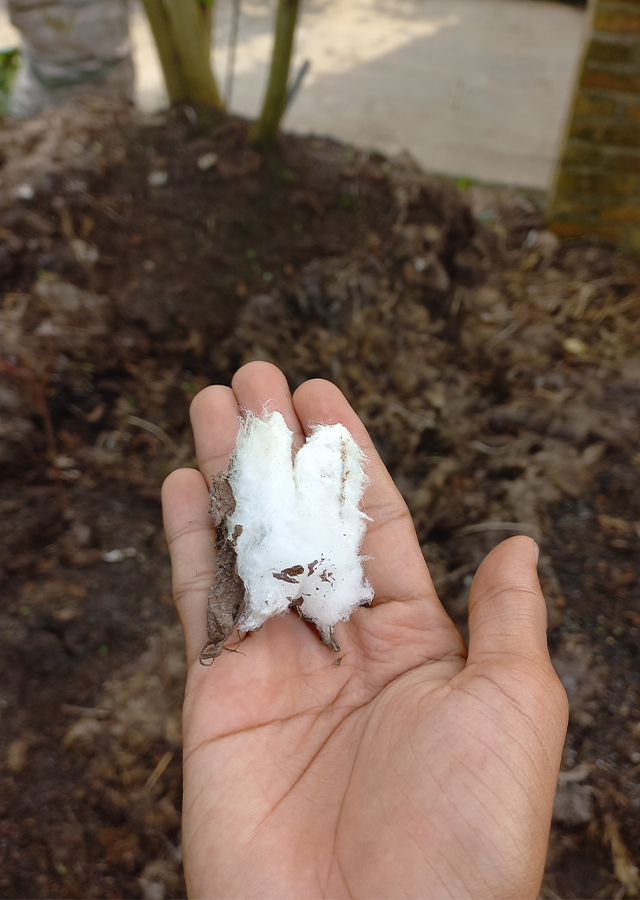
- Seeds ovate shaped, 8-10 mm long, with a pointed hilum, black to dark brown, with a thick covering of long, smooth, white hairs (lint or fiber) and a short fine tomentum (fuzz) everywhere or only at the hilum or absent.
Cultivation
Gossypium barbadense is propagated through seed.
Chemical Content
Triterpenoid and sesquiterpenoid aldehyde compounds, gossypol, hemigossypol, 6-methoxyhemigossypol, 6-deoxyhemigossypol, 6-methoxyhemigossypol, 6,6'-dimethoxyhemigossypol, heliocides H1 and H2, gossyrubilone, 3,4-dihydroxy-5-isopropyl-7-methyl-2H-naphtho[1,8-bc]furan, 3-hydroxy-5-isopropyl-4-methoxy-7-methyl-2H-naphtho[1,8-bc]furan, desoxy-6-methoxyhemigossypol, flavonol, tannins, cytotoxic sulfate compounds, sesquiterpene glycosides, sesterpenoids, essential oil (monoterpenes consisting of tricyclene, bornyl acetate, pinene, terpinene, isoledene).
Benefits
Has properties as an abortifacient, emetic, emmenagogue, laxative, treats difficult or irregular menstruation, strengthens the uterus, treats eye diseases, high blood pressure, stomach cramps and pain, painful ovaries, treats skin rashes and cramps in children, treats itchy skin, a remedy for yaws, as an auricular analgesic, a remedy for canker sores, diarrhea, a dressing for wounds, treats boils, scabies, leprosy, colds, bronchitis, rheumatism, hemorrhoids, treats dental caries and gum inflammation, as a male contraceptive. Has antipruritic, diuretic, hypotensive, antifertility, and antiviral activity.
Local Names
Informasi tidak ditemukan. Butuh penelusuran lebih lanjut.
Traditional Recipes
The following recipes reflect traditional knowledge passed down through generations, not a substitute for professional medical diagnosis or advice. Consult a healthcare provider before use.
1. Treats itchy skin
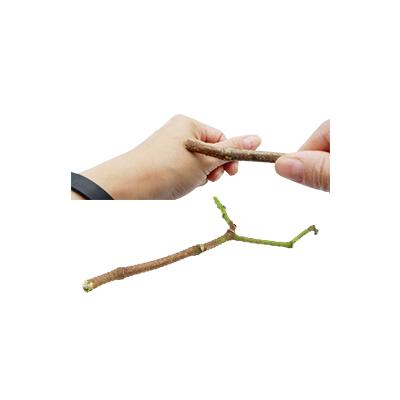
- Take a kapas palembang stem then snap it to release the sap.
- Apply the kapas palembang sap directly to the itchy skin.
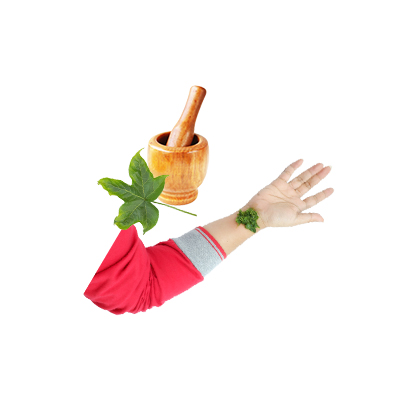
2. Wounds
- Take an adequate amount of kapas palembang leaves.
- Wash clean with running water.
- Grind until it becomes a paste.
- Apply the paste to the injured skin area.
Reference Sources
- Royal Botanic Gardens. 2021. Gossypium barbadense L.. https://powo.science.kew.org/taxon/urn:lsid:ipni.org:names:559677-1. 15-12-2021.
- PROTA. Gossypium barbadense L.. https://www.prota4u.org/database/protav8.asp?g=pe&p=Gossypium+barbadense+L. 15-12-2021.
- Useful Tropical Plants Database. 2021. Gossypium barbadense. http://tropical.theferns.info/viewtropical.php?id=Gossypium+barbadense. 15-12-2021.
- CAB International. 2021. Gossypium barbadense (Gallini cotton). https://www.cabi.org/isc/datasheet/25794. 15-12-2021.
- Essien Emmanuel E. , Sherifat O. Aboaba, Isiaka A. Ogunwande. 2011. Constituents and antimicrobial properties of the leaf essential oil of Gossypium barbadense (Linn.). Journal of Medicinal Plants Research Vol. 5(5), pp. 702-705, 4 March, 2011. https://www.researchgate.net/publication/287417485_Constituents_and_antimicrobial_properties_of_the_leaf_essential_oil_of_Gossypium_barbadense_Linn. 15-12-2021.