Gustavia superba (Kunth) O.Berg
Summary
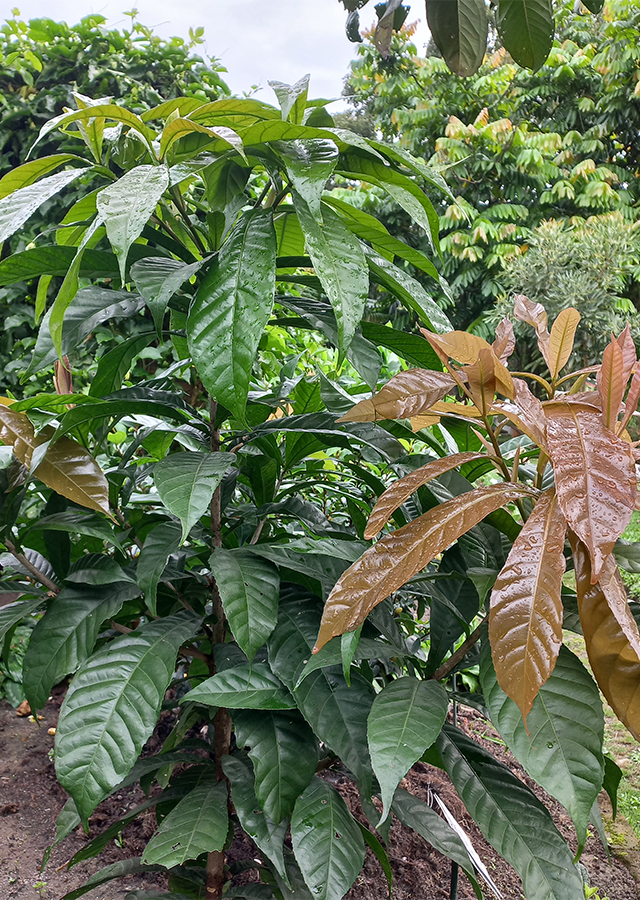
Membrillo (Gustavia superba) is a small tree up to 2 meters tall from the Lecythidaceae family that originates from northern South America to Costa Rica. Its fruit is edible, while its large, fragrant flowers make it a popular ornamental and street shade tree. The Kuna Indians traditionally use a decoction of its cooked bark to relieve body pain.
Agroecology
Gustavia superba prefers high humidity, sunlight and well-drained soil that dries quickly and is not waterlogged. Grows in humid tropical lowland regions, and is mostly found at elevations below 600 m asl, although it also extends to more than 1,000 meters above sea level. In accordance with tropical region temperatures, this plant tolerates up to 35 °C or even more. Prefers moist, nutrient and humus-rich soil, and is also tolerant of slightly low-pH or acidic soil and resistant to shade or shaded places.
Morphology
- Stem light brown colored and somewhat thick-skinned and very foul-smelling when decaying.
- Leaves arranged in a radiating pattern from the shoot down through the leaf arrangement like a palm. Petiole 5-150 x 1-9 mm, semicircular cross-section. Leaf blade ovate-obovate to oblanceolate with a size of 25-128 x 6-25 cm, hairy or smooth, base cartaceous long tapering to pointed or acute and cuneate, leaf margin serrate approaching serrulate, tip acuminate (tapering) or cuspidate (stiff and sharp tip), secondary veins in 16-36 pairs.
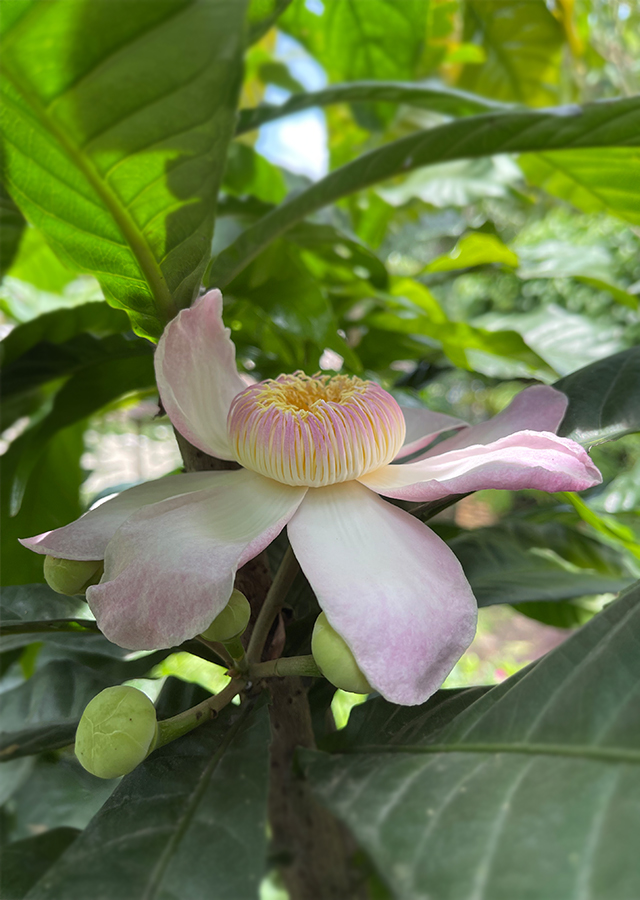
- Flowers with a cauline, racemose, puberulous inflorescence, with 3-12 flowers, stalk or rachis length 10-64 mm, pedicels 29-85 mm long, connected by one ovate to oblong or oblong basal bract 1.8-4 x 1.5-5 mm and bearing at or below the middle 2 ovate, cucullate bracteoles 1-6 x 1.5-5.5 mm, the latter often fusing at the base to form a cup-like structure encircling the flower stalk or pedicel, the cup often having inconspicuous extrafloral nectaries in the axil only easily seen on young picked flowers. Flowers 10-15 cm in diameter, calyx segments very thin 4-lobed, petals or corolla between 7-8-9, oblong obovate or oblanceolate, or oblong-oblong shaped, 33-67 x 12-37 mm, flat glabrous or puberulous, white with pink at the tip and with pink spots throughout. Androecial base 8-15 mm tall, outermost filament length 10-23 mm, yellow with pink base at the tip, anthers 2.5-4 mm, yellow. Ovary smooth, puberulous, 5-6 locular, with 18-30 ovules per locule, puberulous at the tip with a size of 1-2 mm long.
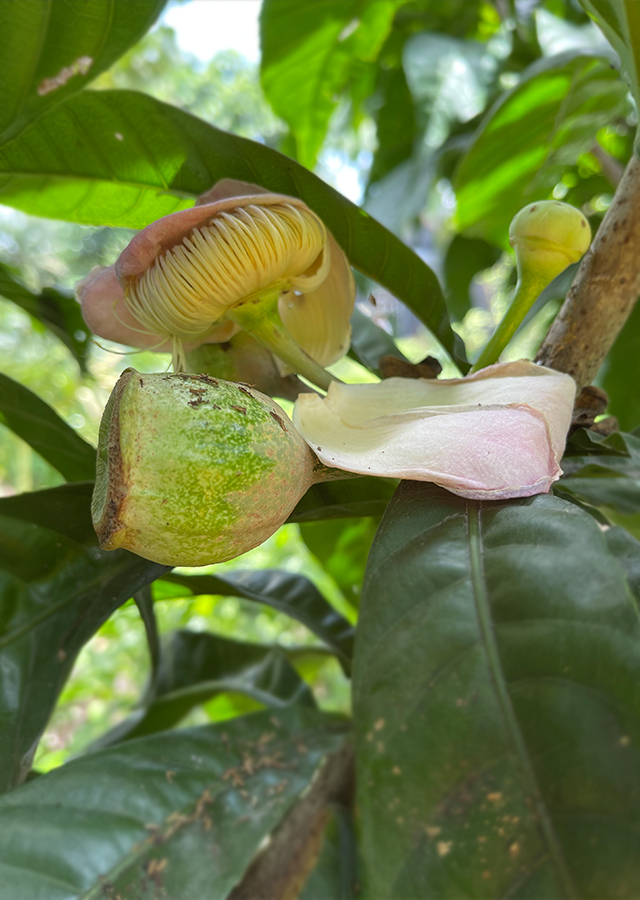
- Fruit round pear-shaped, on the trunk (cauliflorous). Inside the hard green shell are several large seeds about 4 cm in diameter. The flesh is yellowish-orange. Fruit globose or round oval 3-9 x 4-100 cm, the opercular part concave below the fruit surface and diameter less than 1/2 the fruit diameter. Calyx forms a raised circular rim, round, exocarp yellow when mature, and mesocarp orange.
- Seeds usually angular in cross-section 12-35 x 11-22 mm, seed coat turns brown when ripe, aril less developed, yellow and the funicle tapering.
Cultivation
- Propagation generatively by seed and vegetatively through cuttings.
- Seeds of this species are dispersed by many mammals, including white-faced monkeys, red-tailed squirrels, agoutis, and possibly pacas, collared peccaries, and spiny rats.
Chemical Content
Carotenoid, fatty acid.
Benefits
The Kuna Indians use a decoction of the cooked bark as a remedy to relieve body pain.
Simplisia
- Prepare membrillo leaves, wash clean with running water then drain.
- Dry under sunlight or with an oven at 40 °C until moisture content reaches 10%.
- Blend into powder.
- Store in a clean, airtight container.
Local Names
No information found. Further research needed.
Traditional Recipes
The following recipes reflect traditional knowledge passed down through generations, not a substitute for professional medical diagnosis or advice. Consult a healthcare provider before use.
1. Relieving body pain
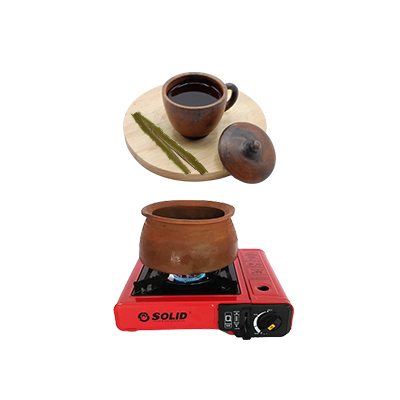
- Prepare membrillo bark and wash until clean.
- Boil until boiling.
- Strain, then drink while warm.
Reference Sources
- Royal Botanic Gardens. Plants of the World Online: Gustavia superba (Kunth) O.Berg. http://www.plantsoftheworldonline.org/taxon/urn:lsid:ipni.org:names:323304-2. 22-10-2021.
- Useful Tropical Plants. 2021. Gustavia superba. http://tropical.theferns.info/viewtropical.php?id=Gustavia+superba.
- Flora Fauna Web. 2021. Gustavia superba. https://www.nparks.gov.sg/florafaunaweb/flora/2/9/2947
- The New York Botanical Garden. 2021. Gustavia superba (Kunth) O.Berg. http://sweetgum.nybg.org/science/projects/lp/taxon-details/?irn=133632. 22-10-2021.
- Mas Eko. Planter and Forester. 2020. Gustavia superba (Kunth) O. Berg, Tanaman Berbunga Indah Berwarna Pink yang Berukuran Besar. https://www.planterandforester.com/2020/10/gustavia-superba-kunth-o-berg-tanaman.html