Hemerocallis fulva (L.) L.
Summary
Hemerocallis fulva or daylily is a flowering plant native to East Asia, especially China, that has been widely cultivated in temperate and subtropical regions as an ornamental thanks to its striking flower color. Besides being used as food—its flowers and young shoots are popularly consumed in parts of East Asia—its rhizome has a long history of use in traditional medicine, including for cancer treatment, though leaves in large quantities are known to be hallucinogenic.
Agroecology
Daylily is generally found growing in forests, thickets, grasslands, riverbanks, floodplains, ditches, forest edges, cemeteries, forest borders, areas along railway tracks, and roadsides, at elevations of 300-2,500 m asl. This species is hardy to temperatures around -20°C. Succeeds in growing in most soils, including dry conditions, but prefers moist, nutrient-rich soil, with a soil acidity (pH) between 6 and 7, and grows well in heavy clay soil. This species prefers a sunny position, but can tolerate partial shade.
Morphology
- Roots a fleshy main root with a swollen tuberous part near its tip, bearing a rhizome. Fibrous roots grow and form a dense system.
- Stem smooth, round, leafless, and branching at the top.
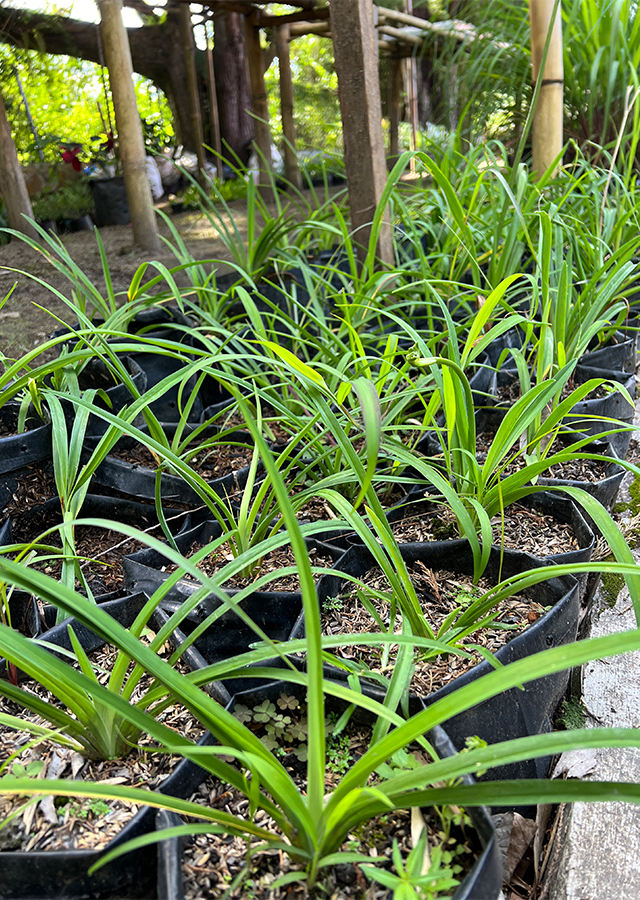
- Leaves basal, bright green, long, linear and sword-shaped, about 50-90 cm long and 1-2.8 cm wide, arching to the ground, arranged in pairs and growing only at the base of the plant, leaf surface hairless, smooth and slightly folded, with a longitudinal midrib on the back of the leaf.
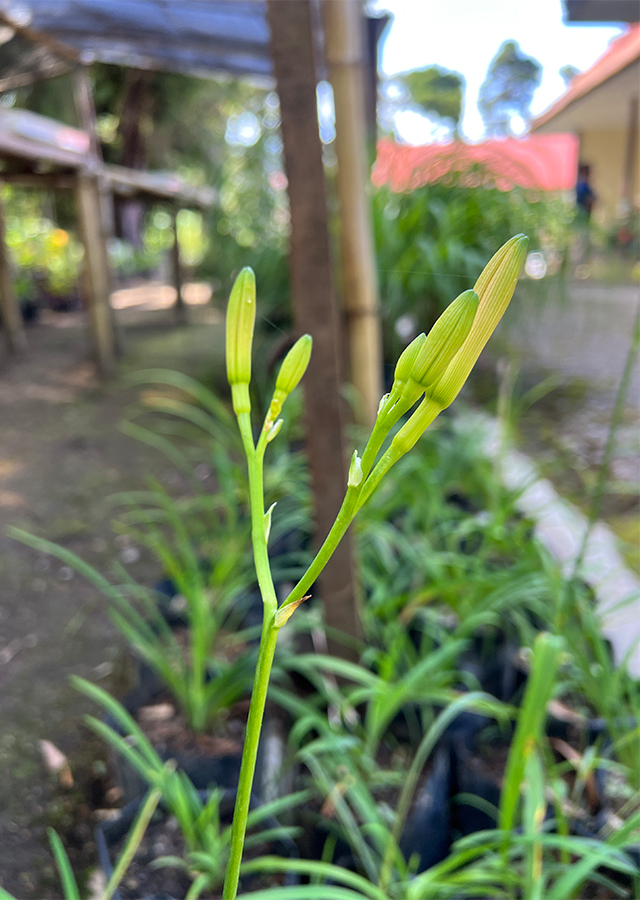
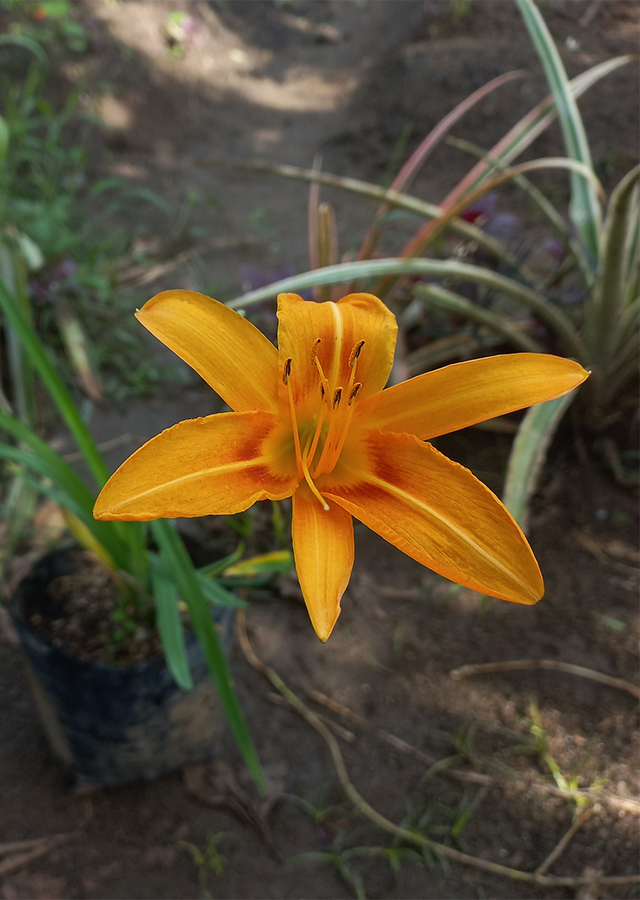
- Flowers large, ± 15 cm in size, trumpet or funnel-shaped. Has 6 tepals (3 petals and 3 similarly shaped sepals), united at the base, but spreading outward and backward toward the tip, the 3 inner tepals somewhat wider than the 3 outer tepals, tepals oblong shaped, smooth and thick, orange, brownish yellow, blooming without spots with a midline that lasts for one day, the edge of each tepal rolled. Flower throat yellow, surrounded by a red band, while the rest of the flower is orange. Flower stalk leafless. Stamens 6, pistil cylindrical. Flower buds green to greenish orange, oblong. Inflorescence is a terminal cluster of long-stalked flowers (cyme) atop a scape. The cluster can produce as many as 10 to 20 flowers, but the flowers in the cluster open one by one, each lasting only one day.
- Fruit an ellipsoid, 3-valved capsule, about 2-2.5 cm long and 1.2-1.5 cm wide, splitting open when ripe to release seeds.
- Seeds few, black.
Cultivation
- Plant propagation through seed, rhizome, and clump division.
- Seeds should be stored at 15-20°C. They usually take two to seven weeks to germinate and plants should be planted with a spacing of about 40 cm.
Chemical Content
Hydroxyglutamic acid, chrysophanol, colchicine, rhein, anthraquinone, 9 glycosides (sweroside, laganin, picraquassioside C, puerarin, 3'-methoxypuerarin, 7-hydroxylnaphthalide-O-beta-D-glucopyranoside, orcinol-3-O-beta-glucopyranoside, HN saponin F, hederagenin-3-O-beta-D-glucopyranosyl-(1-3)-alpha-L-arabinopyranoside-28-O-beta-D-glucopyranosyl ester).
Benefits
Reduces fever, treats jaundice, constipation, pneumonia, purifies the blood, a mild laxative, a sedative, counters arsenic poisoning, treats cancer, hemorrhoids, lung inflammation, colds and coughs in infants and children, cough, swelling, irregular or abnormal menstruation, vaginal discharge, treats edema (swelling due to fluid retention), treats bleeding from the sensory organs or subcutaneous tissue, treats blood in the stool. Is anodyne, antimicrobial, diuretic, antiemetic, antitumor, antispasmodic, tuberculostatic, depurative, anthelmintic against parasitic worms that cause filariasis.
Simplisia
- Prepare daylily rhizome, wash clean with running water.
- Cut into pieces to make it easier to dry.
- Dry under the sun or with an oven at 40°C until the moisture content reaches 10%.
- Grind using a blender until it becomes powder.
- Store in a clean, airtight container.
Local Names
Turuta (Maluku).
Traditional Recipes
The following recipes reflect traditional knowledge passed down through generations, not a substitute for professional medical diagnosis or advice. Consult a healthcare provider before use.
1. Cancer
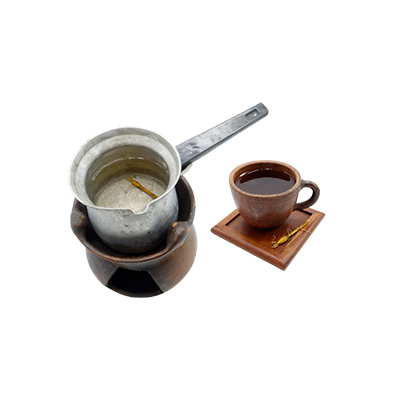
- Take daylily rhizome and wash until clean.
- Boil the rhizome until it boils.
- Let it cool to warm/cold, strain then drink.
Reference Sources
- Royal Botanic Gardens. Plants of the World Online: Hemerocallis fulva (L.) L. https://powo.science.kew.org/taxon/urn:lsid:ipni.org:names:536335-1. 17-04-2022.
- Temperate Plants Database, Ken Fern. 2021. Hemerocallis fulva. https://temperate.theferns.info/plant/Hemerocallis+fulva. 17-04-2022.
- NC State Extension. Hemerocallis fulva. https://plants.ces.ncsu.edu/plants/hemerocallis-fulva/. 17-04-2022.
- Healthbenefitstimes. 2021. Facts about Orange Daylily. https://www.healthbenefitstimes.com/orange-daylily/. 17-04-2022.
- Zhong-Duo L Yang, Tao Li, Yuan-Chao Li. 2008. Chemical constituents in root of Hemerocallis fulva. China Journal of Chinese Materia Medica, 33(3): 269-272. https://www.researchgate.net/publication/5320038_Chemical_constituents_in_root_of_Hemerocallis_fulva. 17-04-2022.
- Natural Products Research Institute Seoul National University. 1998. Medicinal Plants in the Republic of Korea. Information on 150 commonly used medicinal plants. WHO Regional Publications Western Pacific Series No. 21.