Huperzia phlegmaria (L.) Rothm.
Summary
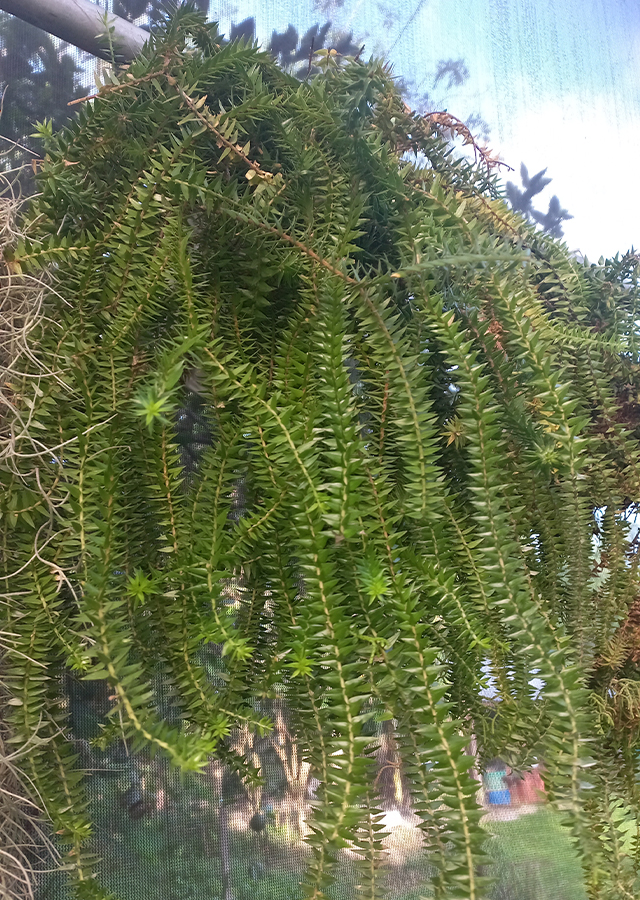
Taratinggi (Huperzia phlegmaria) is an epiphytic herb up to 2 meters long from the Lycopodiaceae family distributed from Africa to Japan and Australia. In Indonesia and the Philippines, this plant is cultivated as an ornamental hanging plant. In Southeast Asia, taratinggi is traditionally used for washing hair in the belief it can stimulate its growth.
Agroecology
H. phlegmaria lives in relatively cool, partially shaded locations on mossy tree trunks or rocks, preferring abundant moisture but tolerating drought, in forests usually at elevations of 800-2,300 m asl.
Morphology
- Roots has a true rooting system.
- Stem pendulous, (15-)40-80(-190) cm × 1-2.5(-5) mm, branching 1-4 times into two equal branches at irregular intervals, brown, dark and glossy at the oldest part, paler near the growing point, rough.
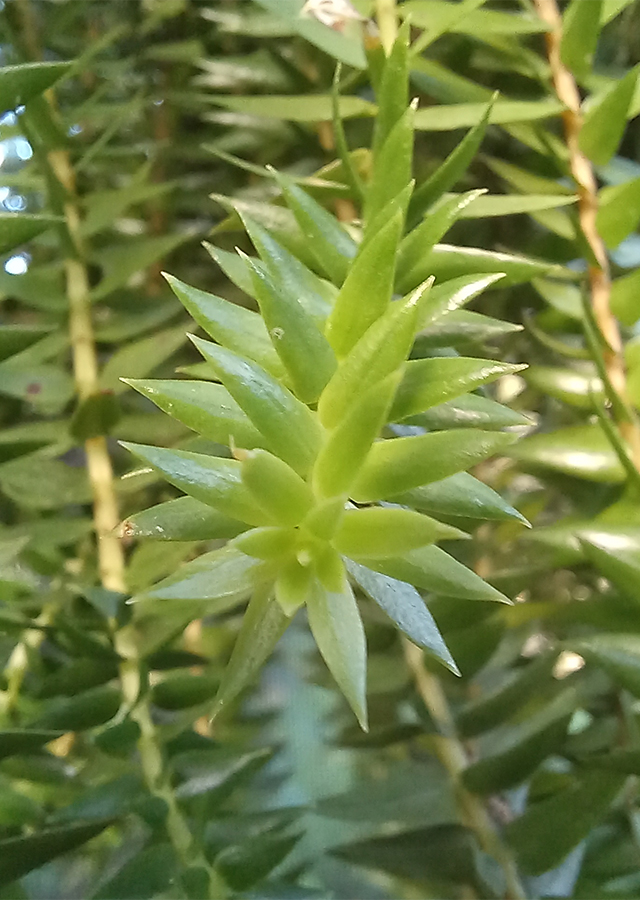
- Leaves stiff, slightly bent, spirally arranged in 4-8 rows, spreading, subpetiolate. Lamina triangular to ovate-lanceolate, 4-15(-30) mm × 2.5-7 mm, base rounded-truncate or heart-shaped, margin entire, yellowish green, coriaceous, midrib prominent.
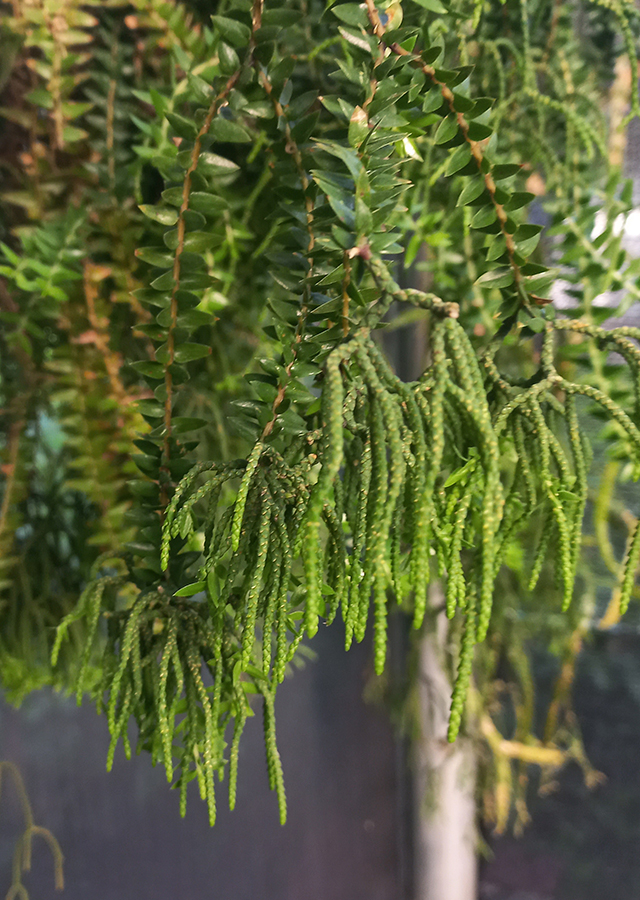
- Strobili terminal, cylindrical, (1.5-) 4-15 cm × 1-2 mm, sharply demarcated from the vegetative part of the stem, repeatedly branching dichotomously. Sporophylls in four rows, densely to distantly packed, pressed, ovate-subdeltoid, about 1.2 mm × 1.5 mm, entire, green, turning yellowish when mature, only partially covering the sporangium. Sporangium located at the base of the sporophyll, reniform shaped, deeply grooved, sessile.
- Spores triangular shaped, trilete, 35 μm in diameter, bright yellow, granular.
Cultivation
- Propagation is done by stem cuttings, layering, bulbils (which fall to the ground when mature and sprout to form new plants), and spores.
- For stem cuttings, remove the apical section (5-15 cm) from the stock plant, place it horizontally on a well-drained soilless medium, and cover the cut end with moist medium; this can be done inside a terrarium to maintain humidity. The shoot tip pointing upward is ideal for stem cuttings. Simple layering of a rooted plant's stem is said to root more easily. New shoots will emerge from the cutting mix within 6-15 months, and can be potted up once reaching a height of 5 cm. Freshly potted plants should be left undisturbed to help establishment.
Chemical Content
Alkaloids lycodoline, lucidioline, lycopodine, the flavonoid apigenin, triterpenoid (21β-hydroxy-serrat-14-en-3α-ol), lycophlegmariol B, and lycophlegmariol D.
Benefits
Use of H. phlegmaria to stimulate hair growth, treat urinary tract disorders, cancer, wounds, kidney pain, and is thought to be able to cure cancer.
Simplisia
- Prepare the taratinggi plant, wash clean with running water then drain.
- Sun-dry directly for several days or use an oven at 40°C until the moisture content reaches 10%.
- Store the simplicia in a clean, airtight plastic or container.
Local Names
Kumpai rante, Kumpai pure (Sunda), Kumpai rantai.
Traditional Recipes
The following recipes reflect traditional knowledge passed down through generations, not a substitute for professional medical diagnosis or advice. Consult a healthcare provider before use.
1. Wounds
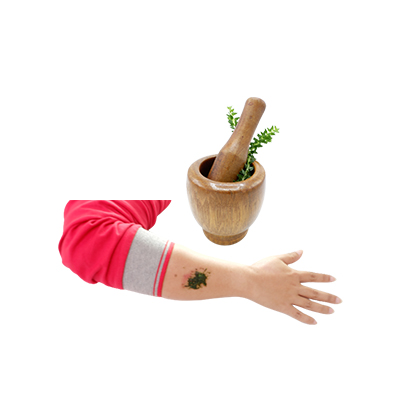
- Take an adequate amount of fresh taratinggi leaves and wash until clean.
- Grind until it becomes a paste.
- Apply the taratinggi leaf paste to the wound.

2. Stimulates hair growth
- Take an adequate amount of fresh taratinggi leaves and wash until clean.
- Soak the fresh leaves in an adequate amount of water and let sit for a while.
- Use the infusion as a tonic to nourish the hair.
Reference Sources
- Royal Botanic Gardens. 2021. Plants of the World Online: Huperzia phlegmaria (L.) Rothm.. http://www.plantsoftheworldonline.org/taxon/urn:lsid:ipni.org:names:169764-3. 23-11-2021.
- PROSEA. 2016. Huperzia phlegmaria. https://uses.plantnet-project.org/en/Huperzia_phlegmaria_(PROSEA). 23-11-2021.
- Muhamad Nikmatullah, Elga Renjana, Muhamad Muhaimin, Mulyati Rahayu. 2020. POTENSI TUMBUHAN PAKU (FERNS & LYCOPHYTES) YANG DIKOLEKSI DI KEBUN RAYA CIBODAS SEBAGAI OBAT. AL-KAUNIYAH: Jurnal Biologi, 13(2), 2020, P-ISSN: 1978-3736, E-ISSN: 2502-6720. http://journal.uinjkt.ac.id/index.php/kauniyah. 23-11-2021.