Hypericum perforatum L.
Summary
Hypericum perforatum or St. John's Wort is native to Europe and spread to North Africa and West Asia, with a long history as an herbal remedy, though it lost popularity in the nineteenth century before being revisited thanks to modern research. In clinical trials, about 67% of patients with mild to moderate depression showed improvement after consuming it, and various in vitro and in vivo studies have also confirmed the antioxidant, antiviral, and wound-healing properties of this plant—though its use requires caution, especially for pregnant women.
Agroecology
Easy to grow in reasonably good soil with good drainage but moisture-retentive. Succeeds in dry soil. The plant grows well in sun or semi-shade but flowers better when in a sunny position.
Morphology
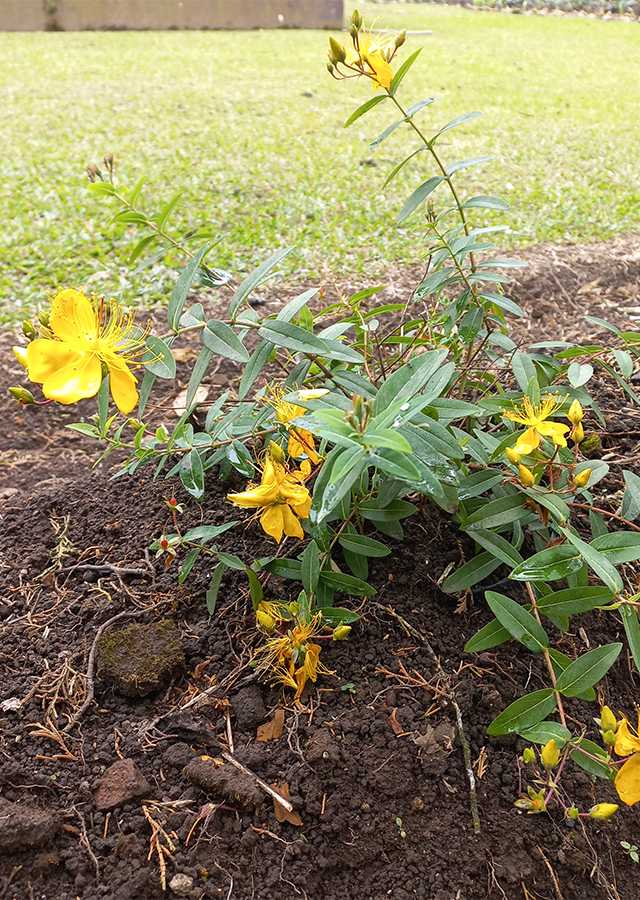
- Stem reddish, upright and branching at the top, and can grow up to 1 m (3 ft 3 in) tall. The stem is woody near the base and may appear fused from leaf scars. Branches usually cluster around a depressed base.
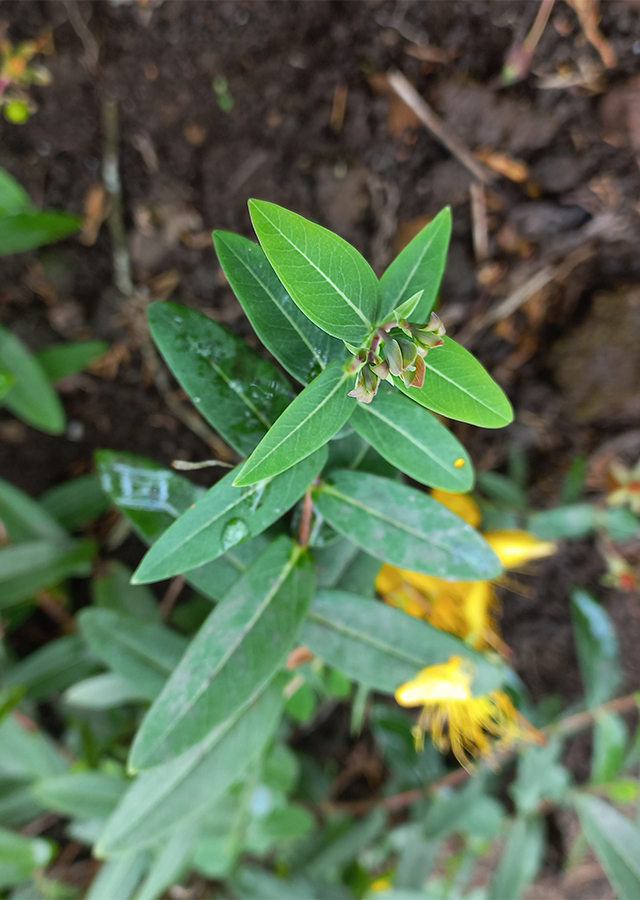
- Leaves opposite and stalkless, narrow and oblong shaped, 1-2 cm (0.39-0.79 in) long. Leaves borne on branches cover the shortened branches. The leaves are yellow-green, with scattered translucent glandular dots. The dots appear conspicuous when held up to light, giving the leaves a "perforated" appearance, which refers to the plant's Latin name.
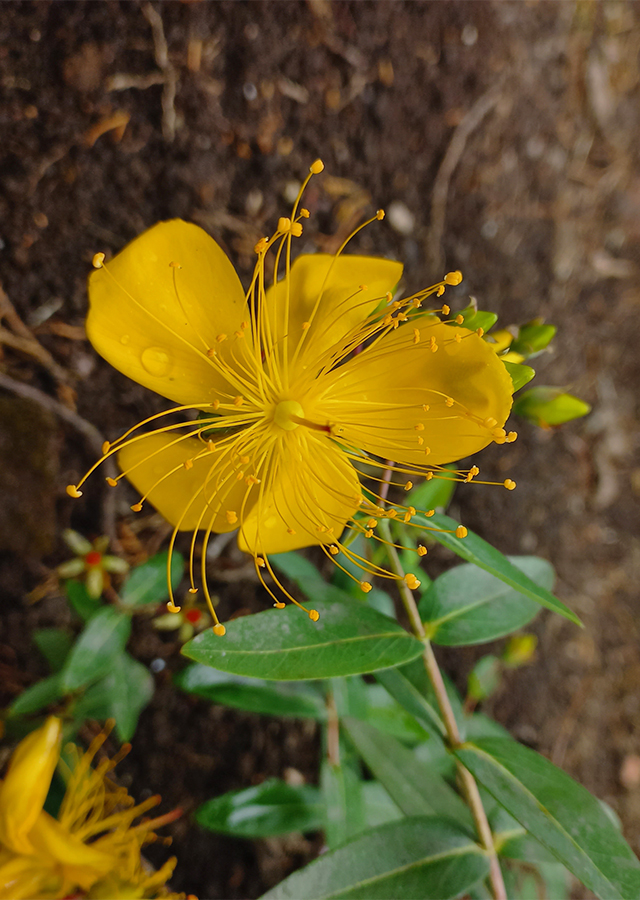
- Flowers up to 2.5 cm (0.98 in) in size, with five petals and sepals, and bright yellow with conspicuous black dots. The flowers appear in broad helicoid cymes at the tips of the upper branches, between late spring and early to mid-summer. The cymes are leafy and produce many flowers. Pointed sepals have black glandular dots. The numerous stamens are fused at the base into three bundles. Pollen grains are ellipsoidal in shape.
- Seeds black and glossy, rough, netted with rough grooves.
Cultivation
Propagation is generative using seed, sow seed in a greenhouse as soon as ripe. Usually germinates within 1-3 months at 10°C. Plant seedlings into individual pots when large enough, plant out into permanent positions. For vegetative propagation, use clump division. This method is said to be very easy; larger clumps can be replanted directly into their permanent position, though it is best to plant smaller clumps and grow them in a cold frame until they are well rooted.
Chemical Content
Phloroglucinols (hyperforin, adhyperforin), naphthodianthrones (hypericin, pseudohypericin), flavonoids (rutin, quercetin, quercitrin, isoquercitrin, hyperoside, and amentoflavone), phenolic acids, pectin, choline, sitosterol, and a small amount of essential oil.
Benefits
Used to treat various disorders, including lung complaints, bladder problems, diarrhea, stomach and gallbladder disorders, inflammation of the respiratory and urogenital systems, migraine, diabetes, and nervous depression. It is also very effective in treating urinary incontinence in children. Externally, it is used in poultices to remove abscesses/swelling tumors, caked breasts, bruises, etc. Use the plant with care and do not prescribe it for patients with chronic depression. The plant was used to induce abortion by some Native North Americans, so it should preferably not be used by pregnant women; treatment of external boils, burns, wounds (especially those with severed nerve tissue), bruises, cramps, boils, swelling, rheumatism, treatment of sunburned skin and as a cosmetic preparation for the skin, treatment of AIDS, bites, insect stings, treatment of injured areas rich in nerves such as the spine, eyes, fingers, etc. Has analgesic, antiseptic, antispasmodic, aromatic, astringent, cholagogue, digestive, diuretic, expectorant, calming, solvent, sedative, stimulant, vermifuge, and vulnerary activity.
Simplisia
- Prepare an adequate amount of fresh St. John's Wort flowers, wash clean with running water then drain.
- Dry under direct sunlight for several days or with an oven at 40°C until the moisture content reaches 10%.
- Store the simplicia in plastic or a clean, airtight container.
Local Names
Informasi tidak ditemukan. Butuh penelusuran lebih lanjut.
Traditional Recipes
The following recipes reflect traditional knowledge passed down through generations, not a substitute for professional medical diagnosis or advice. Consult a healthcare provider before use.
1. Bruises
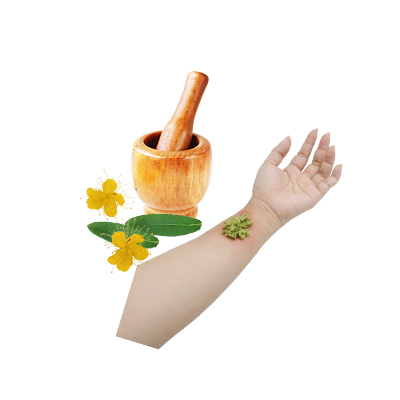
- Prepare an adequate amount of St. John's Wort flowers and leaves and wash until clean.
- Grind until it becomes a paste.
- Apply the paste as a poultice on the bruised area.
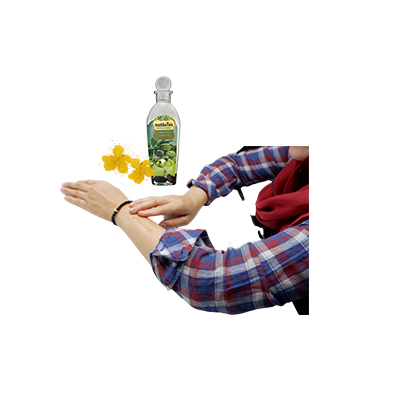
2. Rheumatism
- Prepare an adequate amount of fresh St. John's Wort flowers and wash until clean.
- Soak in olive oil and wait for a while.
- Apply to the rheumatism.
Reference Sources
- Royal Botanic Gardens. Plants of the World Online: Hypericum perforatum L. https://powo.science.kew.org/taxon/urn:lsid:ipni.org:names:433719-1. 27-05-2022.
- Useful Temperate Plants. 2022. Hypericum perforatum. 27-05-2022. http://temperate.theferns.info/plant/Hypericum+perforatum.
- Nebojša Kladar, Jasminka MrÄ‘anović, Goran AnaÄkov, Slavica Šolajić, Neda Gavarić, Branislava SrÄ‘enović, dan Biljana Božin. 2017. Hypericum perforatum: Synthesis of Active Principles during Flowering and Fruitification—Novel Aspects of Biological Potential. Journal hindawi. https://doi.org/10.1155/2017/2865610.
- Portillo Jerman. Hypericum perforatum (Hyperic).https://www.jardineriaon.com/id/hypericum-perforatum.html.