Ipomoea quamoclit L.
Summary
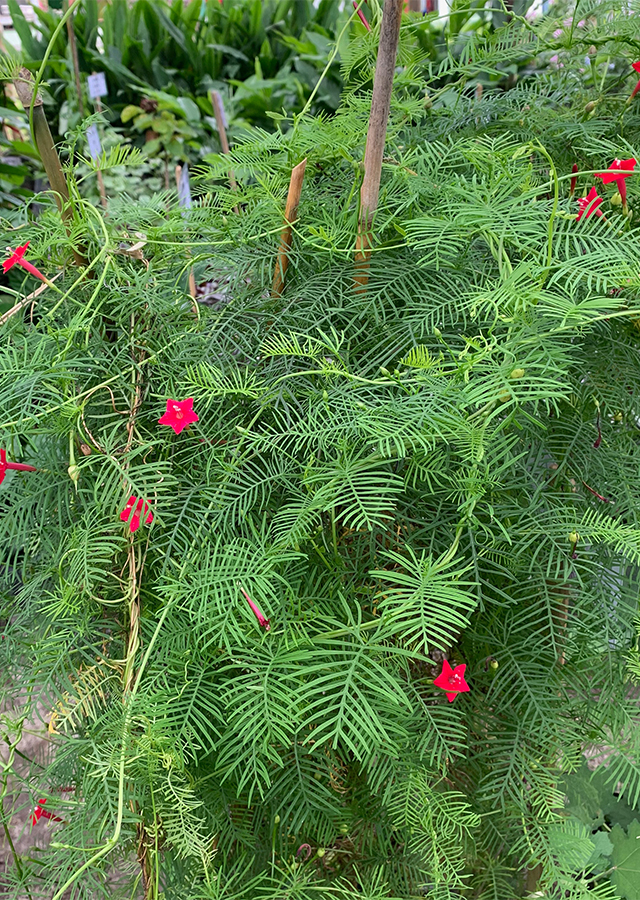
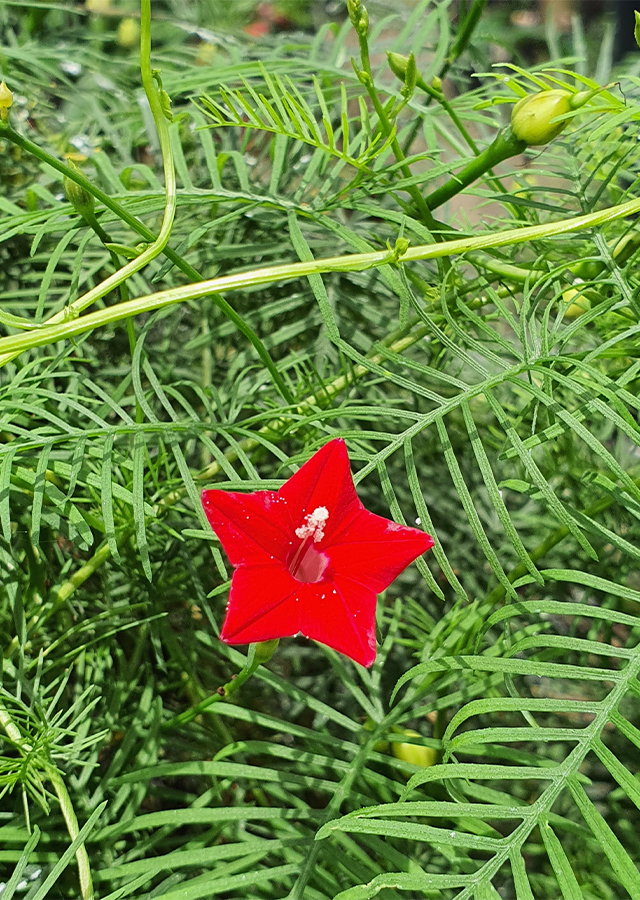
Rincik bumi, or cypress vine (Ipomoea quamoclit), is an annual or biennial climbing plant up to 6 meters tall of the Convolvulaceae family, native to tropical America and now naturalized across nearly every continent. Its finely lace-like foliage and bright flowers make it a popular ornamental for trellises and garden fences. Traditionally, rincik bumi is also believed to address boils, acne, and hemorrhoids.
Agroecology
This plant grows wild in abandoned land or is grown as an ornamental climbing on fences. Grows well in humid regions (tropical rainforest climate), sandy or loamy soil with a pH ranging from 6.1-7.8. Favors open areas, at elevations up to 1,800 m above sea level.
Morphology
- Stem moist, climbing, green.
- Leaves deeply divided oblong shape, 4-7 cm long.
- Flowers emerge from the leaf axils on long stalks, red
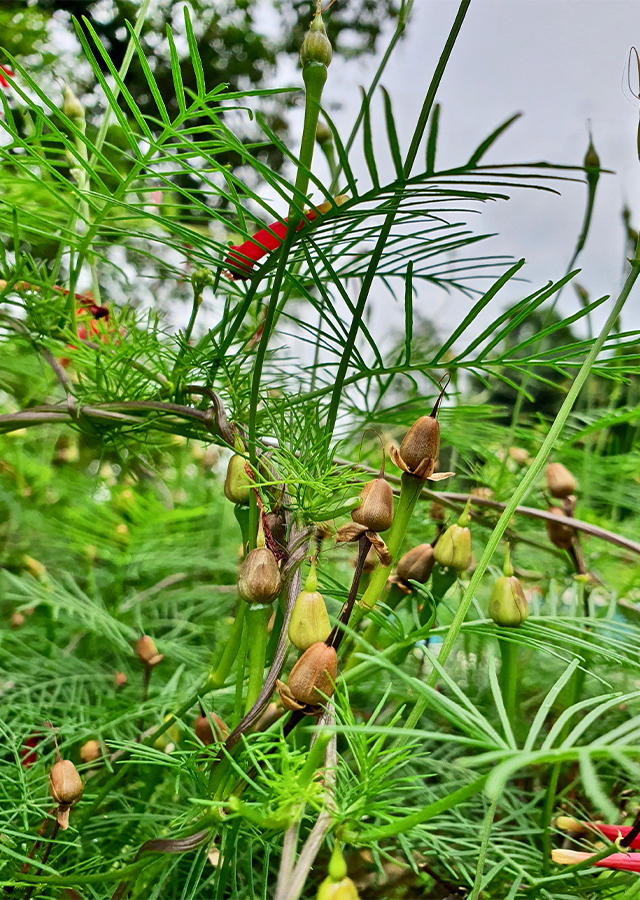
- Fruit ovate with a pointed tip, green when young, brown when ripe
Cultivation
Propagated generatively (using seed). Dispersed by rain, water flow, gravity, and human activity.
Chemical Content
Lauric acid, palmitic acid, stearic acid, oleic acid, linoleic acid, cyanogenic glycoside, resin glycosides, jalapin, quamoclins I-IV, 7-O-β-D-glucopyranosyl-dihydroquercetin-3-O-α-D-glucopyranoside.
Benefits
Addresses boils, swelling, acne, and skin infections; addresses hemorrhoid bleeding; reduces fever; addresses dysentery.
Simplisia
Not yet available
Local Names
Sangga langit, Songgo langit (Malay), Bunga tali (Sunda) and Katilan.
Traditional Recipes
The following recipes reflect traditional knowledge passed down through generations, not a substitute for professional medical diagnosis or advice. Consult a healthcare provider before use.
1. Swelling
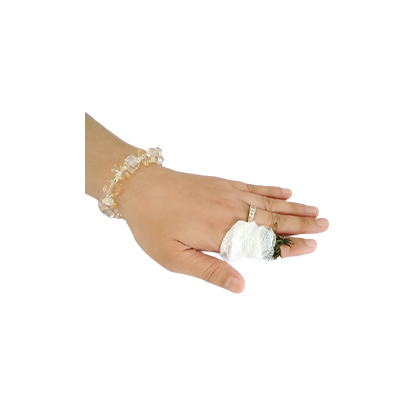
- Prepare 15 g of rincik bumi leaves. Wash thoroughly, then pound the leaves until fine.
- Apply the mixture to the swollen area, then wrap with a clean cloth.
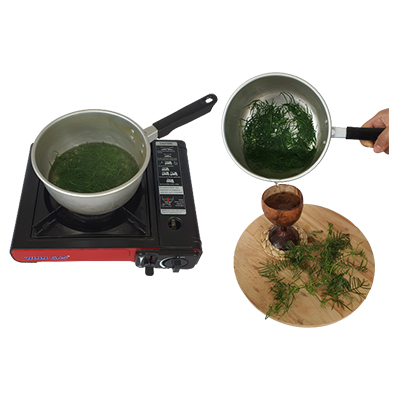
2. Hemorrhoid Bleeding
- Internal use: wash 6-9 g of rincik bumi leaves thoroughly.
- Boil in a sufficient amount of water until boiling. Drink the decoction.
- External use: mash rincik bumi leaves, then squeeze and collect the liquid. Use the liquid to wash the affected area.
Reference Sources
- National Parks. Flora & Fauna Web. Ipomoea quamoclit L. 'White Feather'. https://www.nparks.gov.sg/florafaunaweb/flora/3/9/3999 20-01-2021.
- Badan Penelitian dan Pengembangan Kesehatan. 1997. Inventaris Tanaman Obat Indonesia (IV) (Bengkak). Departmen Kesehatan Badan Penelitian dan Pengembangan Kesehatan.
- Widyaningrum Herlina. 2019. Kitab Tanaman Obat Nusantara (Pendarahan pada wasir ). Media Pressindo, Jakarta.
- Paul Dipak, Sinha Sankar Narayan . 2016. An update on biological activities of medicinal plant Ipomoea quamoclit L. Research article, ISSN (E): 2349–1183. ISSN (P): 2349–9265. 3(1): 186–190
- JituNews.com. Rincik Bumi, Si Penuntas Hemorrhoid. https://www.jitunews.com/read/16631/rincik-bumi-si-penuntas-hemorrhoid 12-06-2020