Jatropha podagrica Hook.
Summary
Jarak bali (Jatropha podagrica) is a succulent shrub 0.5-1 meter tall from the Euphorbiaceae family that originates from Central America, with a unique bottle-like lower stem that makes it a favorite as a potted ornamental and bonsai. Jarak bali is traditionally believed to be an aphrodisiac tonic and is also used to heal wounds, fever, and snake bites.
Agroecology
The jarak bali plant grows in an optimal environment, with elevations of 0-1,000 m asl, temperatures ranging between 18-30 °C, average rainfall of 300-1,200 mm per year, well-drained, non-waterlogged, and soil pH of 5.0-6.5. Prefers areas with full sun and partial shade, and prefers not overly wet conditions.
Morphology
- Lower stem swollen, protruding, gray-skinned, with a large bottle-like caudex.
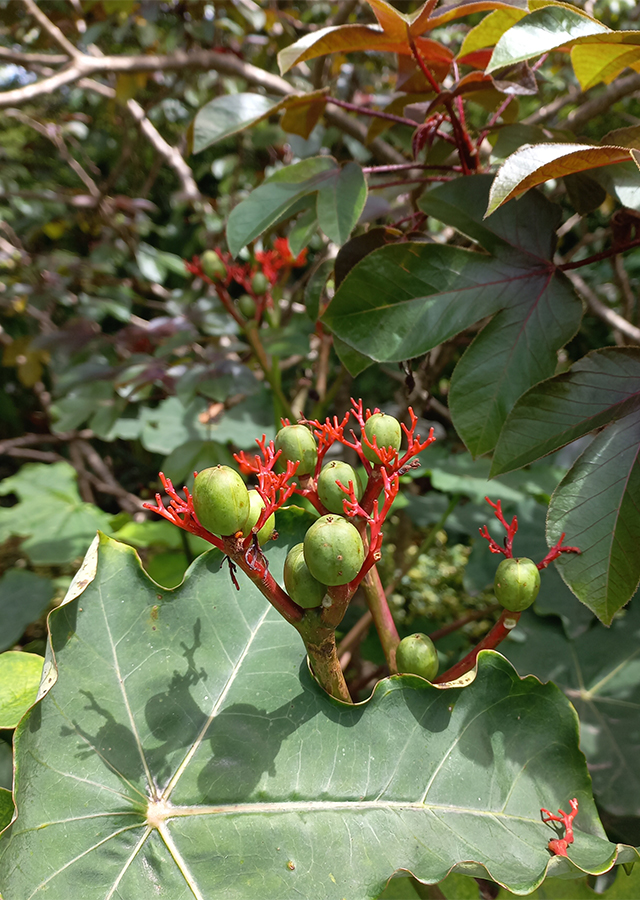
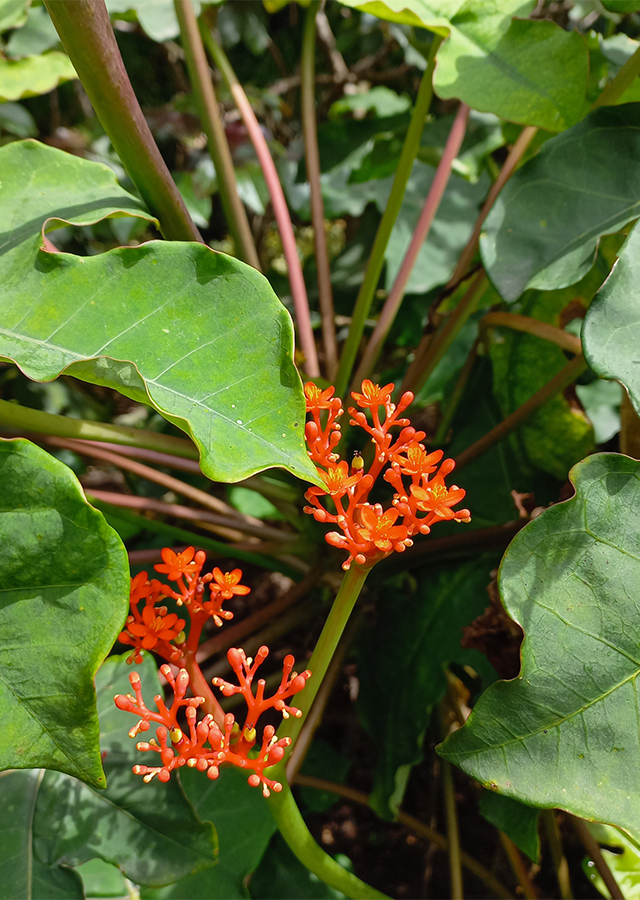
- Leaves petiole 8-10 cm long. Peltate leaves, glossy green on the upper surface, gray-green on the lower surface, smooth, wavy, or shallowly 3- to 5-lobed margin, 6 to 8 palmate veins, up to 30 cm in diameter, with a sturdy stalk attached to the underside of the leaf.
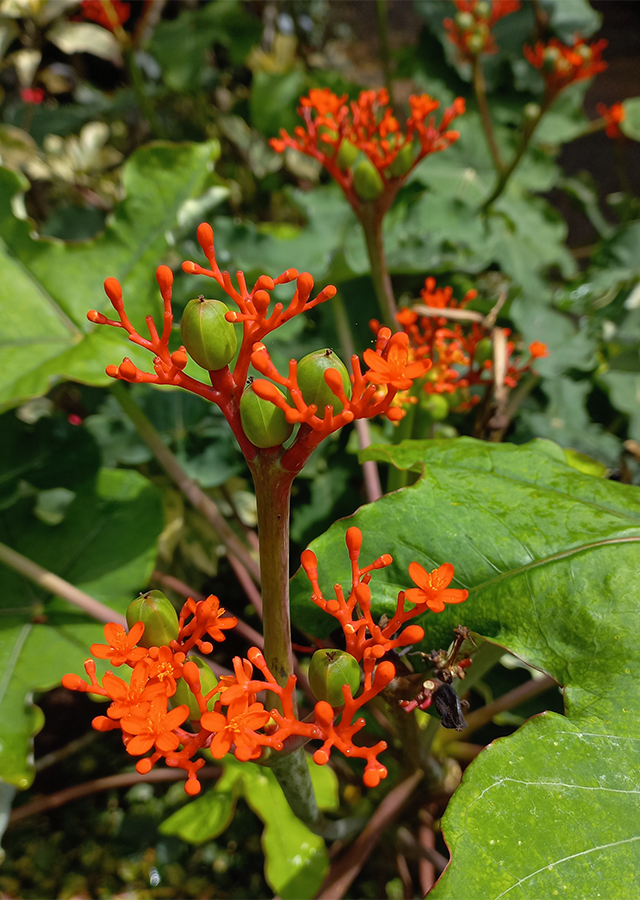
- Flowers small, bright red or orange-red, and clustered like a bouquet at the tip of a long red stalk.
- Fruit a capsule, ellipsoidal, about 1.5 cm, with 3 longitudinal grooves, initially green and fleshy, ripening to dark brown and splitting explosively to produce 2 to 3 black seeds, scattering them 3-4 m away.
- Seeds smooth and glossy brown, about 1.5-2 cm long.
Cultivation
Nursery propagation of the jarak bali plant can be done using plants derived from branch or stem cuttings or seeds. Seedling supply is even done using tissue culture techniques. Nurseries usually widely use seeds carried out using polybag media, namely by sowing plants with polybag media that has been prepared with soil media mixed with fertilizer, and carrying out maintenance like other plants until it grows well.
Chemical Content
Alkaloids, tannins, flavonoids, saponins, coumarins, steroids, phenols, phenolic acids, glycoflavones, proanthocyanidins, japodic acid, erythrinasinate, fraxidin, triterpenes, fraxidin, fraxetin, scoparone, 3-acetylaleuritolic acid, sitosterol and sitosterone, oleum infernale or oleum ricini majoris, toxalbumin (curcin).
Benefits
As a tonic, aphrodisiac, and erection aid (viagra) for men, heals wounds, relieves pain, reduces swelling, detoxifies snake bites, treats infections, treats jaundice, gonorrhea, as a laxative, worm remedy, abortifacient, gout remedy, paralysis, skin diseases, rheumatism, pruritus, parasitic skin diseases, hemostatic agent, antipyretic, diuretic, choleretic, rheumatism, hemorrhoids, worms, tooth and mouth pain, menstrual disorders, glossitis, postpartum disorders, boils.
Local Names
Jarak batang gajah, Jarak botol.
Traditional Recipes
The following recipes reflect traditional knowledge passed down through generations, not a substitute for professional medical diagnosis or advice. Consult a healthcare provider before use.
1. Hemorrhoids
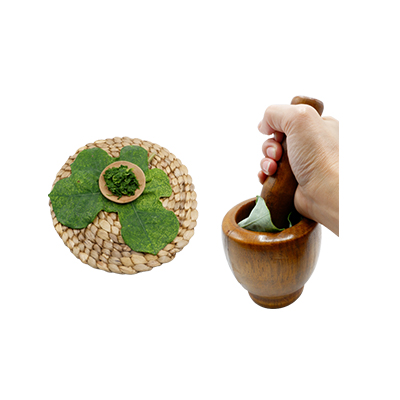
- Take jarak bali leaves as needed and wash until clean.
- Mash the leaves into a paste.
- Apply the paste to the hemorrhoids.
2. Mouthwash for tooth and mouth disease
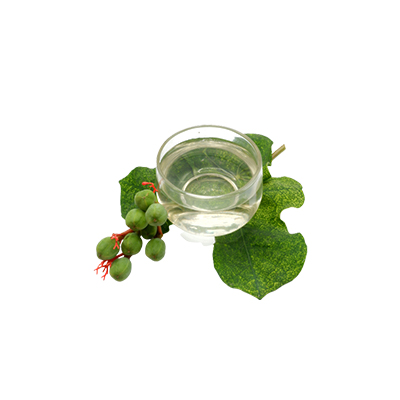
- Take jarak bali fruit, leaves, and flowers as needed and wash until clean.
- Boil all ingredients until boiling.
- Let stand until warm/cool.
- Use as a mouthwash for tooth and mouth disease.
Reference Sources
- Stuartxchange. 2019. Philippine Medicinal Plants: Buddha belly plant. http://www.stuartxchange.org/BuddhaBellyPlant. 28-09-2021.
- Royal Botanic Gardens. 2017. Plants of the World Online: Jatropha podagrica Hook. http://plantsoftheworldonline.org/taxon/urn:lsid:ipni.org:names:350415-1. 28-09-2021.
- Flora Fauna Web. 2019. Jatropha podagrica Hook. https://www.nparks.gov.sg/florafaunaweb/flora/2/1/2154. 28-09-2021.