Johannesteijsmannia altifrons (Rchb.f. & Zoll.) H.E.Moore
Summary
Johannesteijsmannia altifrons or daun sang is a palm plant distributed in the forest regions of Malaysia, Thailand, and Sumatra, protected under Government Regulation No. 7 of 1999 in Indonesia. Its large, unique leaves are commonly used by residents near forests as wall and roof material for huts, while its seeds, grated into a powder, are believed to cure sore throat, cough, and asthma.
Agroecology
Johannesteijsmannia altifrons is generally found scattered or as pure stands terrestrially, in thickets in moist rainforests (both primary and secondary) on ridge tops and hillsides in well-drained soil, mostly above 300-500 m asl. This species is never found in regrowing secondary forest and rarely survives logging, but often suffers considerable damage from fallen trees, and scorches when exposed to direct sunlight. Johannesteijsmannia altifrons does best in warm, sheltered locations, prefers partial shade, and can grow indoors. This species requires well-drained soil, high humidity, and avoidance of excessive watering. Does not tolerate drought and full sun, especially in dry climates. Johannesteijsmannia altifrons can grow well in tropical and subtropical climates, but tolerates temperatures as low as -4°C (USDA Zones 9b to 11) and is fairly cold-hardy, especially when grown under shade, but for safe cultivation normal temperatures should not drop below 5°C. The root system is very sensitive to cold and must be protected if temperatures drop below freezing.
Morphology
- Trunk underground and creeping.
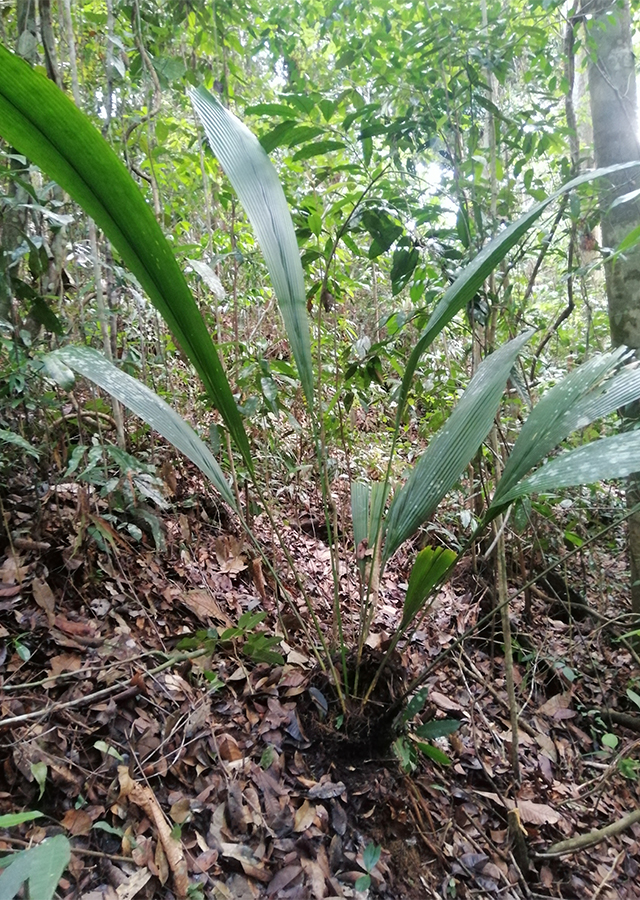
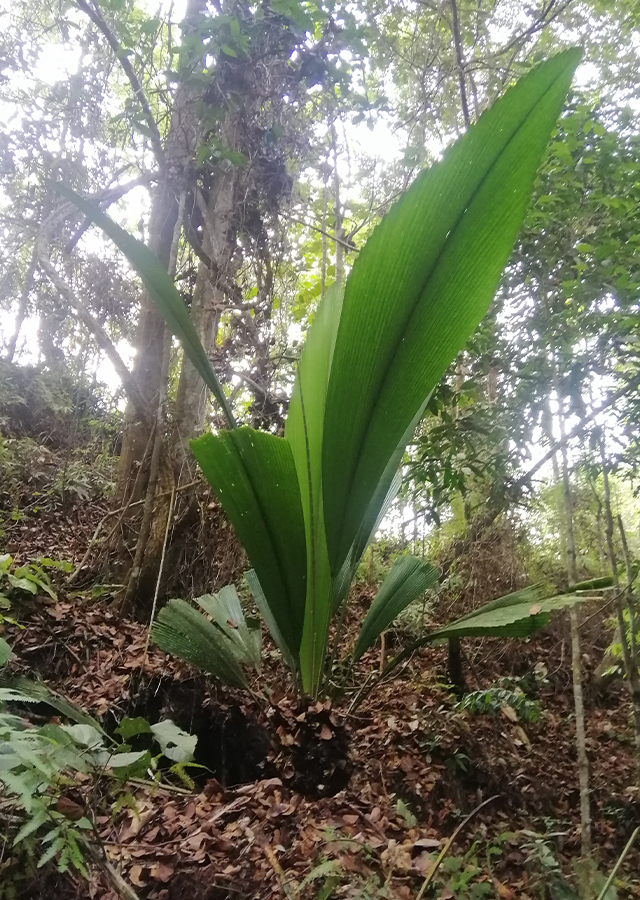
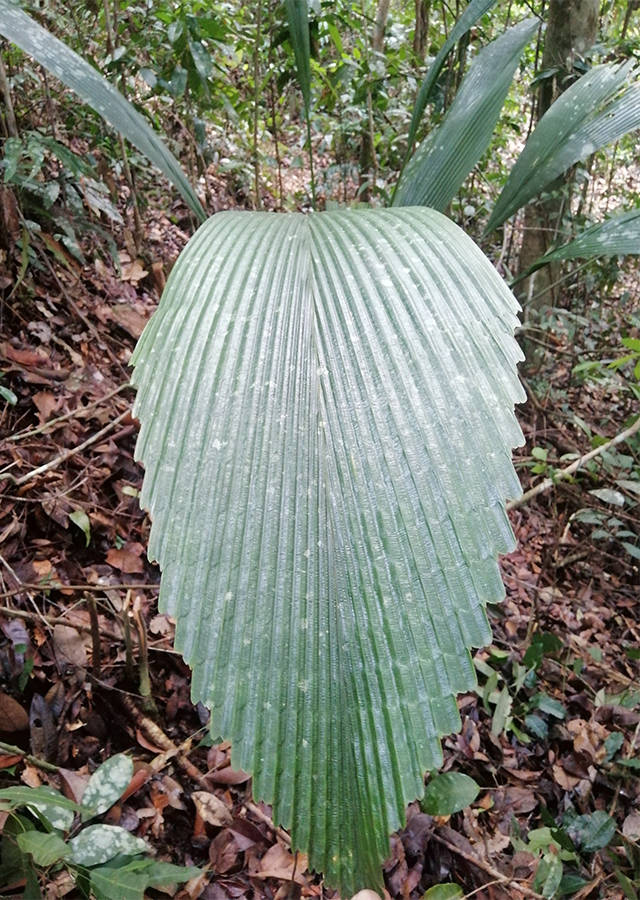
- Leaves large (up to 6 m long), wide, undivided, relatively strong, usually growing singly consisting of 20-30 leaves, upright, diamond-shaped, emerging directly from the ground, green, leaf margin toothed, strong texture, glossy surface, tapering at the tip and base of the leaf and widening at the middle. Slightly lobed on 2 upper margins and with prominent veins parallel to the 2 lower margins. The leaf sheath is characterized by reversed spines on both sides. The petiole is armed with short spines.
- Flowers hermaphroditic, having a fleshy, cream-white corolla, up to 4 cm long. Inflorescence small, panicle-shaped, located in the leaf axils, upright in form. Base sheath-shaped. Bracts 5-6, lanceolate.
- Fruit woody, round, with a rough surface, usually containing 1 seed (rarely 2 or 3 seeds). The fruit is covered with 60-80 brown corky protrusions, almost 1 cm tall.
Cultivation
Plant propagation through seed (generative) which germinates within about 3 months. Before sowing, soak the seed for 1 day in warm water, then sow in a light mix at 35°C during the day, 25°C at night.
Chemical Content
2-[(1'E)-3'-hydroxy-1'-methyl-1'-propen-1'-yl]-6-methoxy-7-[(2''-methylheptyl)oxy]-5-benzofurancarboxylic acid, β-sitosterol, γ-taraxasterol, and stigmasterol.
Benefits
Addresses respiratory disorders, wounds, reduces fever in children. Seeds are also grated into a powder and applied to the face, chest, or tongue to cure sore throat, cough, and asthma.
Local Names
Daun payung, Salo.
Traditional Recipes
The following recipes reflect traditional knowledge passed down through generations, not a substitute for professional medical diagnosis or advice. Consult a healthcare provider before use.
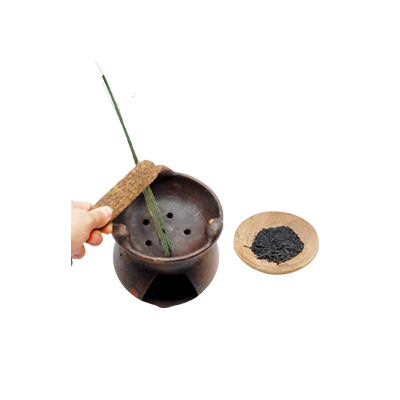
1. Addresses respiratory disorders
- Take an adequate amount of daun sang petiole.
- Burn until it becomes ash.
- Apply the petiole ash to the chest to address respiratory disorders.
Reference Sources
- Royal Botanic Gardens. Plants of the World Online: Johannesteijsmannia altifrons (Rchb.f. & Zoll.) H.E.Moore. https://powo.science.kew.org/taxon/urn:lsid:ipni.org:names:667632-1. 03-06-2022.
- KSDAE. Penemuan Salo (Johannestijsmania altifron) Di SPTN I TN.Bukit Tigapuluh. http://ksdae.menlhk.go.id/info/7059/penemuan-salo-(johannestijsmania-altifron)-di-sptn-i--tn.bukit-tigapuluh.html. 03-06-2022.
- Flora Fauna Web. 2021. Johannesteijsmannia altifrons. https://www.nparks.gov.sg/florafaunaweb/flora/5/0/5084. 03-06-2022.
- LLIFLE - Encyclopedia of living forms. 2022. Johannestijsmania altifron. http://www.llifle.com/Encyclopedia/PALMS_AND_CYCADS/Family/Arecaceae/32980/Johannesteijsmannia_altifrons. 03-06-2022.
- NOOR AZIIRAA SABRI, W.A. YAACOB, NUR SHAFIQA ABDULLAH. 2017. New Chemical Constituent from the Rhizomes of Johannesteijsmannia altifrons. Sains Malaysiana 46(8)(2017): 1285–1288. http://dx.doi.org/10.17576/jsm-2017-4608-14