Kalanchoe pinnata (Lam.) Pers.
Summary
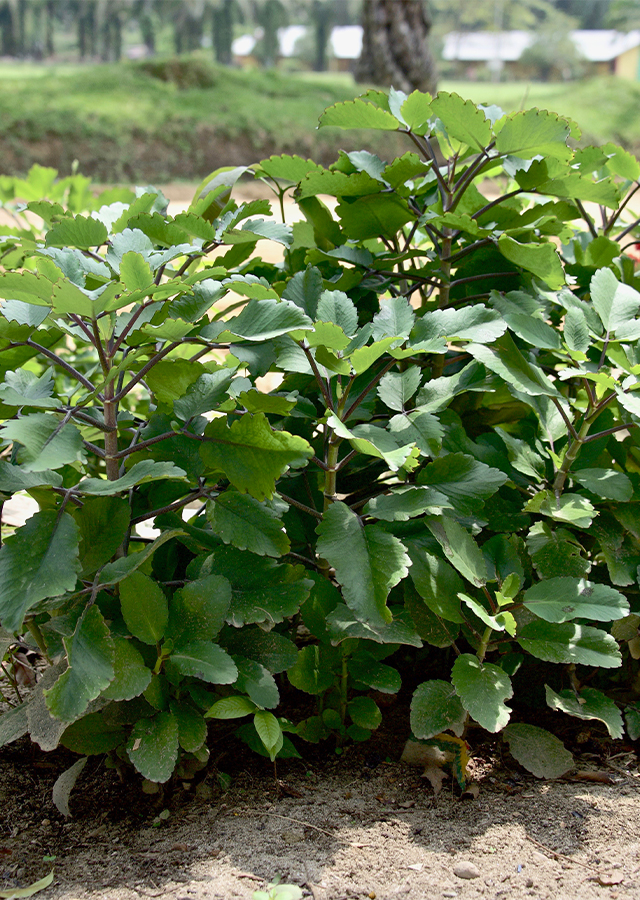
Cocor bebek (Kalanchoe pinnata) is an upright succulent 30-200 cm tall of the Crassulaceae family, originating from Madagascar and now distributed across both tropical and cooler climate regions. Its distinctive thick leaves can sprout new plantlets along their edges, making it an easily propagated ornamental plant, even used as a natural shampoo ingredient. Traditionally, cocor bebek is believed to relieve bruises, fever, and stomach pain.
Agroecology
Can grow wild on ravine edges, roadsides, and rocky ground in hot, dry areas. Grows from lowlands up to elevations of 1,000 m above sea level, with average rainfall of 1,000-2,000 mm/year and an annual temperature of 22.5°C. Prefers full sunlight as well as shaded locations.
Morphology
- Stem upright, soft, square-shaped and jointed.
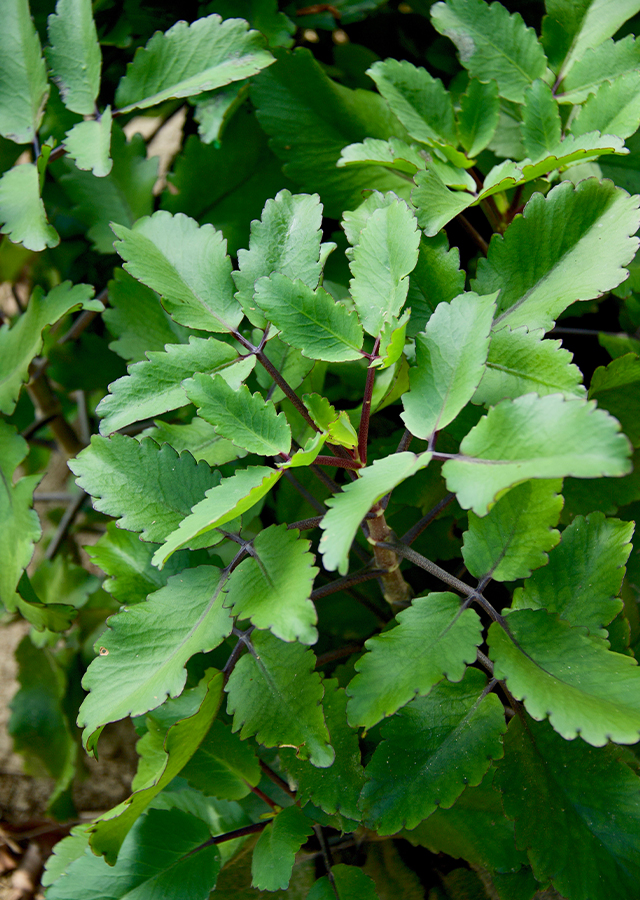
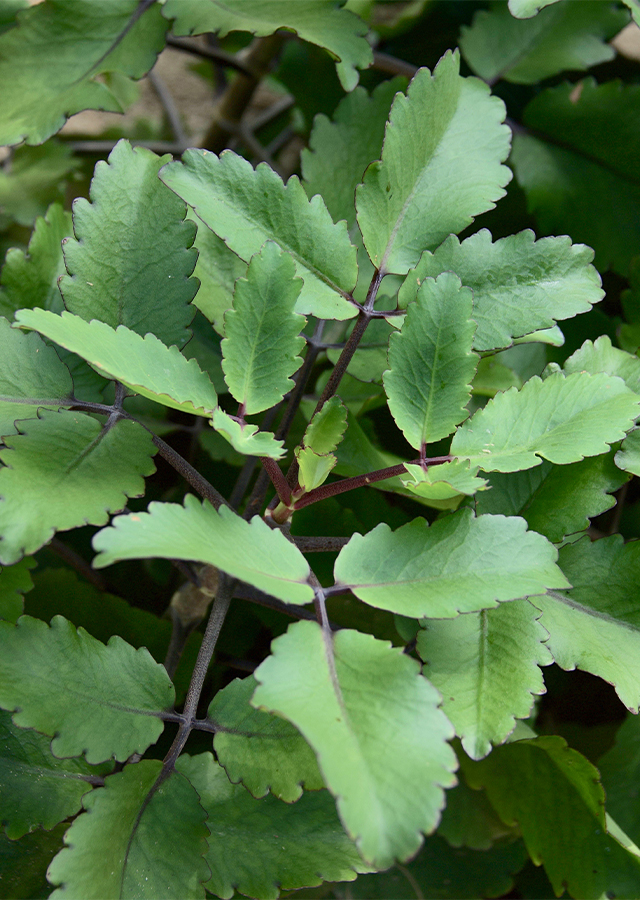
- Leaves green, thick and watery, single, oblong with a short stalk.
- Flowers compound panicle-shaped, cylindrical purplish-red calyx, funnel-shaped red petals.
- Fruit a capsule, purple with white flecks.
- Seeds small, white in color.
Cultivation
- Propagation of cocor bebek can be done using leaves.
- A picked leaf will form plantlet buds in the notches along its edges.
Chemical Content
Alkaloids, terpenoids, flavonoids, saponins, tannins, sitosterol, α-amyrin, β-amyrin acetate, bryophyllin A, arachidic acid, astragalin, benzenoid, behenic acid, steroids, butadienolides.
Benefits
Treats bruises (contusio), antipyretic, treats stomach pain, treats boils, antirheumatic, treats hemorrhoids, anticancer, fever.
Simplisia
- Take fresh cocor bebek leaves.
- Wet sorting (leaf stalks and shoot parts discarded) then wash thoroughly. Chop the leaves into small pieces.
- Air-dry or oven-dry at 40 °C for 96 hours until dry.
- Dry-sort the material then grind and sift with a 60 mesh sieve.
Local Names
Ceker itik (Sunda), Suru bebek, Sosor bebek, Teres (Java), Sidingin beueu (Aceh).
Traditional Recipes
The following recipes reflect traditional knowledge passed down through generations, not a substitute for professional medical diagnosis or advice. Consult a healthcare provider before use.
1. Fever
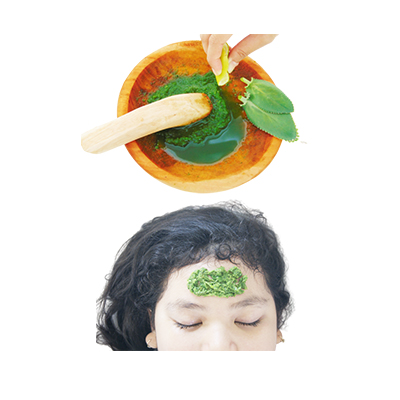
- Prepare 1 handful of cocor bebek leaves, 1 lime, and 5 tsp water.
- Mash the cocor bebek leaves, add lime juice and water. Pound and mix until well combined and forms a paste.
- Apply to the child's forehead as a compress. Change the mixture once it starts to dry. Repeat until the child's fever goes down.
- Can also be applied to the child's whole body.
Reference Sources
- Dalimartha S. 1999. Atlas Tumbuhan Obat Indonesia. Jakarta: Trubus Agriwidya.
- Putri VAN, Hasanah. Review: Profilling senyawa kuersindari tanaman cocor bebek (Kalanchoe pinnata) dengan menggunakan berbagai metode analisis. Jurnal Farmaka Suplemen, 15(1).
- Indriyanti NAN, Garmana. 2011. Ekstrak daun cocor bebek (Kalanchoe pinnata) untuk terapipreventif lupus pada mencit yang diinduksi dengan 2, 6, 10, 14, tetramethylpentadecane. J. Trop. Chem, 1(3).
- Ministry of Health. 2009. Guidelines For the Use of Herbal Medicines in Family Health Care. Ministry of health, republic of indonesia (Demam).
- Semanticscholar.THE MIRACLE PLANT ( KALANCHOE PINNATA ): A PHYTOCHEMICAL AND PHARMACOLOGICAL REVI EW. https://www.semanticscholar.org/paper/THE-MIRACLE-PLANT-(-KALANCHOE-PINNATA-)%3A-A-AND-REVI-Majaz-Khurshid/70b24e16a2efdcaab3a6a0effe8cf676df4426a6 05-03-2021.