Kigelia africana (Lam.) Benth.
Summary
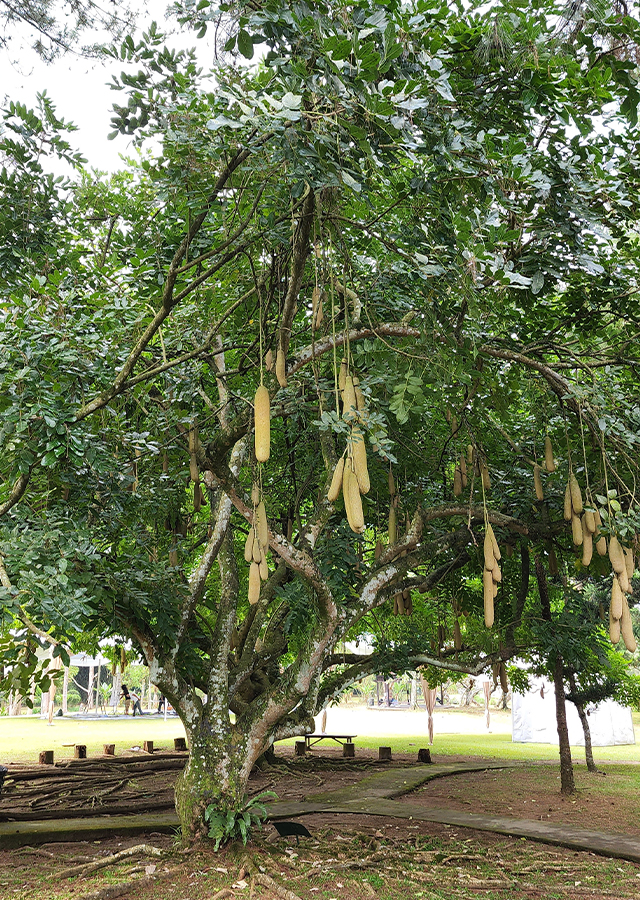
Kigelia africana or the sausage tree is native to tropical Africa and widely distributed as far as Asia and the Americas, and has long been exploited for its medicinal, religious, and cultural value. In some African communities, this tree is considered sacred and protected, while traditionally its fruit and plant parts are used for skin care, treating diarrhea, toothache, and gynecological disorders—though the fruit flesh itself is poisonous if consumed raw.
Agroecology
The sausage tree is usually found growing wild in wet areas along waterways, riverbanks, alluvial and open forests, savannas with high rainfall, thickets, and rainforests. Thrives in many soil types but prefers fertile, humus-rich, well-drained soil, usually found growing on red clay-loam soil texture, sometimes rocky, moist, or peaty, from sea level up to an elevation of 3,000 m. This species prefers locations with rainfall occurring throughout the year. Mean annual rainfall ranges between 900 and 2,000 mm, but this species becomes deciduous in places with a long dry season. Best planted in warm areas, as this species is frost-sensitive, but young plants will survive if protected during the first three years. This species' growth also prefers full sun conditions and is drought-tolerant.
Morphology
- Trunk thick, dark gray to light brown, thinly scaly, peeling, low-branching, branches and twigs spreading and lenticellate.
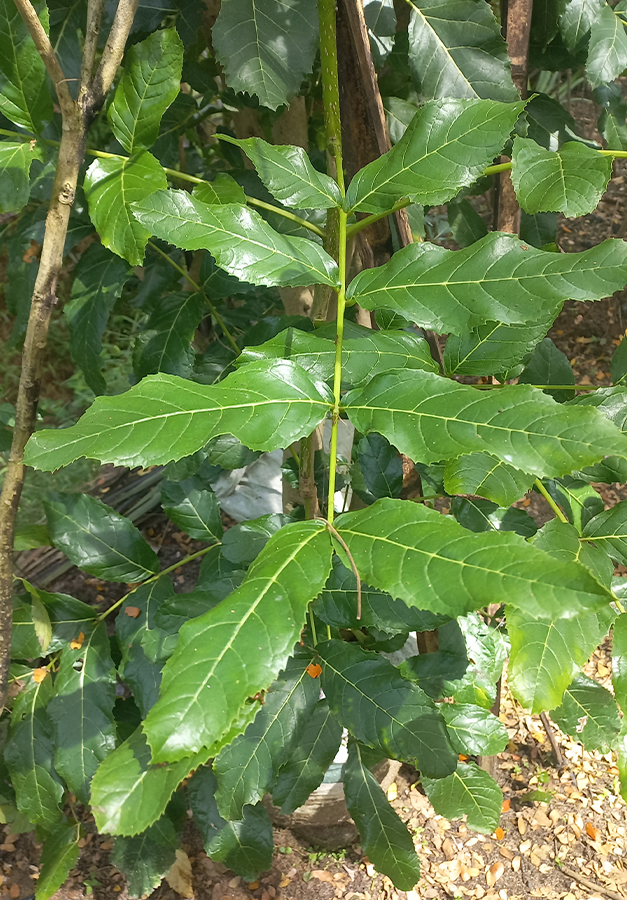
- Leaves compound, arranged alternately, imparipinnate, no stipules, rachis up to 50 cm long. Leaflets in three to six opposite pairs, usually with a terminal leaflet, elliptic to elongate-lanceolate, tip abruptly acuminate, base somewhat asymmetric, rounded to cuneate, margin entire or sometimes slightly toothed, serrate, or wavy, glossy green above, and dull green below, hairless to more or less hairy on both surfaces. Main lateral veins 7-12 pairs and prominent below.
- Flowers hermaphroditic, bisexual, large, 5-lobed, tips curved upward. Calyx short, bell- to cone-shaped (campanulate), fleshy, irregularly 5-lobed, abruptly widening and curving upward, lower lobe generally longer at maturity, greenish yellow. Corolla initially yellowish, then becoming dark red to purplish, tube cylindrical at the base and abruptly widening and curving upward, limb bilabiate with 5 lobes, upper lip bilobed, lower lip 3-lobed and curved, lobes more or less rounded. Stamens four, attached to the corolla tube, one staminode. Ovary cone-shaped, tapering into a slender style equaling the stamens. Has a very unpleasant aroma, blooms at night, lasting only one night. Inflorescence a panicle, terminal, each panicle containing 6-12 flowers.
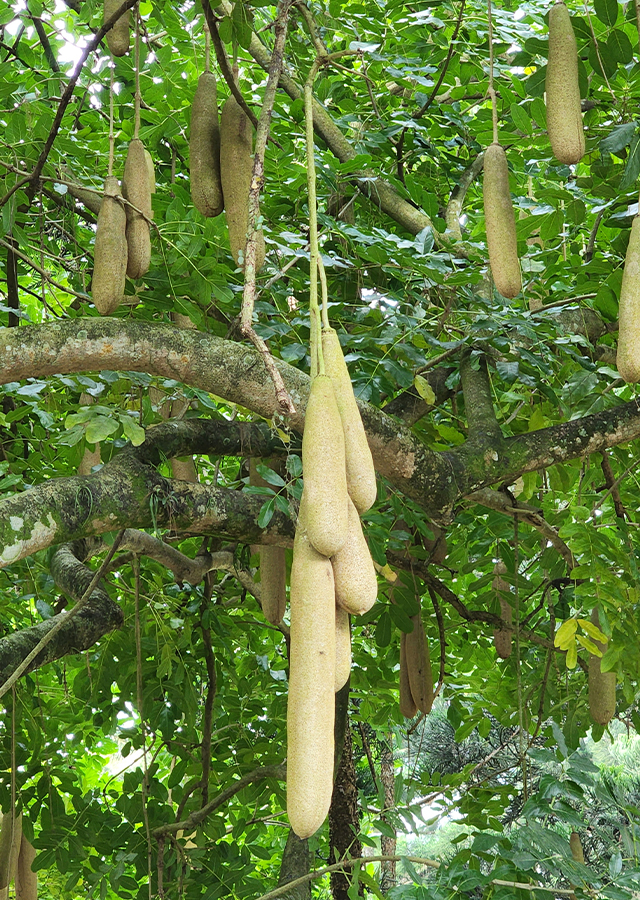
- Fruit indehiscent, cylindrical, sausage-shaped, hanging or dangling, up to 50 cm long and 15 cm in diameter, woody-walled with fibrous pulp, grayish brown, heavily marked with lenticels on the surface, fruit stalk elongated. Usually weighs about 5-10 kg.
- Seeds numerous, unwinged, ovoid, thick, hard, testa rough, embedded in the pulp.
Cultivation
- Plant propagation is generative through seed, and vegetative using the cutting method.
- Germination begins within 10-25 days. Germination rate is usually high and increases linearly with temperature in the range of 11-31°C. Seedlings require shade for successful growth and do not perform well under direct sunlight.
Chemical Content
Iridoids (specioside, verminoside, minecoside), quinones (lapachol, dehydro-α-lapachone, 2-acetylfuro-1,4-naphthoquinone, kigelinol, kigelinone, isokigelinol, pinnatal, isopinnatal, norviburtinal, sonoviburtinal, kigelinone, tecomaquinone-1, kojic acid, 2-(1-hydroxyethyl)-naphtho[2,3-b]furan-4,9-quinone, 2-acetylnaphtho[2,3-b]furan-4,9-quinone, 2-(1-hydroxyethyl)naphtho[2,3-b]furan-4,9-dione), phenolic compounds (p-coumaric acid, caffeic acid, ferulic acid, atranorin, nonacosanoic acid 2-(4-hydroxyphenyl)ethyl ester, luteolin, luteolin 7-O-glucoside, 6-hydroxyluteolin, 6-p-coumaroyl-sucrose, kigeliol, balaphonin), coumarins, sterols (β-sitosterol, stigmasterol, γ-sitosterol), triterpenes (oleanolic acid, pomolic acid, 2β,3β,19α-trihydroxy-urs-12-en-28-oic acid), diterpenes (phytol, 3-hydro-4,8-phytene), flavonoids, tannins, alkaloids, saponins.
Benefits
Treats diarrhea and dysentery, worm infestation, pneumonia, toothache, eye ailments, malaria, colds, flu, gastritis, gynecological disorders (venereal disease), diabetes, kidney disorders, convulsions, postpartum hemorrhage, sun keratosis and skin cancer, lower back pain, boils, constipation, infertility, uterine cancer, hemorrhoids and rheumatism, epilepsy, cleaning and dressing flesh wounds and open sores, scabs, skin diseases (fungal infections, boils, psoriasis, abscesses, eczema, herpes, acne), anemia (especially in pregnant women), edema, cataracts, jaundice, tumors and breast cancer, sexually transmitted diseases, lowers high blood pressure, a general tonic to improve health and growth, promotes breast development in young women, reduces swelling and mastitis in the breasts, abortion (inducing miscarriage), sexual complaints (infertility, impotence, poor libido), increases breast milk production. Has antimicrobial, anti-inflammatory, anticancer, analgesic, antidiabetic, diuretic, antioxidant, and antiaging activity.
Simplisia
- Prepare sausage tree fruit, wash clean with running water.
- Cut into pieces to make it easier to dry.
- Dry under the sun or with an oven at 40°C until the moisture content reaches 10%.
- Grind using a blender until it becomes powder.
- Store in a clean, airtight container.
Local Names
Pohon mentimun.
Traditional Recipes
The following recipes reflect traditional knowledge passed down through generations, not a substitute for professional medical diagnosis or advice. Consult a healthcare provider before use.
1. Back pain
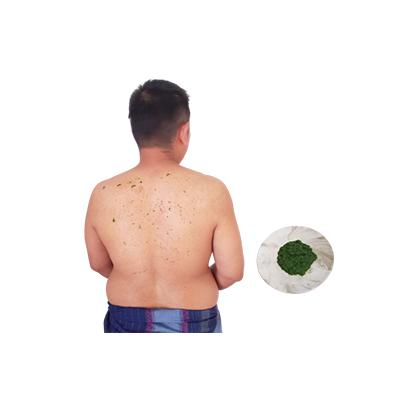
- Take an adequate amount of sausage tree leaves and wash until clean.
- Grind until it becomes a paste.
- Apply the leaf paste to the back.
Reference Sources
- Royal Botanic Gardens. Plants of the World Online: Kigelia africana (Lam.) Benth. https://powo.science.kew.org/taxon/urn:lsid:ipni.org:names:109874-1#image-gallery. 19-05-2022.
- Nabatanzi A., Nkadimeng S. M., Lall N., Kabasa J. D., McGaw L. J. 2020. Review: Ethnobotany, Phytochemistry and Pharmacological Activity of Kigelia africana (Lam.) Benth. (Bignoniaceae). Plants, 9, 753. doi:10.3390/plants9060753.
- Suman Halder, Amit Sharma. 2017. A REVIEW ON KIGELIA AFRICANA. World Journal of Pharmaceutical Research, 6(11): 389-411.
- Plant Resources of Tropical Africa. 2015. Kigelia africana (PROTA). https://uses.plantnet-project.org/en/Kigelia_africana_(PROTA). 19-05-2022.
- Flora Fauna Web. 2020. Kigelia africana (Lam.) Benth. https://www.nparks.gov.sg/florafaunaweb/flora/2/9/2980. 19-05-2022.
- CAB International. 2022. Invasive Species Compendium: Kigelia africana (sausage tree). https://www.cabi.org/isc/datasheet/29403#touses. 19-05-2022.
- Tropical Plants Database, Ken Fern. 2021. Kigelia africana. https://tropical.theferns.info/viewtropical.php?id=Kigelia+africana. 19-05-2022.
- Stuartxchange. 2021. Phillipine Medicinal Plants: African sausage tree. http://www.stuartxchange.org/AfricanSausageTree.html. 19-05-2022.