Lasia spinosa (L.) Thwaites
Summary
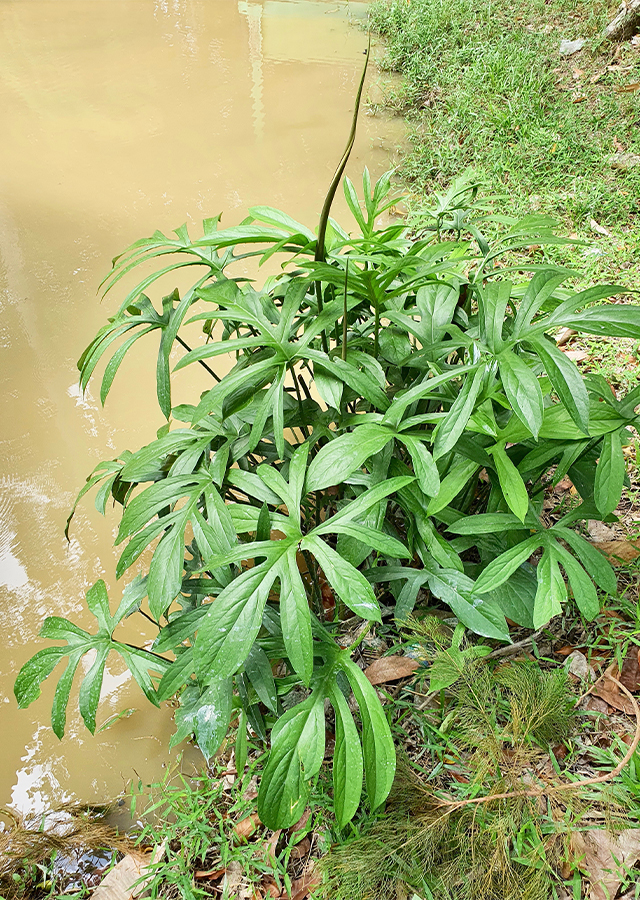
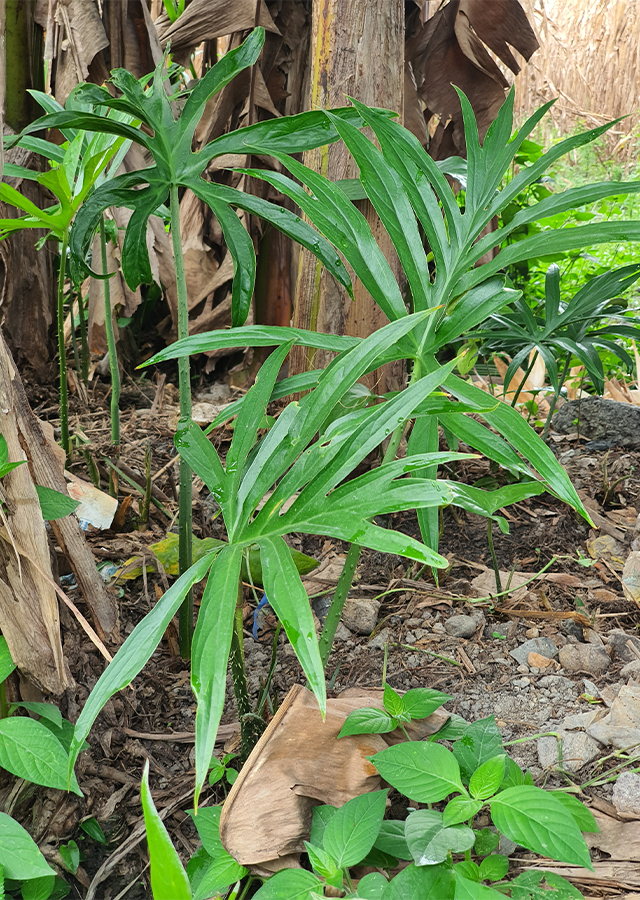
Keladi duri, or spiny taro (Lasia spinosa), is a terrestrial herb 1-2 meters tall of the Araceae family, native to India and distributed as far as Papua New Guinea, China, and the Malay Peninsula. Its young leaves, good for breastfeeding mothers, are commonly cooked as a vegetable, while its peeled stem is used as a cooking seasoning. Traditionally, spiny taro is also believed to relieve rheumatism, hemorrhoids, and intestinal disorders.
Agroecology
Grows ideally in lowlands to mid-elevations. Generally found in tropical and subtropical rainforests, along rivers, ditches, swampy land, and open, wet locations.
Morphology
- Roots fibrous, white.
- Stem erect, soft, round, green.
- Leaves green, simple, oblong, notched base, smooth margins, pinnate venation, glossy surface, 20-40 cm long, 20-30 cm wide, with a cylindrical petiole.
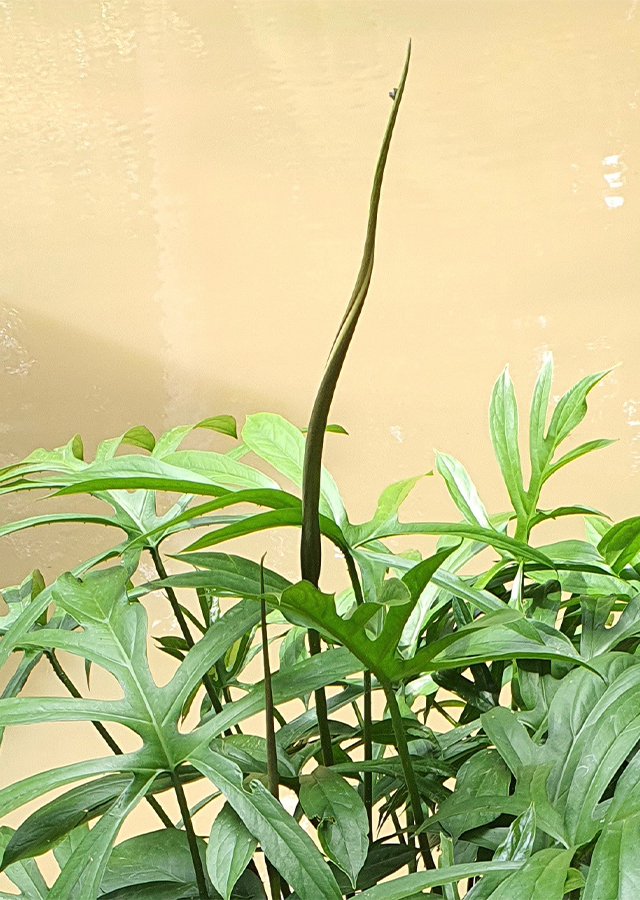
- Flowers reddish-yellow, compound, spadix-shaped, bisexual, in the leaf axils, triangular calyx and 12 cm long corolla.
- Fruit a berry, triangular and dirty white.
- Seeds small, brown.
Cultivation
- Generative propagation (by seed).
- Vegetative propagation using offshoots.
Chemical Content
Alkaloids, tannins, phenols, flavonoids, steroids, saponins, glycosides, ascorbic acid, α-carotene, β-carotene, β-carotene-5,6,5′,6′-diepoxide, 5,6,5′,6′-diepoxy-5,8,5′,8′-tetrahydro-β,β-carotene-3,3′-diol, cis-neoxanthin.
Benefits
Addresses colic, rheumatism, hemorrhoids, lung inflammation, intestinal disorders, coughing blood, uterine cancer, snake and insect bites, wounds, bleeding, joint pain, skin infections; has anthelmintic (dewormer), analgesic (pain relief), antibacterial, antitussive (cough relief), anti-inflammatory, and antidiarrheal activity.
Simplisia
Kohila Flour
- Select tubers that are not too mature, then wash thoroughly.
- Peel the tuber and separate it from the skin, then cut into small pieces.
- Place in an oven and dry at 60°C for 48 hours. Grind using a grinder or blender until completely fine. Sift through a 100-mesh sieve to get a fine powder.
- Pack in an airtight package and store at 4°C.
Local Names
Geli-geli (Malaysia), Ngamling, Sambeng, Sampi (Indonesia).
Traditional Recipes
The following recipes reflect traditional knowledge passed down through generations, not a substitute for professional medical diagnosis or advice. Consult a healthcare provider before use.
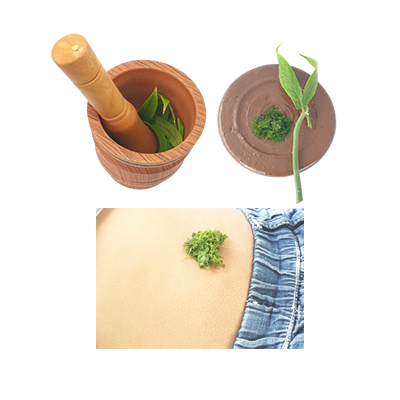
1. Stomach Ache
- Wash 10 g of spiny taro leaves, pound until mashed.
- Apply to the stomach (navel).
Reference Sources
- National Parks. Flora & Fauna Web. Lasia spinosa (L.) Thw. https://www.nparks.gov.sg/florafaunaweb/flora/2/1/2186 13-01-2021
- Suharmiati, Lestari. 2005. Ramuan Tadisional untuk Keadaan Darurat Di rumah (Sakit Perut), agromedia pustaka
- Yadav Arun Kumar, Temjenmongla. 2011. Efficacy of Lasia spinosa leaf extract in treating mice infected with Trichinella spiralis.Parasitol Res (2012) 110:493–498.
- Goshwami, Durajan , Rahman Md. Mostafizur , Muhit Md. Abdul , Islam 2 Md. Saiful and Ansari Mukhtar. 2012. Antioxidant Property, Cytotoxicity and Antimicrobial Activity of Lasia spinosa Leaves.Nepal Journal of Science and Technology 13(2):215-218.
- Deb, Debashish et al. 2010. Anti-inflammatory and Anti-diarrheal Activities of the Hydroalcoholic Extract of Lasia spinosa Linn. (Araceae) Roots. Latin American Journal of Pharmacy.29 (8): 1269-76.
- Shefana. A, G and S Ekanayake. 2009. Some nutritional aspects of Lasia spinosa (kohila). Vidyodaya J of Science 1(1):59-64.
- Rahman,Atiqur et al. 2019. Phenolic Profile, Essential Oil Composition and Bioactivity of Lasia spinosa (L.) Thwaites. Brazilian Archives of Biology and Technology Vol.62
- Hasan, Md. Nazmul, Mita Munshi, Mohammad Habibur Rahman, S.M. Nur Alam, Akinori Hirashima. Evaluation of Antihyperglycemic Atiity of Lasia Spinosa Leaf Extract in Swiss Albino Mice. World Journal of Pharmacy and Pharmaeutial Sciences 3(10):118-124.