Lobularia maritima (L.) Desv.
Summary
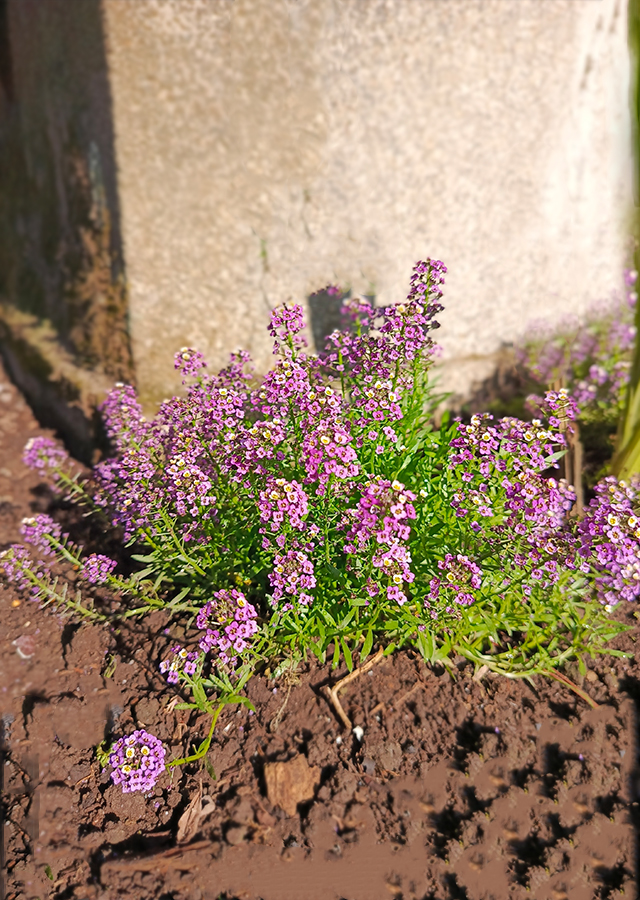
Lobularia maritima or alyssum is an herb native to the rocky coastlines of the Mediterranean, the Canary Islands, and the Azores, now popularly cultivated as an ornamental for its beautiful flower shape. In Sicily, southern Italy, its young leaves and flowers are traditionally used as a salad seasoning, while as a medicinal plant alyssum is believed to help heal wounds and relieve headaches—though its oral consumption is not recommended for pregnant women.
Agroecology
Alyssum's habitat is usually roadsides, wastelands, vacant lots, agricultural fields, walls, thickets, sand dunes, coastal zones, especially along the Atlantic, Gulf, and Pacific coasts as well as inland, at elevations from sea level up to 800 m asl. In the Mediterranean, alyssum is usually found in dry, sunny places, and in Britain it grows along the coast. Its growth prefers an open, sunny position. Alyssum grows well in almost any soil, but does better if the soil is sandy, loose, light, fertile, and well-drained. This species is also drought-tolerant.
Morphology
- Roots shallow, low and spreading.
- Stem branching and forming many flower clusters.
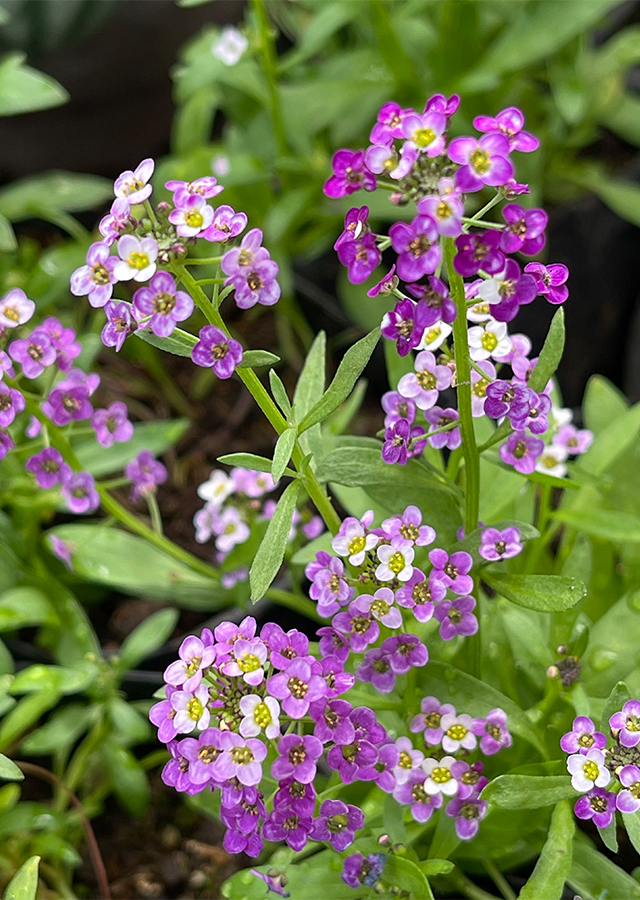
- Leaves alternate, oblong to lanceolate without indentations, grayish green.
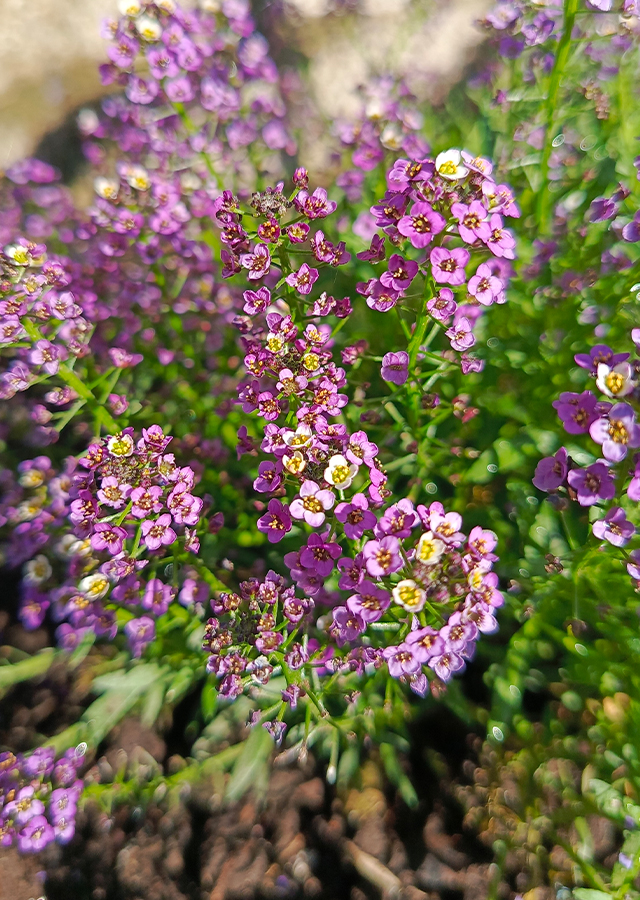
- Flowers small and dense, usually white but sometimes pink or lavender, fragrant with a honey-like aroma. Petals ovate. Stamens 6, glands flanking short oblong filaments. Each flower has 4 petals. Flowers cluster together in dense terminal heads (racemes).
- Fruit flat and round, often purplish, long, pointed, sparsely hairy.
- Seeds light brown to reddish, unwinged.
Cultivation
Plant propagation through seed (generative). After about 10-14 days after sowing, young shoots will emerge.
Chemical Content
Linalool, flavonoids (kaempferol, kaempferol-7-rhamnoside, kaempferol 3-glucoside-7-rhamnoside, kaempferol-3-diglucoside, quercetin-7-glucoside, kaempferol 3-O-β-D-glucopyranosyl-(1→2)-O-α-L-xylopyranoside, and kaempferol 3-O-α-L-rhamnopyranosyl-(1→2)-O-α-L-arabinopyranoside), alkaloids, saponins, tannins, essential oil, and other compounds.
Benefits
Speeds up wound healing, relieves headache, improves and maintains skin health, neutralizes toxins on the skin, treats gonorrhea, refreshes the body. Has antiscorbutic and diuretic activity.
Local Names
Alder laut.
Traditional Recipes
The following recipes reflect traditional knowledge passed down through generations, not a substitute for professional medical diagnosis or advice. Consult a healthcare provider before use.
1. Wounds
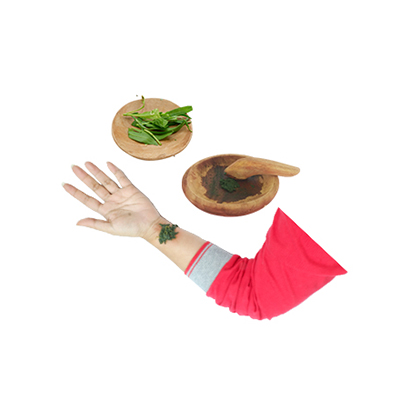
- Take an adequate amount of fresh alyssum leaves and wash until clean.
- Grind until it becomes a paste.
- Apply the leaf paste to the wound.
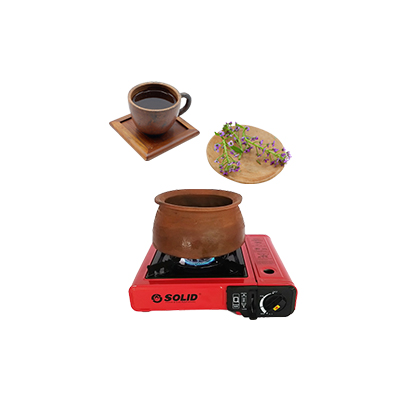
2. Refreshes the body
- Take 500 g of fresh alyssum flowers and wash until clean.
- Boil until it boils and the water changes color.
- Strain then drink while warm.
Reference Sources
- Temperate Plants Database, Ken Fern. 2021. Lobularia maritima. http://temperate.theferns.info/plant/Lobularia+maritima. 25-005-2022.
- IDN Medis. 2022. Lobularia Maritima: Manfaat – Efek Samping dan Tips Penggunaan. https://idnmedis.com/lobularia-maritima. 25-05-2022.
- Mariangela Marrelli, Maria Pia Argentieri, Pinarosa Avato, and Filomena Conforti. 2020. Lobularia maritima (L.) Desv. Aerial Parts Methanolic Extract: In Vitro Screening of Biological Activity. Plants, 9(89). doi:10.3390/plants9010089.
- Flora of North America. 2020. Lobularia maritima. http://beta.floranorthamerica.org/Lobularia_maritima. 29-05-2022.
- Burke Museum Herbarium. 2022. Lobularia maritima. http://biology.burke.washington.edu/herbarium/imagecollection/taxon.php?Taxon=Lobularia%20maritima. 29-05-2022.