Ludwigia octovalvis (Jacq.) P.H.Raven
Summary
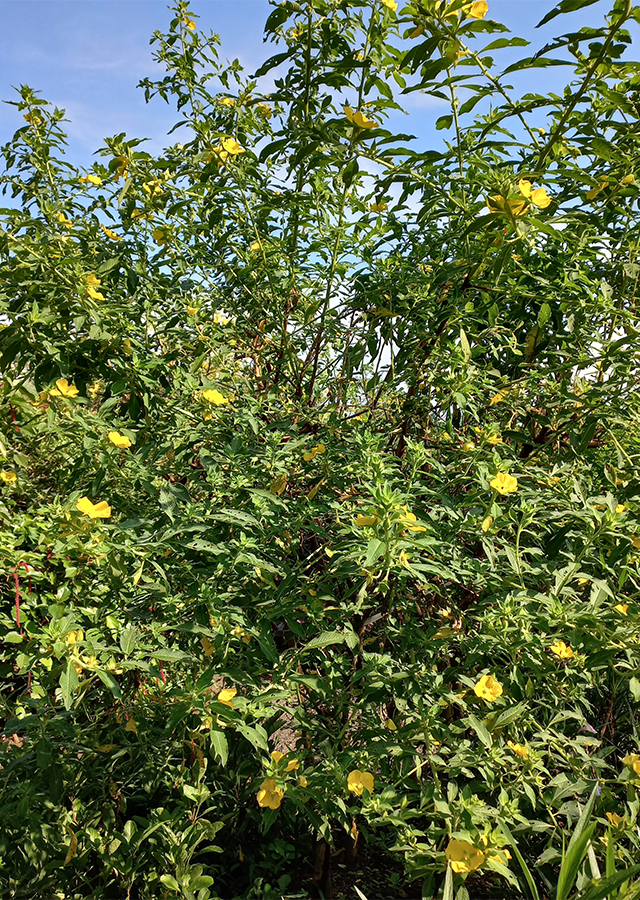
Cacabean (Ludwigia octovalvis) is an erect herb up to 4 meters tall from the Onagraceae family, a pantropical weed spread across almost all tropical regions of the world, making its exact origin difficult to trace. In India and the Malay Peninsula, its leaf mucilage is used as a poultice for headaches and swollen glands. Cacabean also has potential as a phytoremediation plant absorbing arsenic and other dangerous metals.
Agroecology
Cacabean can be found throughout tropical regions, at elevations from sea level up to 1,500 m asl. Usually grows in wet soil and shallow water, in humid areas, moist grasslands, rice fields, along ditches, swamps, ponds, riverbeds, floating islands, lakes, and in coconut plantations. This plant prefers full sun (about 6-8 hours per day) and tolerates no more than side shade, with high water needs.
Morphology
- Roots taproot, white or brown.
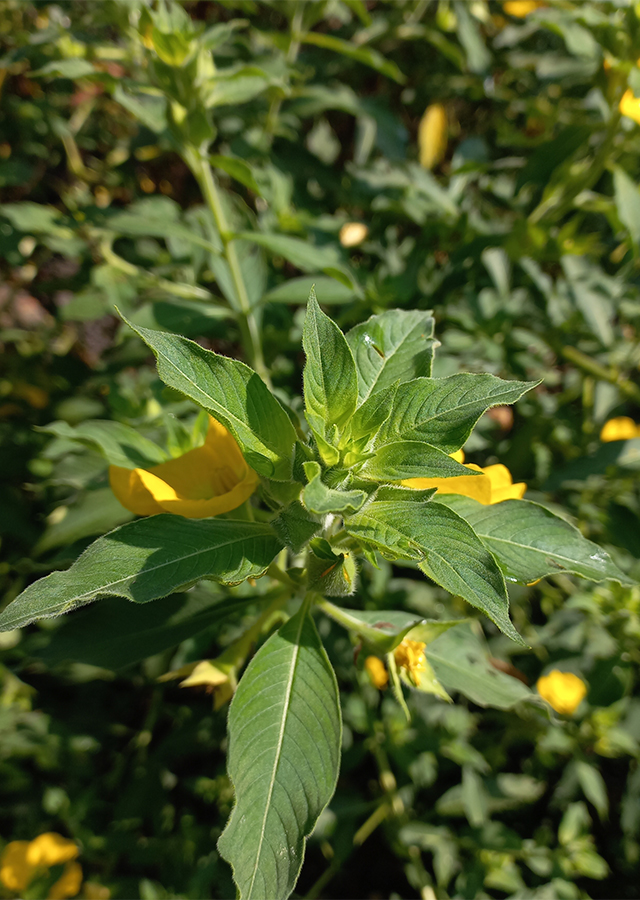
- Stem green or reddish-brown, branched, hairy, ribbed, sometimes becoming woody at the base.
- Leaves alternately arranged, light green, can turn red when old, narrowly lanceolate to ovate, narrowing or tapering at the base and tip, velvety hairy on both sides, short petiole.
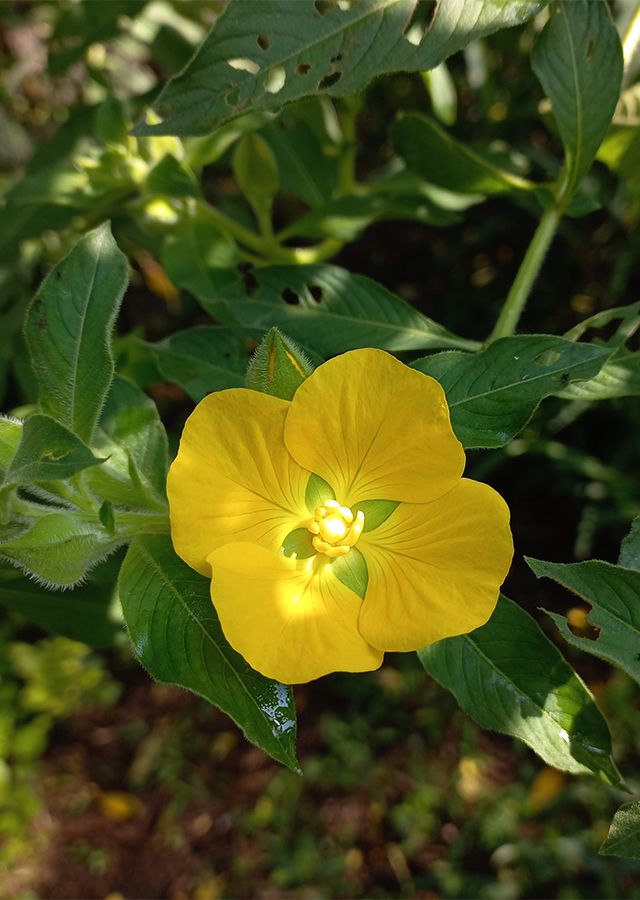
- Flowers have 4 sepals, ovate, calyx tube slender. Petals numbering 4-5, ovate arranged in a cross-like pattern, petal tips sometimes folded downward, forming a large notch-like indentation. Corolla has distinct concave venation that creates a wavy surface, pale yellow to bright yellow. Stamens numbering 8, pale greenish-yellow. Flowers appear solitary in the leaf axils and at branch tips.
- Fruit a capsule 8-ribbed, thin-walled, 4-angled, narrowly cylindrical, velvety hairy, color varying from green to pale or reddish-brown or purplish, with 8 darker grooves, splitting irregularly at its locules.
- Seeds round, brown, arranged in many rows in each chamber.
Cultivation
- Propagation is done generatively using seeds. Seed dispersal is done by birds and agricultural equipment used for rice field cultivation.
- Seeds that fall to the ground germinate within 14 days.
Chemical Content
Alkaloids, tannins, saponins, phenols, steroids, beta-sitosterol, oleanolic acid, 2alpha-hydroxy ursolic acid, tormentic acid, daucosterol, maltol, methyl brevifolincarboxylate, 3,4,8,9,10-pentahydroxydibenzo[b,d]pyran-6-one, ellagic acid, luteolin, quercetin, apigenin, gallic acid, (23Z)-coumaroylhederagenin, (23E)-coumaroylhederagenin, and (3Z)-coumaroylhederagenin.
Benefits
Treats diarrhea, dysentery, nasal boils, orchitis (testicular inflammation), swollen glands, nerve diseases, relieves headaches, chest pain, rheumatic pain, heals dermatitis, ulcers, impetigo, acne, has laxative, vermifuge (worm remedy), carminative (relieving intestinal gas colic), analgesic (pain relieving), antibacterial, and antioxidant properties.
Local Names
Salah nyowo (Java), Gagabusan (Sunda), Kalamenja (Madura), Pangambo (East Sumbawa), Keletele tengen (Minahasa), Daun panu (Ambon), Lakum air, Jebungan.
Traditional Recipes
The following recipes reflect traditional knowledge passed down through generations, not a substitute for professional medical diagnosis or advice. Consult a healthcare provider before use.
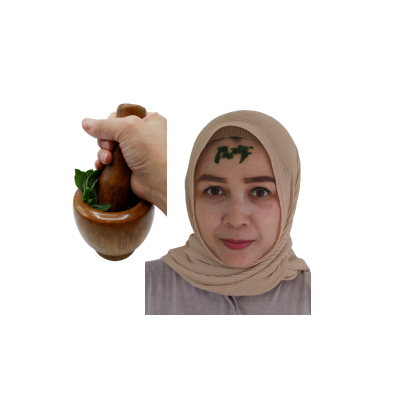
1. Relieving headaches
- Take cacabean leaves as needed.
- Wash clean with running water.
- Mash into a paste.
- Apply the paste to the forehead.
Reference Sources
- Yan J., Yang X.W. 2006. Studies on the chemical constituents in herb of Ludwigia octovalvis. China journal of Chinese materia medica 30(24): 1923-6 dalam https://www.researchgate.net/publication/7283309_Studies_on_the_chemical_constituents_in_herb_of_Ludwigia_octovalvis.
- Setyawati,T., Narulita, S., Bahri I.P., Rahardjo,G.T. 2015. A Guide Book to Invasive Alien Plant Species in Indonesia. Research, Development and Innovation Agency. Ministry of Environment and Forestry.
- CAB International. 2021. Invasive Species Compendium: Ludwigia octovalvis (primrose willow). https://www.cabi.org/isc/datasheet/31671#toPictures. 04-10-2021.
- Flora Fauna Web. 2020. Ludwigia octovalvis (Jacq.) P.H. Raven. https://www.nparks.gov.sg/florafaunaweb/flora/4/8/4862. 04-10-2021.
- Royal Botanic Gardens. 2021. Plants of the World Online: Ludwigia octovalvis (Jacq.) P.H.Raven. http://powo.science.kew.org/taxon/144385-2. 04-10-2021.
- Yakob H.K., Sulaiman S.F., Uyub A.M. 2012. Antioxidant and Antibacterial Activity of Ludwigia octovalvis on Escherichia coli O157:H7 and Some Pathogenic Bacteria. World Applied Sciences Journal 16 (1): 22-29.
- Useful Tropical Plants Database. 2021. Ludwigia octovalvis. http://tropical.theferns.info/viewtropical.php?id=Ludwigia+octovalvis. 04-10-2021.
- PROSEA. 2016. Ludwigia octovalvis (PROSEA). https://uses.plantnet-project.org/en/Ludwigia_octovalvis_(PROSEA). 04-10-2021.
- Stuartxchange. 2018. Philippine Medicinal Plants: Malapako. http://www.stuartxchange.org/Malapako.html. 04-10-2021.