Lumnitzera littorea (Jack) Voigt
Summary
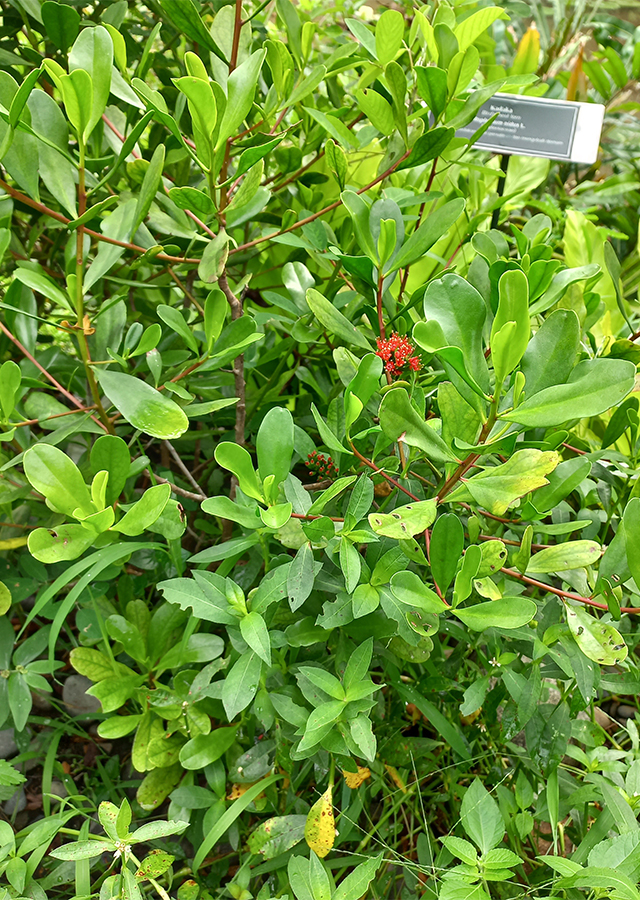
Taruntum merah (Lumnitzera littorea) is a true mangrove tree 7-25 meters tall from the Combretaceae family spread from India to the Pacific Islands, now increasingly rare due to coastal development. Its wood is used to build bridges and ships, while its bark becomes rope material. The Mandori tribe in Papua has used taruntum merah as an itch remedy for generations.
Agroecology
Taruntum merah is a tropical, humid lowland plant that can be found around sea level. Generally grows in coastline areas such as mangrove forests, sandy beaches, and rocky shores. This plant grows well in areas with average annual rainfall in the range of 1,000-2,500 mm, but can tolerate 800-4,000 mm and average annual temperature ranging between 22-28 °C, but can tolerate 10-32 °C. Prefers areas with sunny conditions or getting full sun but can tolerate partial shade. This plant also requires soil with a soil acidity (pH) in the range of 6.8-7.2 but tolerant at 6.5-7.5 and saline soil.
Morphology
- Roots have pneumatophores, knee-shaped breathing roots, dark brown.
- Stem has dark brown bark with longitudinal fissures or cracks.
- Leaves single, opposite, green, somewhat thick and fleshy, hard or stiff, clustered at branch tips, short-stalked, obovate leaf shape, leaf tip rounded to notched or split (emarginate), smooth leaf margin.
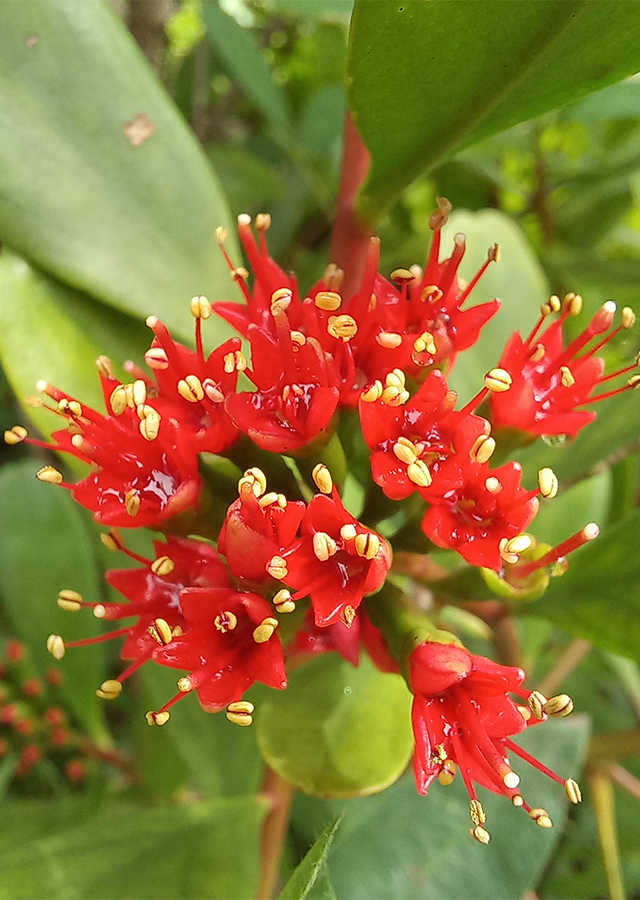
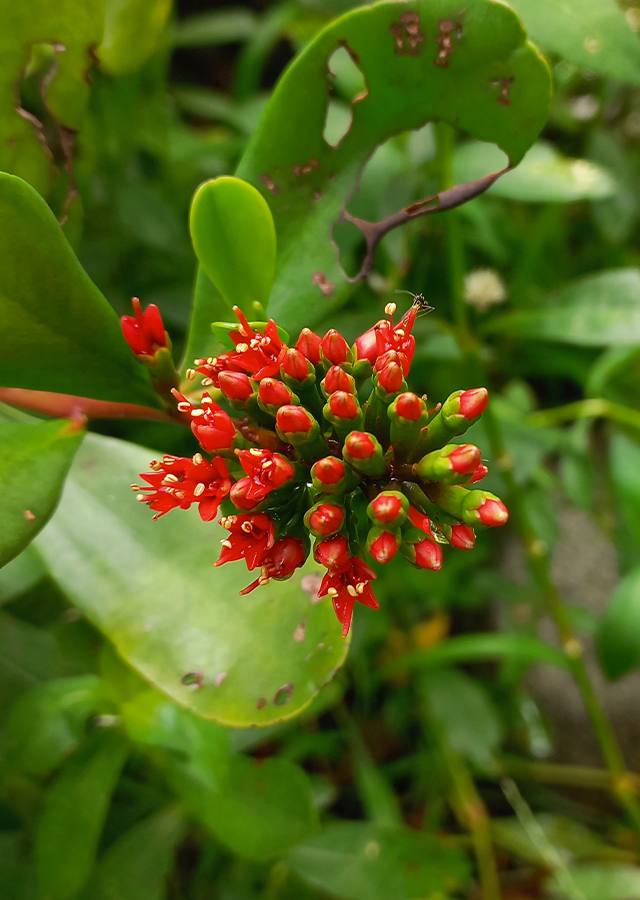
- Flowers bisexual, fragrant, filled with nectar, and short-stalked. Corolla numbering 5 and bright red, calyx numbering 5 and green. Stamens numbering fewer than 10, stamen length twice the size of the petal. Has two ovate bracteoles. Inflorescence a spike located at the tip.
- Fruit small, vase-shaped, purplish-green and turning brown when ripe, somewhat hard, glossy surface, ribbed, fibrous fruit wall, cork-like and can float.
- Seeds numbering 1 in each fruit.
Cultivation
Propagation is done generatively using seeds.
Chemical Content
Quercetin, quercitrin, myricetin, myricitrin, naringenin, chrysoeriol, pilloin, afzelin, myricetin 3-O-(4″-O-galloyl)-α-L-rhamnopyranoside, flavonoid glycoside, triterpene, sterol, macrocyclic lactones, 6,7-dimethoxycoumarin.
Benefits
Heals acne, canker sores in infants, promotes hair growth, soothes and softens skin, treats itchy skin, induces sweating, reduces fever, relieves constipation, has diuretic properties.
Simplisia
- Prepare taruntum merah root then wash until clean then drain.
- Dry under direct sunlight for several days or with an oven at 40 °C until moisture content reaches 10%.
- Store the dried preparation in a clean, airtight plastic or container.
Local Names
Duduk agung (Java), Randai (East Kalimantan), Tarungtung (Sunda), Parem (Papua), Kedukduk, Truntun, Duguk-raya.
Traditional Recipes
The following recipes reflect traditional knowledge passed down through generations, not a substitute for professional medical diagnosis or advice. Consult a healthcare provider before use.
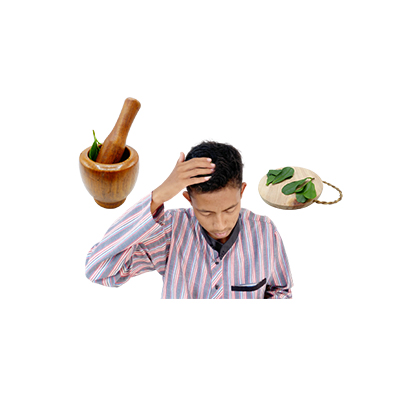
1. Promoting hair growth
- Take fresh taruntum merah leaves as needed and wash until clean.
- Mash into a paste.
- Apply the leaf paste to the scalp and massage gently until absorbed.
Reference Sources
- Useful Tropical Plants Database. 2021. Lumnitzera littorea. https://tropical.theferns.info/viewtropical.php?id=Lumnitzera+littorea. 27-10-2021.
- Royal Botanic Gardens. 2021. Plants of the World Online: Lumnitzera littorea (Jack) Voigt. http://www.plantsoftheworldonline.org/taxon/urn:lsid:ipni.org:names:170675-1. 27-10-2021.
- Flora Fauna Web. 2019. Lumnitzera littorea (Jack) Voigt. https://www.nparks.gov.sg/FloraFaunaWeb/Flora/3/2/3266. 27-10-2021.
- PROSEA. 2016. Lumnitzera littorea (PROSEA). https://uses.plantnet-project.org/en/Lumnitzera_littorea_(PROSEA). 27-10-2021.
- Wetlands. Lumnitzera littorea. http://www.wetlands.or.id/mangrove/mangrove_species.php?id=31. 27-10-2021.
- Thuy N.T.L. et al. 2019. A New Flavone Glycoside From Lumnitzera littorea with In Vitro α-Glucosidase Inhibitory Activity. Natural Product Communications 2019: 1-5.
- Manurung J. et al. 2021. Analysis of Unusual Sulfated Constituents and Anti-infective Properties of Two Indonesian Mangroves, Lumnitzera littorea and Lumnitzera racemosa (Combretaceae). Separations 8(82). https://doi.org/10.3390/separations8060082.