Magnolia × alba (DC.) Figlar
Summary
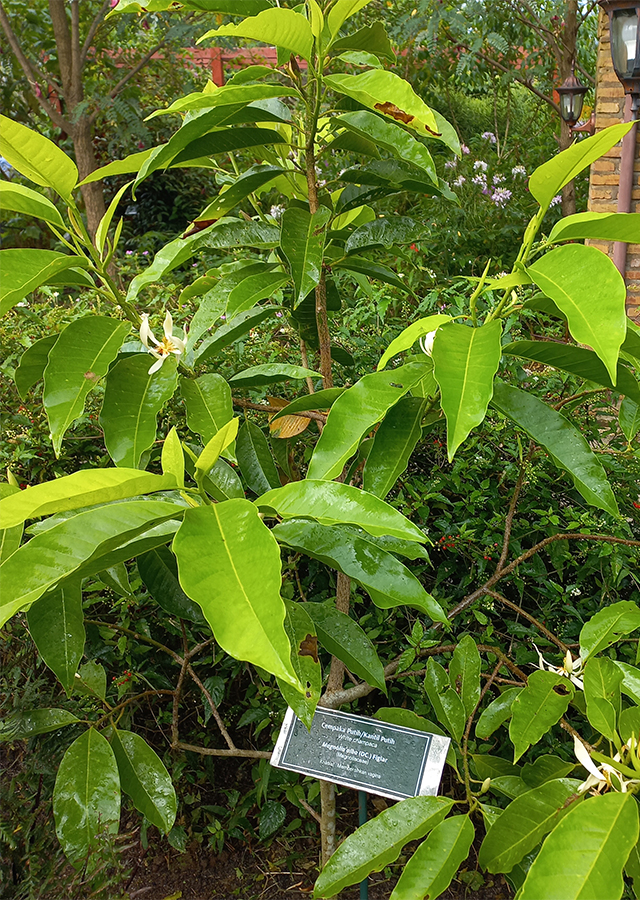
White champaca (Magnolia x alba) is a hybrid tree 16-30 meters tall from the Magnoliaceae family, a cross between Magnolia champaca and Magnolia montana. Its flower buds are commonly used in traditional Indonesian ceremonies, while in China it is called 'bai lan' and brewed into yulan tea. In traditional Chinese medicine, white champaca is used to move qi energy and relieve cough.
Agroecology
White champaca prefers sandy, well-drained soil. Like most tropical members of the Magnoliaceae family, white champaca grows best in acidic soil, from pH 6.5 to as acidic as pH 5.6. This plant requires full sun and moderate watering, and does not tolerate overwatering.
Morphology
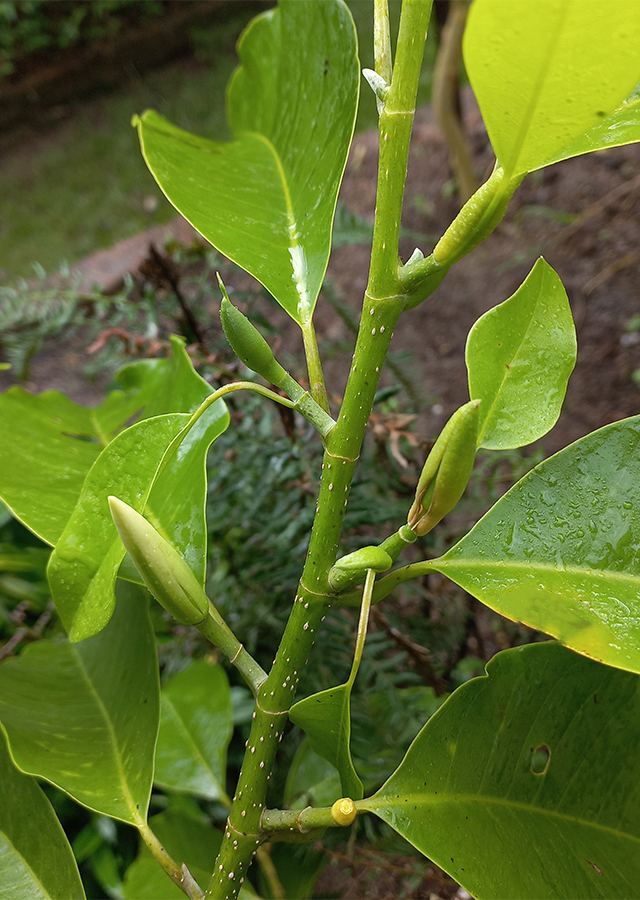
- Stem woody, a large plant, branching far from the ground, bark gray. Twigs and leaves fragrant when crushed. Twigs persistent, forming a broad umbrella-like crown, young twigs and buds densely pale yellowish-white finely hairy, trichomes gradually shedding with age. Stipule scar reaching almost to the middle of the petiole.
- Leaves petiole 1.5-2 cm, sparsely hairy, blade long-elliptic to narrowly ovate, 10-27 × 4-9.5 cm, thin, rough, lower surface sparsely hairy, leaf surface smooth, veins pinnate very conspicuous on both surfaces when dry, base tapering, apex long-tapering to caudate-acuminate.
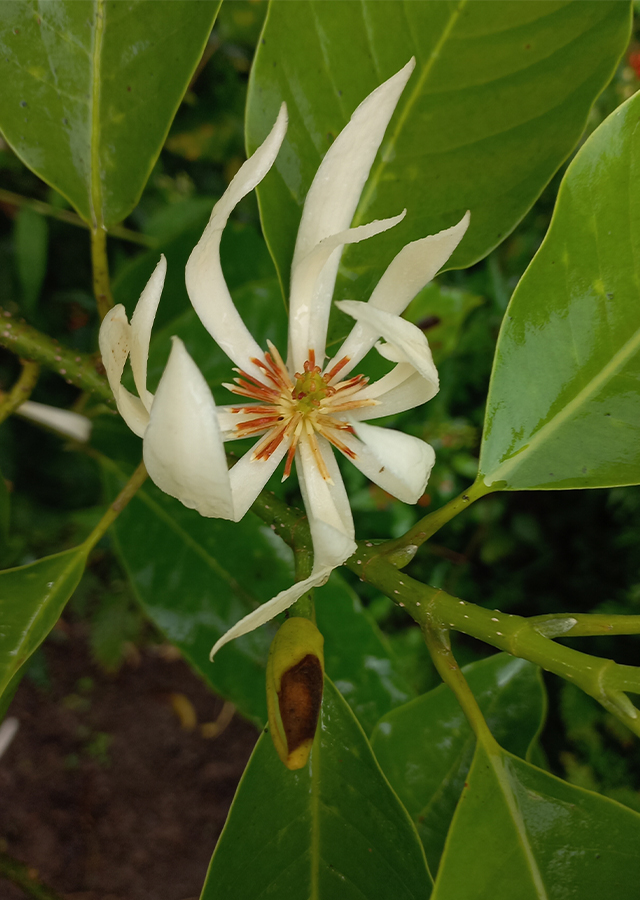
- Flowers very fragrant. Tepals 10, white, lanceolate, 3-4 cm × 3-5 mm. Staminal connective protruding and forming a long tip. Gynophore 4 mm; gynoecium smooth; carpels numerous, usually partly undeveloped, rarely forming a follicle fruit as the torus elongates when ripe.
- Fruit single, round, 2-3 cm in diameter, green when young and turning reddish yellow when mature.
Cultivation
There are two ways to propagate white champaca, namely generative (seed) and vegetative. Many farmers propagate white champaca vegetatively by air-layering/grafting.
Chemical Content
Essential oil (camphene, β-pinene, α-phellandrene, β-myrcene, limonene, 1,8-cineole), linalool, methyl eugenol, methyl ethyl acetate ester, acetic acid, (-)-N-formylanonaine, (-)-oliveroline, (+)-nornuciferine, lysicamine, (+)-cyperone, (+)-epi-yangambin, ficaprenol-10, pheophytin a, aristophyll C, and michephyll A.
Benefits
A feminine hygiene wash and heals cough.
Simplisia
- Take an adequate amount of fresh white champaca flowers and wash until clean.
- Once washed, drain.
- Sun-dry directly for several days or use an oven at 40°C until the moisture content reaches 10%.
- Once dry, store the simplicia in a clean, airtight plastic or container.
Local Names
Kantil putih, cendana putih, atau pohon anggrek giok putih.
Traditional Recipes
The following recipes reflect traditional knowledge passed down through generations, not a substitute for professional medical diagnosis or advice. Consult a healthcare provider before use.
1. Cleansing the feminine area
- Pick fresh white champaca flowers then wash until clean.
- Boil the flowers until it boils.
- Wait until warm/cold.
- Use the decoction to cleanse the feminine area.
Reference Sources
- Royal Botanic Gardens. 2017. Plant of the World Online: Magnolia × alba (DC.) Figlar. https://powo.science.kew.org/taxon/20011680-1. 25-12-2021.
- Flora of China. Michelia ×alba . http://www.efloras.org/florataxon.aspx?flora_id=2&taxon_id=250090229. 25-12-2021.
- Flora Fauna Web. 2021. Magnolia (DC.) Figlar × alba. https://www.nparks.gov.sg/florafaunaweb/flora/3/0/3024. 25-12-2021.
- Stuartxchange. 2011. Philippine Medicinal Plants: Tsampakang-puti. http://www.stuartxchange.ph/Tsampakang-puti.html. 25-12-2021.
- Eko Mas. 2020. Planter and Forester: Bunga Kantil, Cempaka Putih, Magnolia × alba (DC.) Figlar Bunga yang sangat wangi. https://www.planterandforester.com/2020/12/bunga-kantil-cempaka-putih-magnolia.html?m=0. 25-12-2021.