Magnolia figo (Lour.) DC.
Summary
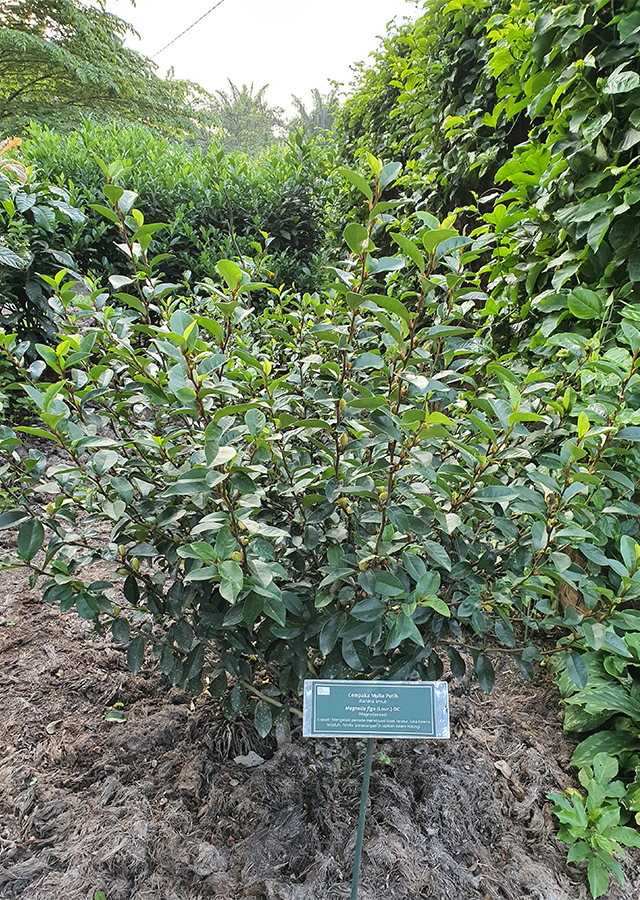
Cempaka mulia putih (Magnolia figo) is a woody shrub or small tree up to 5 meters tall from the Magnoliaceae family that originates from Southern China and Korea. Its flowers, with an aroma like ripe melon or banana, are used to scent China's distinctive Yulan tea. Cempaka mulia putih is traditionally used to address irregular menstruation and rhinitis.
Agroecology
Magnolia figo is found distributed in lowland primary to mountain rainforests, up to an elevation of 2,100 m asl. It thrives in moist clay soil, with neutral to alkaline pH rich in humus and well-drained, in direct sunlight or partial shade, and does not tolerate overly extreme soil conditions (dry or wet).
Morphology
- Stem often many-branched, twigs often zigzagging, with brown hairs.
- Leaves rough, glossy surface, thick, narrowly elliptical to oblong, 4-10 cm long, 1.8-4.5 cm wide, base pointed, tip tapering to a tail-like point, dark green when the plant is in full sun.
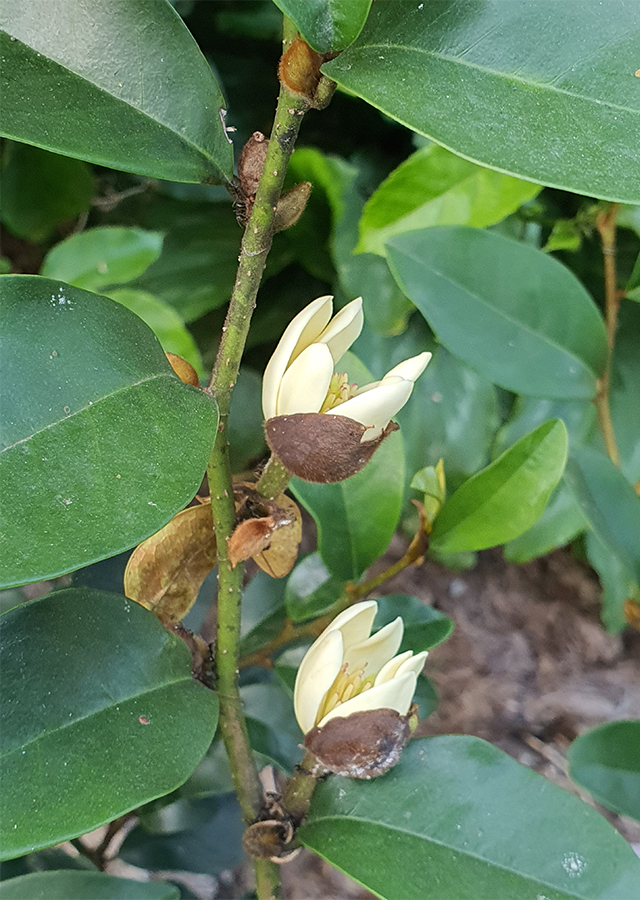
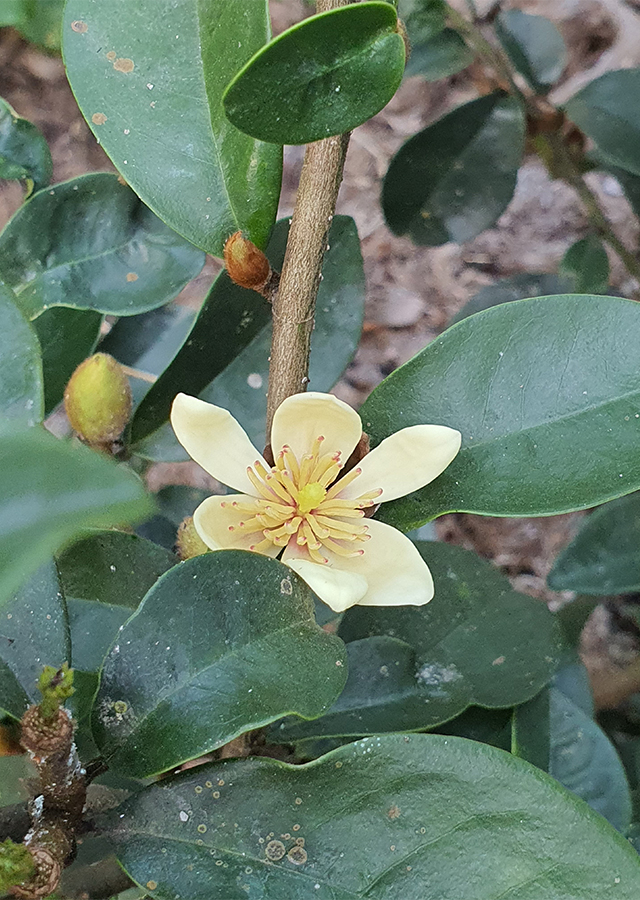
- Flowers buds enclosed in hairy brown bracts. Flowers small (about 4 cm wide), magnolia-like, with creamy-white, wax-like petals, very fragrant (especially toward evening), aromatic like ripe melon, banana, or fruit gum.
- Fruit a single carpel (follicle), subglobose, 8 mm in diameter, often containing only 1 seed.
Cultivation
Propagation by seed and stem cuttings. Seeds are best sown in a slightly shaded spot in a nursery bed as soon as they are ripe.
Chemical Content
Flowers: five alkaloids (asimilobine, roemerine, anonaine, thalifoline, and corydaldine), two steroids (β-sitosterol and stigmasterol), four benzenoids (p-hydroxybenzaldehyde, p-hydroxybenzoic acid, methylparaben, and vanillin), two coumarins (scopoletin and aesculetin dimethyl ether) and one sesquiterpene, caryophyllene oxide. Leaves: three alkaloids (nuciferine, anonaine, and N-methylcorydaldine), two steroids (sitostenone and stigmasta-4,22-dien-3-one), four benzenoids (p-hydroxybenzaldehyde, p-hydroxybenzoic acid, methylparaben, and vanillin), six chlorophylls (pheophytin a, pheophorbide a, pheophytin b, pheophorbide b, aristophyll-C, 132-hydroxy-(132-S)pheophytin a), and one sesquiterpene lactone, 11,13-dehydrolanuginolide. Flower heads: butyl acetate, ethyl hexanoate, ethyl butyrate, 2-methylbutyl acetate, ethyl isobutyrate and ethyl 2-methylbutyrate.
Benefits
Addresses irregular menstrual periods, qi-stagnation abdominalgia, rhinitis (inflammation of the inner lining of the nose), wounds from falls.
Local Names
Cempaka pisang, Cempaka ambon, Cempaka telor (Common), Cempaka gondok (Java).
Traditional Recipes
The following recipes reflect traditional knowledge passed down through generations, not a substitute for professional medical diagnosis or advice. Consult a healthcare provider before use.
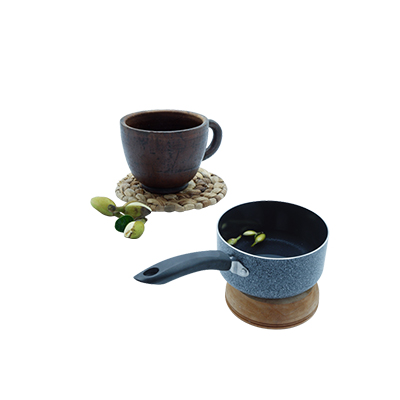
1. Irregular menstruation
- Prepare cempaka mulia putih flower buds as needed and wash until clean.
- Boil the ingredients until boiling.
- Strain the decoction.
- Drink while warm.
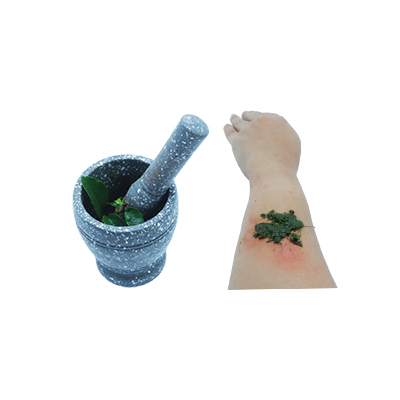
2. Wounds from falls
- Prepare cempaka mulia putih leaves, wash until clean.
- Mash the leaves into a paste.
- Apply the leaf paste to the injured wound.
Reference Sources
- Royal Botanic Gardens. 2017. Plants of the World Online: Magnolia figo (Lour.) DC.. http://powo.science.kew.org/taxon/urn:lsid:ipni.org:names:554702-1. 17-09-2021.
- Flora Fauna Web. 2019. Magnolia figo (Lour.) DC. https://www.nparks.gov.sg/florafaunaweb/flora/2/2/2224. 17-09-2021.
- Useful Tropical Plants Database. 2021. Magnolia figo. http://tropical.theferns.info/viewtropical.php?id=Magnolia+figo. 17-09-2021.
- Medicinal Plant Images Database. 2007. Michelia figo (Lour.) Spreng. https://libproject.hkbu.edu.hk/was40/detail?lang=en&record=3&channelid=1288&searchword=parent_chi%3D%E5%90%AB%E7%AC%91%E5%B1%ACC. 17-09-2021.
- L. Lin, C. L. Kao, S. T. Huang, H. T. Li, dan C. Y. Chen. 2019. CHEMICAL CONSTITUENTS OF THE FLOWERS OF Michelia figo. Chemistry of Natural Compounds, Vol. 55, No. 4, July, 2019. file:///C:/Users/HP01/Downloads/s10600-019-02811-7.pdf. 17-09-2021.
- H. C. Chen, C. T. Chen, H. Li, C. Chen. 2018. Chemical Constituents of the Leaves of Michelia figo. Chemistry of Natural Compounds. DOI:10.1007/s10600-018-2364-5Corpus ID: 4976959. https://www.semanticscholar.org/paper/Chemical-Constituents-of-the-Leaves-of-Michelia-Chen-Kao/e046088facae421c68525aadc9d6c29f1e6afda8. 17-09-2021.
- PROSEA. Plant Resources of South-East Asia. 2021. Michelia (PROSEA Essential oils). https://uses.plantnet-project.org/en/Michelia_(PROSEA_Essential_oils). 17-09-2021.