Matricaria chamomilla L.
Summary
Matricaria chamomilla or chamomile is native to Southern and Eastern Europe as well as northern and western Asia, and is now widely cultivated around the world. This herb has been used in herbal medicine since thousands of years ago in Ancient Egypt, Greece, and Rome, even believed by the Anglo-Saxons to be one of nine sacred herbs, and is now recorded in the pharmacopoeia of 26 countries. Its flowers are brewed as herbal tea and its essential oil is widely used in cosmetics and fragrances, with various studies confirming its antioxidant, antibacterial, and anti-inflammatory properties.
Agroecology
M. chamomilla can be found growing in vacant land, roadsides, and fields. Grows best in areas where the mean annual daytime temperature is in the range of 19-25°C, but can tolerate 6-30°C. When dormant, the plant can survive temperatures down to -5°C, but young growth can be severely damaged at 0°C. This species is tolerant of cold weather but grows better in full sun and requires long summer days and high temperatures. M. chamomilla also grows well in areas with mean annual rainfall in the range of 700-1,000 mm, but tolerates 300-1,300 mm. M. chamomilla can grow in all well-drained soil types, but planting it in rich, heavy, and moist soil should be avoided. Its growth also prefers neutral to slightly acidic soil pH conditions and succeeds in poor soil and moderate salinity conditions.
Morphology
- Roots thin, spindle-shaped.
- Stem branched, upright.
- Leaves narrow and long, bipinnate to tripinnate.
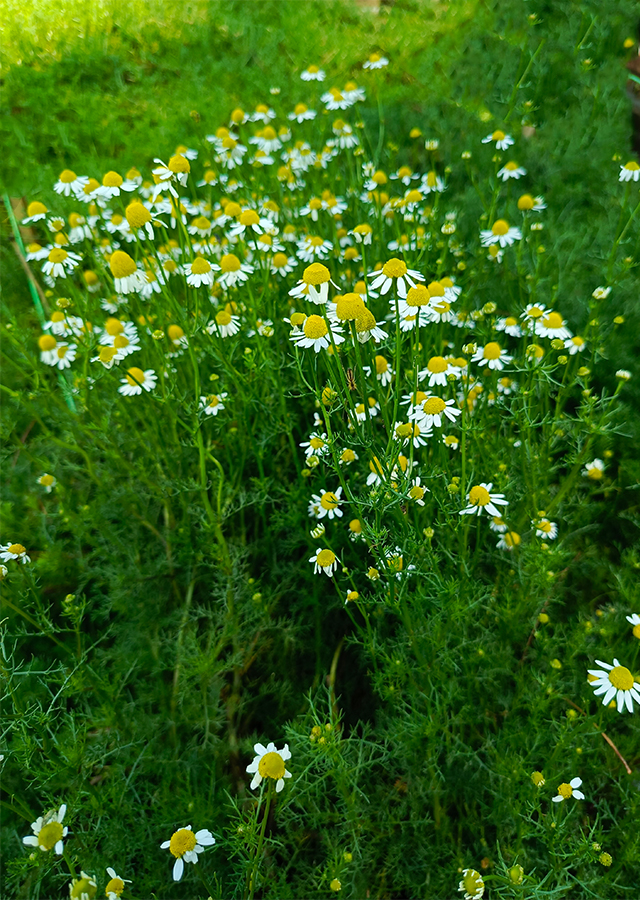
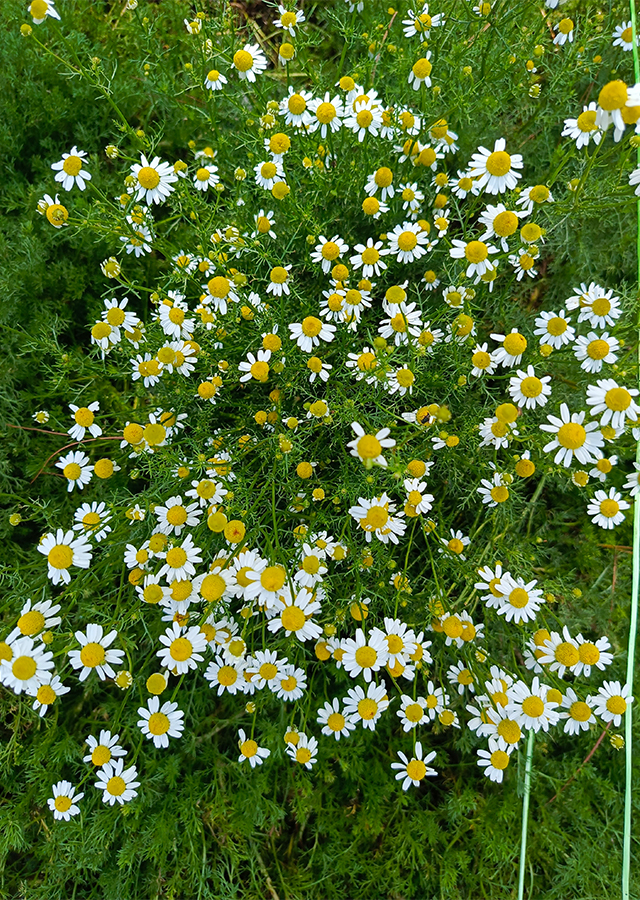
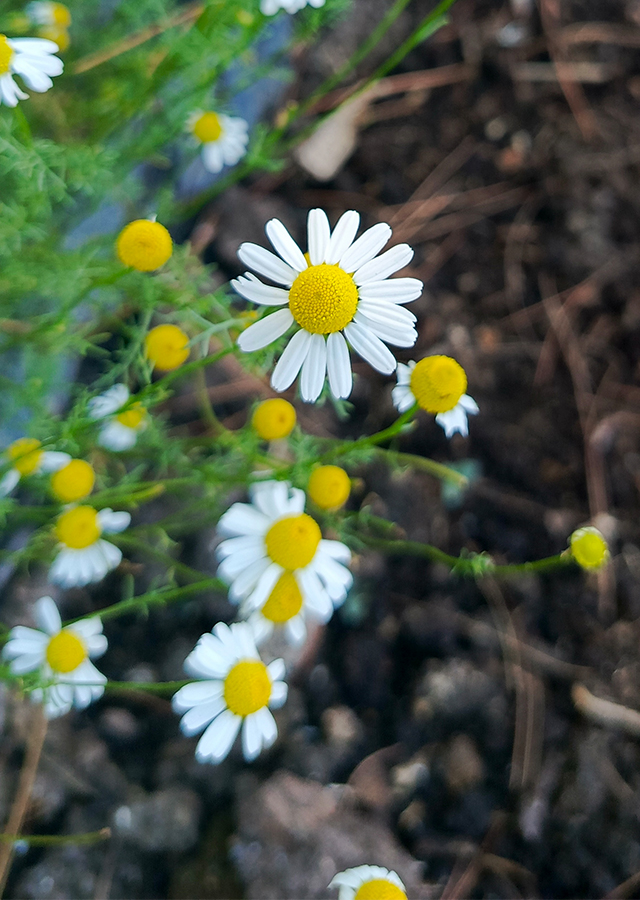
- Flowers white, 11 to 27 flowers arranged concentrically. Flower head stalked, heterogamous. Disc florets tube-shaped, golden yellow with 5 teeth, about 1.5 to 2.5 mm long, always ending in a glandular tube. Receptacle 6-8 mm wide, flat at first and conical shaped, later becoming cone-shaped, hollow (a very important distinguishing feature of Matricaria).
- Fruit a cypsela, yellowish brown with 3-5 faint ribs.
Cultivation
- Propagation is done generatively with seed.
- Seed germination begins within 4-5 days after sowing, and is ready to be transplanted within 4-5 weeks. Seedlings older than 5 weeks should not be transplanted, as this results in a less good harvest.
Chemical Content
Essential oil (consisting of terpenoids, such as α-bisabolol and its oxides A and B, bisabolol oxide A, chamazulene, and β-farnesene), phenolic compounds (including phenolic acids, flavonoids, and coumarins).
Benefits
Addresses stomach disorders related to pain, sluggish digestion, diarrhea and nausea, bloating, the common cold, liver disorders, neuropsychiatric issues, intermittent fever, respiratory problems, fights pain and infection, heals skin diseases (herpes zoster, boils), hemorrhoids, eyes, inflammation of the mouth and throat. Has antioxidant, antibacterial, antifungal, anticancer, antidiabetic, antiparasitic, anti-inflammatory, antidepressant, antipyretic, antiallergic, and analgesic activity.
Simplisia
- Pick an adequate amount of fresh chamomile flowers.
- Wash clean with running water.
- Air-dry in a shaded location for several days or dry using an oven at 40°C until evenly dry.
- Store the simplisia in a closed, light-proof container at room temperature.
Local Names
Information not found. Further research is needed.
Traditional Recipes
The following recipes reflect traditional knowledge passed down through generations, not a substitute for professional medical diagnosis or advice. Consult a healthcare provider before use.
1. Addresses digestive disorders
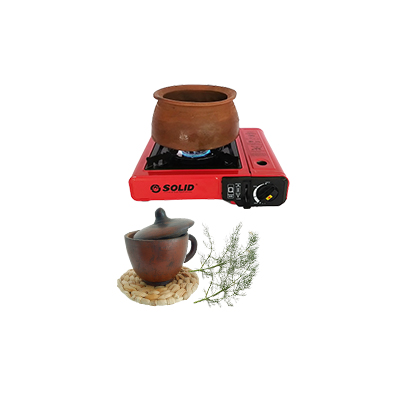
- Take an adequate amount of fresh chamomile leaves and wash until clean.
- Boil until it boils.
- Let it cool to warm/cold.
- Strain then drink.
Reference Sources
- Royal Botanic Gardens, Kew. (No date). Plants of the World Online: Matricaria chamomilla L. https://powo.science.kew.org/taxon/urn:lsid:ipni.org:names:154715-2. 23-11-2022.
- Fern, Ken. (2022). Useful Tropical Plants: Matricaria chamomilla. https://tropical.theferns.info/viewtropical.php?id=Matricaria+chamomilla. 23-11-2022.
- GBIF. (No date). Matricaria chamomilla L. https://www.gbif.org/species/8370958. 23-11-2022.
- Singh, Ompal, et al. (2011). Chamomile (Matricaria chamomilla L.): An overview. Pharmacogn Rev. 2011 Jan-Jun; 5(9): 82–95. doi: 10.4103/0973-7847.79103. Also available: https://www.ncbi.nlm.nih.gov/pmc/articles/PMC3210003/.