Melanolepis multiglandulosa (Reinw. ex Blume) Rchb. & Zoll.
Summary
Kayu along (Melanolepis multiglandulosa) is a tree 4-10 meters tall of the Euphorbiaceae family, distributed from Taiwan to Papua New Guinea, crossing southern Thailand and Indonesia. Its leaves are used to sweeten traditional fermented cassava, while its wood is used to make shoes. Traditionally, kayu along is also believed to relieve itching, broken bones, and venomous animal bites.
Agroecology
Grows well at elevations of 300-1,335 m above sea level. This plant can live in various soil types such as clay, alluvial sand, volcanic soil, and red loam. Usually easily found along roadsides, open forests, plantations, and mangrove forests.
Morphology
- Stem upright woody, young stem covered with fine whitish hairs, smooth bark. Has milk-like, sticky latex.
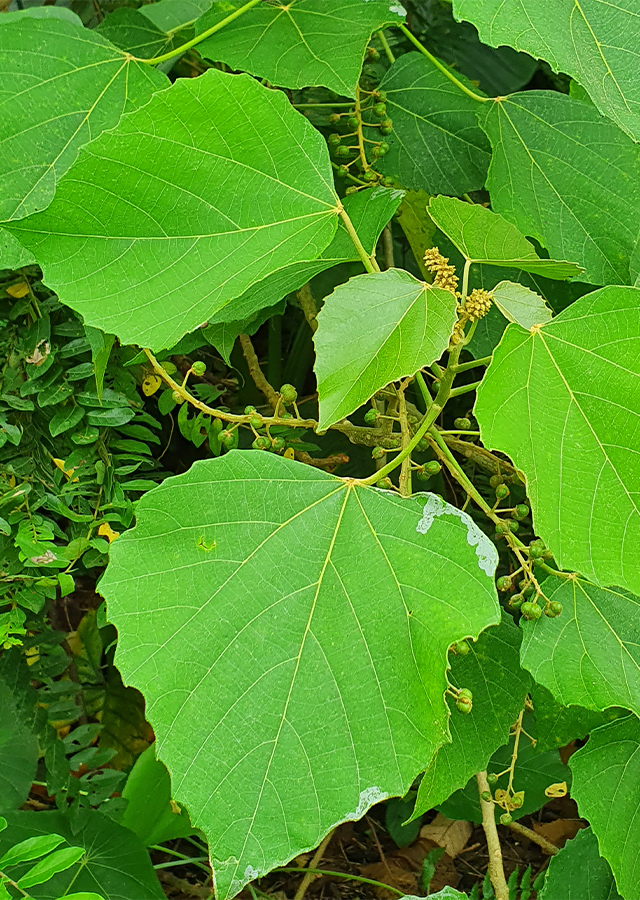
- Leaves heart to wedge shaped, large, coarsely serrated edges, palm-like veins, green, rough surface.
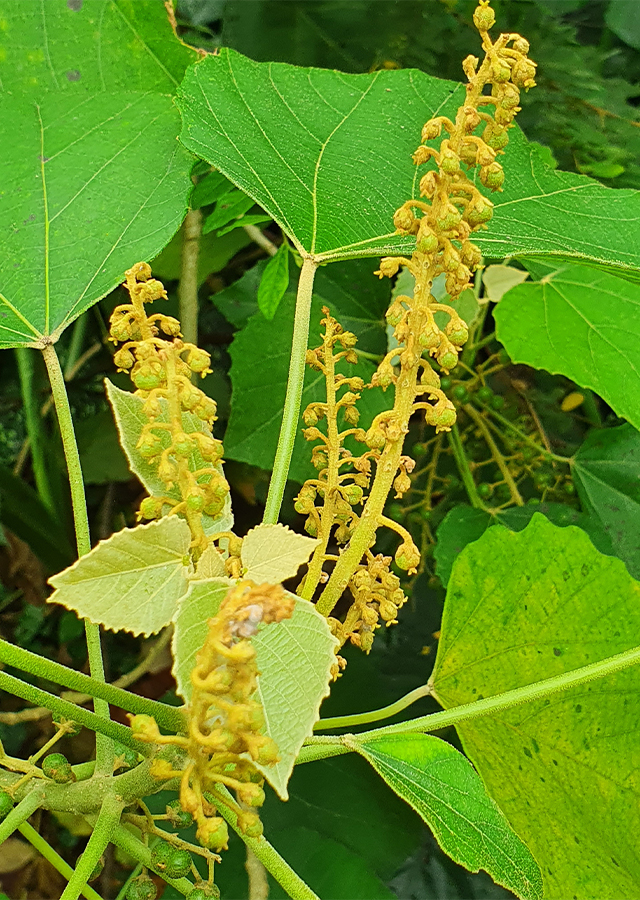
- Flowers yellowish-green in color. Round flower buds, female flowers hairy and thorny. Grow in panicles from leaf axils, near branch tips.
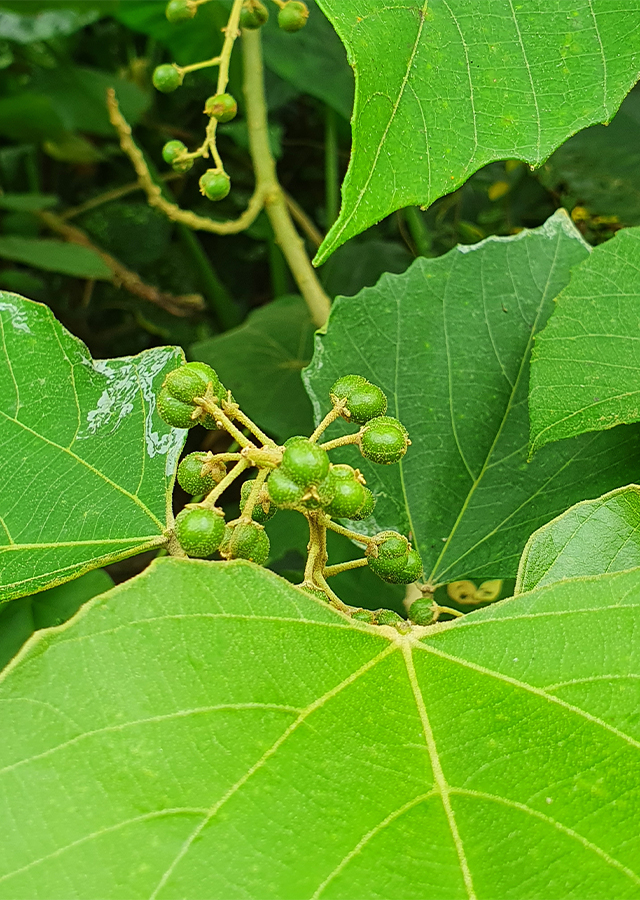
- Fruit gray to green in color, finely short-haired on the surface. Inverted heart-shaped capsule sized 9-15 x 7-9 mm.
- Seeds round shaped, brown in color, rough texture sized 5.5-6 x 4.5-5 mm.
Cultivation
- Propagated by seed and stem cuttings.
- Seeds germinate faster in bright conditions (without shade), around 5 weeks.
Chemical Content
Friedelin, oleanolic acid, β-amyrin acetate, phytosterol, stigmasterol, β-sitosterol, squalene, β-carotene, alkaloids, flavonoids, saponins, tannins.
Benefits
Remedy for itching, gonorrhea, broken bones, worm remedy (parasites), cough, constipation, tuberculosis, fever, addresses snake and centipede venom, addresses dandruff problems.
Simplisia
- Select fresh leaves. Wash thoroughly with running water then drain.
- Dry in an oven at 40 °C or in the sun until evenly dry (leaves crumble when crushed).
- Once dry, grind the material and store in a closed, airtight container at room temperature.
Local Names
Kakuk lamak, Donu, Daun kapur (Malay, Maluku), Ngalu (Halmahera, Tidore), Tutup (Java).
Traditional Recipes
The following recipes reflect traditional knowledge passed down through generations, not a substitute for professional medical diagnosis or advice. Consult a healthcare provider before use.
1. Addressing Centipede and Snake Venom
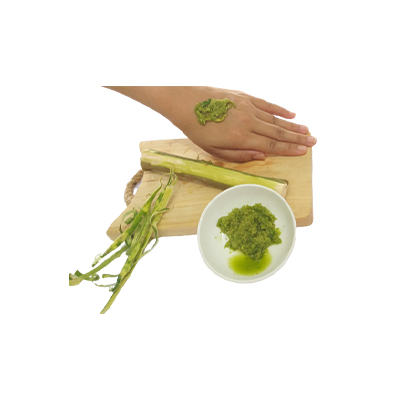
- Take an adequate amount of kayu along bark, wash thoroughly with boiled water.
- Chew then apply the liquid to the skin bitten by a centipede or snake.
2. Addressing Dandruff
- Wash kayu along leaves and an adequate amount of ginger thoroughly.
- Peel the ginger and cut into pieces then mash together with the kayu along leaves.
- Apply to the scalp for a while then shampoo.
Reference Sources
- Stuartxchange. Philippine Medicinal Plants. Alim. http://www.stuartxchange.org/Alim.html 15-09-2020. Sumber Ramuan: Steven E. Windou. 2020. (Mengatasi bisa kelabang dan ular).
- Stuartxchange. Philippine Medicinal Plants. Alim.http://www.stuartxchange.org/Alim.html akses 15 sept 2020. Sumber ramuan : Jane G. Morilla, dkk., 2014. (Mengatasi ketombe).
- ReseachGate. Chemical Constituents of Melanolepis multiglandulosa (Reinw. ex Blume). https://www.researchgate.net/publication/312147483_Chemical_Constituents_of_Melanolepis_multiglandulosa_Reinw_ex_Blume 22-02-2021.