Melastoma malabathricum L.
Summary
Senggani (Melastoma malabathricum) is a shrub up to 1-5 meters tall of the Melastomataceae family, a medicinal plant native to Indonesia and China widely used by communities in West Kalimantan and Central Sulawesi as a fever remedy. Its leaves are also used in cooking to remove the bitter taste from papaya flowers. Senggani is traditionally believed to stop bleeding and neutralize cassava poisoning.
Agroecology
Senggani can be found in tropical and subtropical climates, from lowlands up to elevations of 1,650 m above sea level. Grows wild at forest edges, disturbed land, thickets, and mountain slopes. Prefers ample sunlight and low (acidic) soil pH.
Morphology
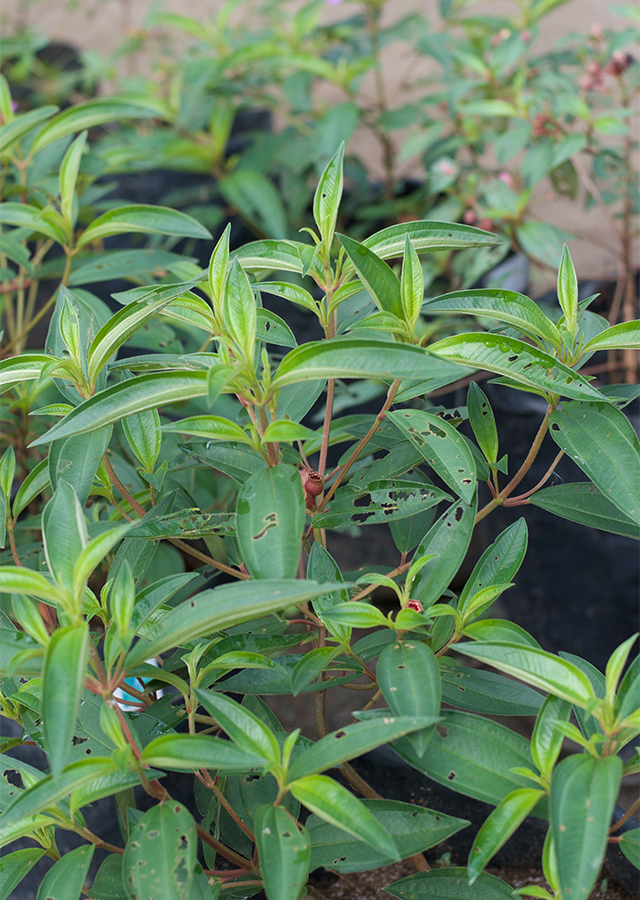
- Stem reddish in color, covered with hairy scales and small hairs.
- Leaves thick, stiff, green to yellowish-green in color.
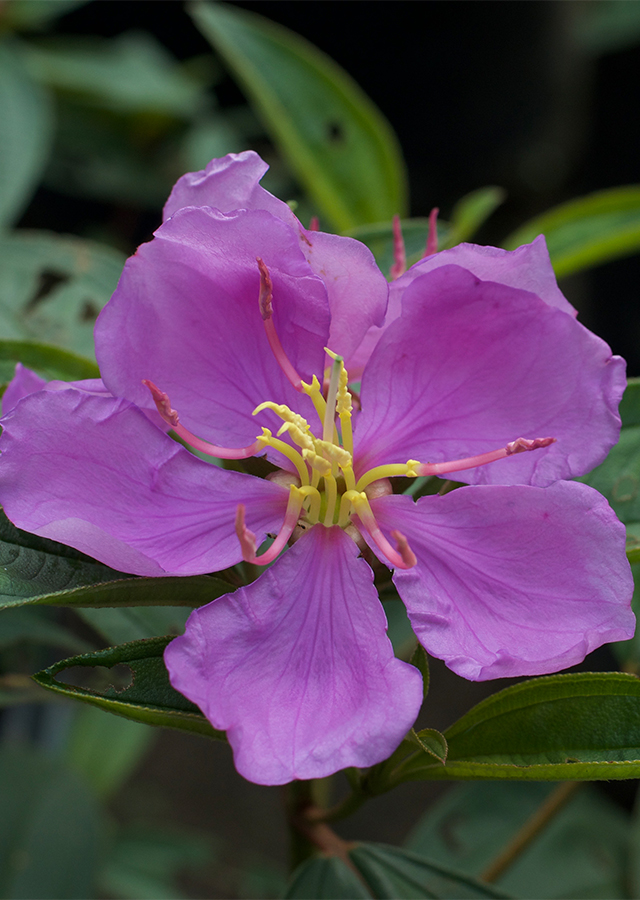
- Flowers reddish-purple, with a greenish-brown raceme and stalk.
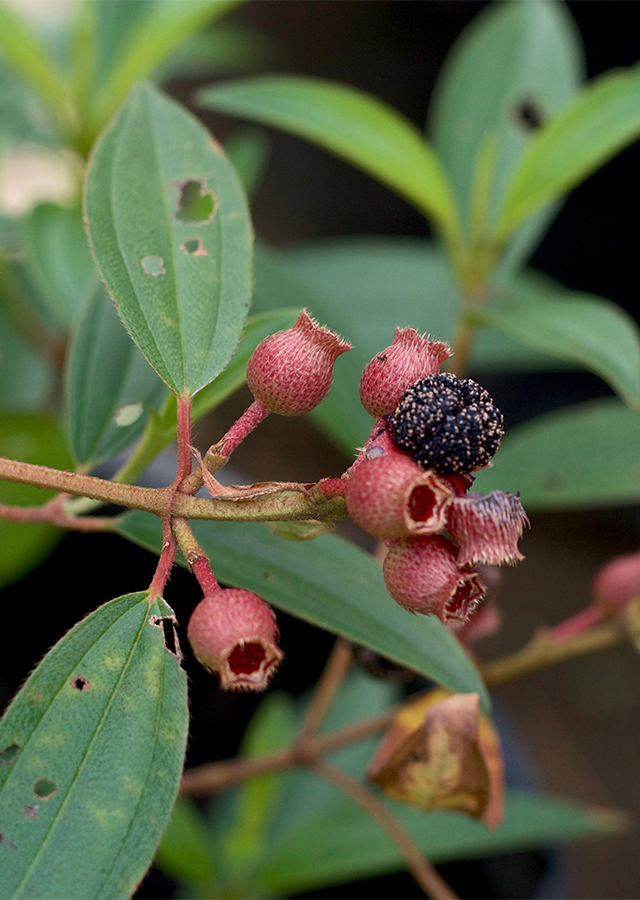
- Fruit a round, capsule-shaped berry, which splits open into several segments when ripe, dark reddish-purple in color.
- Seeds small, brown-speckled.
Cultivation
- Propagated using seed.
- Fast-growing, usually able to flower within 3 months.
Chemical Content
Flavonoid, tannin, saponin, castalagin compound, procyanidin B-2, helichrysoside, ellagic acid, anthocyanin, melastomic acid, sterol, ursolic acid, p-hydroxybenzoic acid, gallic acid.
Benefits
Relieves pain, reduces fever, stops bleeding, improves blood circulation, addresses swelling, vaginal discharge, as a diuretic, antiseptic, diarrhea, canker sores, neutralizes cassava poisoning.
Simplisia
- Collect senggani leaves. Clean off dirt attached to the leaves.
- Dry the leaves in the sun for approximately 5-7 days on a mat.
- Grind into powder.
- Pack the simplisia in vacuum plastic then store.
Local Names
Known locally as Senduduk (Malay), Cengkodok (West Kalimantan), Harendong (Sunda), Kluruk (Java), Kemanden (Madura), Kedebik (Bangka).
Traditional Recipes
The following recipes reflect traditional knowledge passed down through generations, not a substitute for professional medical diagnosis or advice. Consult a healthcare provider before use.
1. Vaginal discharge
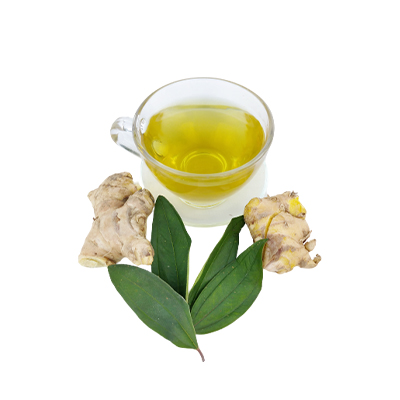
- Wash thoroughly 2 handfuls of fresh senggani leaves, 1 thumb-sized ginger, and 1 thumb-sized bangle (Zingiber cassumunar).
- Boil all ingredients with 3 glasses of water and 1 tbsp vinegar until boiling and reduced to 2 glasses, cool and strain.
- Drink twice a day, 1 glass each time.
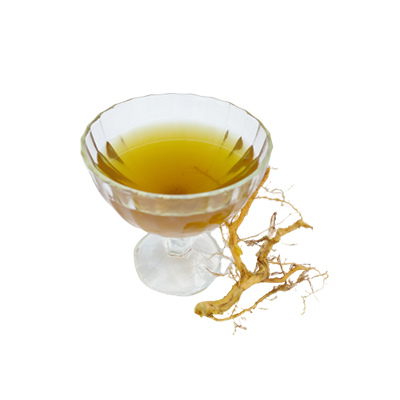
2. Neutralizing cassava poisoning
- Boil 60 g senggani root or leaves with 3 glasses of water until reduced to 1 glass.
- Cool then strain, drink all at once.
Reference Sources
- Tropical Plants Database, Ken Fern. tropical.theferns.info. Melastoma malabathricum. http://tropical.theferns.info/viewtropical.php?id=Melastoma+malabathricum 31-01-2021
- Hindawi.com. Melastoma malabathricum (L.) Smith Ethnomedicinal Uses, Chemical Constituents, and Pharmacological Properties: A Review. https://www.hindawi.com/journals/ecam/2012/258434/ 15-01-2021
- Cheng JT, Hsu FL, Chen HF. 1993. Antihypertensive principles from the leaves of Melastoma candidum. Planta Med 1993 59(5): 405-406
- ISSG. Global Invasive Species Database. Melastoma candidum. http://www.iucngisd.org/gisd/species.php?sc=1053 16-12-2019
- Marjoni MR, Zulfisa A. 2017. Antioxidant Activity of Methanol Extract/Fractions of Senggani Leaves (Melastoma candidum D. Don). Pharm. Anal. Acta. 8(8): 557-563.
- Pertanianku. 2015. Mengenal Tanaman Senggani. https://www.pertanianku.com/mengenal-tanaman-senggani/ 13-12-2019
- Wang YC, Hsu HW, Liao WL. 2007. Antibacterial activity of Melastoma candidum D. Don. Food Science and Technology 41: 1793-1798.