Miconia crenata (Vahl) Michelang.
Summary
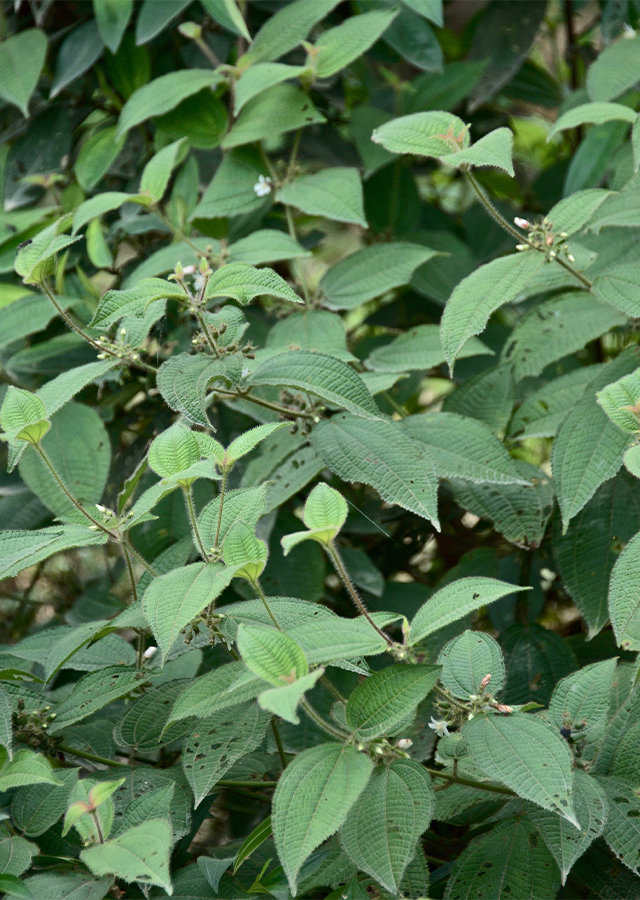
Senggani bulu (Miconia crenata) is a shrub up to 3 meters tall of the Melastomataceae family, a plant native to Central and South America nicknamed 'Koster's Curse' because it was accidentally spread to Fiji via coffee seedlings in the 1880s and became an invasive weed. Even so, its fruit can be eaten and its leaves are traditionally believed to be antiseptic. Senggani bulu is also used to dry out wounds and stop bleeding from leech bites.
Agroecology
The natural habitat of the senggani bulu plant is in areas with high humidity such as wet forests, secondary forests, ravine edges and shrubland at elevations up to 1,300 m above sea level. This plant grows well under shade as well as in open areas. Average annual rainfall 1,000-4,000 mm/year.
Morphology
- Roots taproot, brown in color.
- Stem round, densely hairy, woody, brown, sympodial branching.
- Leaves single, oval, dark green, covered with reddish-brown hairs, 5-18 cm long and 3-8 cm wide.
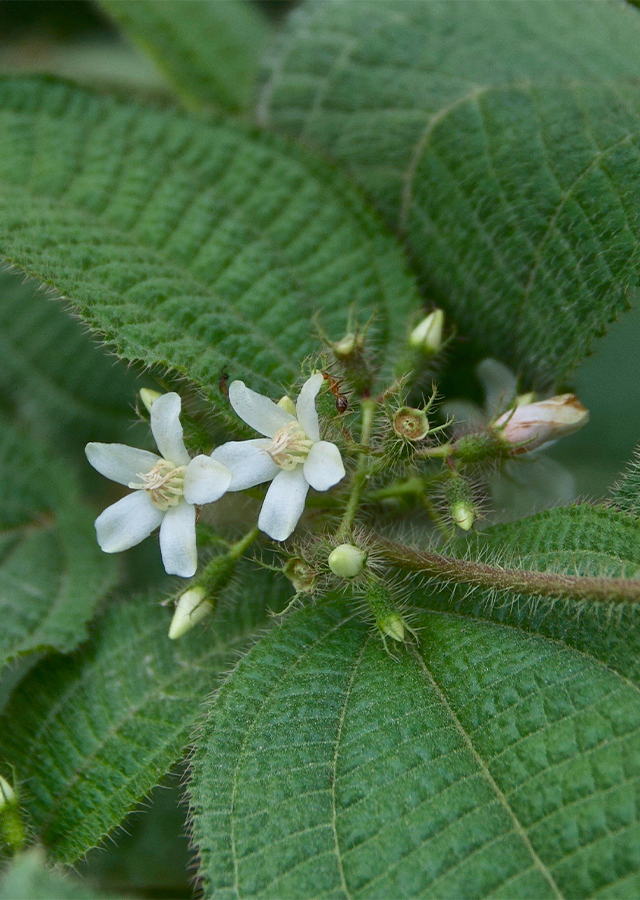
- Flowers compound, white, located at the branch tip with a fused calyx.
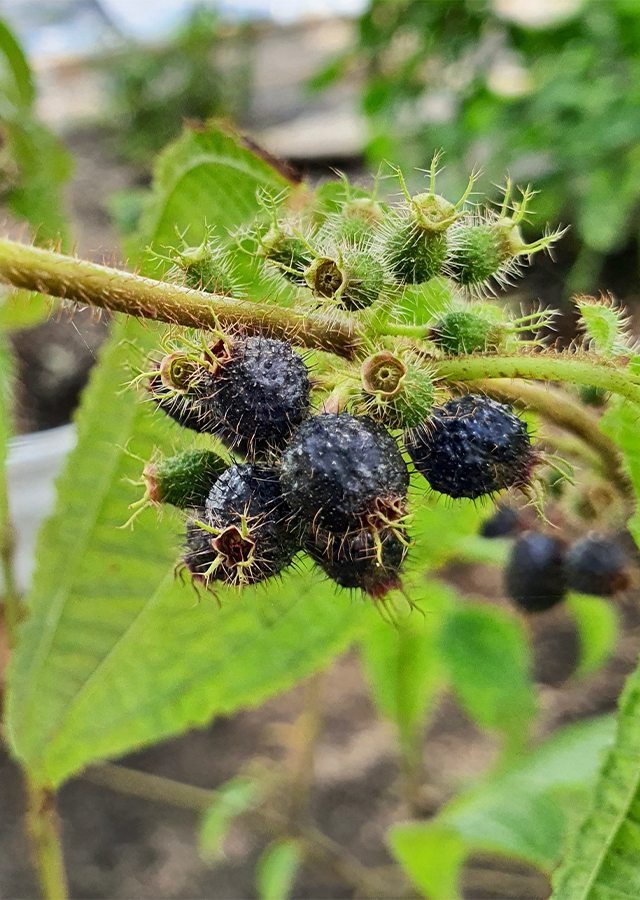
- Fruit egg-shaped, green when young and turning blackish-purple when mature.
- Seeds small, purple in color
Cultivation
- Propagated generatively (by seed).
- Seeds can be carried by shoes or vehicle tires and are able to grow after more than 4 years.
Chemical Content
Alkaloids, flavonoids, steroids, triterpenoids, tannins, saponins, glycosides, ellagic acid, hentriacontane hydrocarbon, quercitrin
Benefits
Antiseptic, astringent, antispasmodic, stomach ache remedy, fungal infections, canker sores, excessive menstruation, dries out wounds, stops bleeding from leech bites.
Simplisia
- Collect senggani bulu leaves then sort the material (selecting healthy materials).
- Wash with clean water then air-dry/dry in the sun until dry.
- Pack in plastic (vacuum), label and note the processing date. Store indoors (temperature 8-15°C).
Local Names
Senduduk bulu (Sumatra), Harendong bulu, Harendonglalaki, Harendong leuweung (Sunda), Keduduk bulu, Kapasan.
Traditional Recipes
The following recipes reflect traditional knowledge passed down through generations, not a substitute for professional medical diagnosis or advice. Consult a healthcare provider before use.
1. Canker Sores
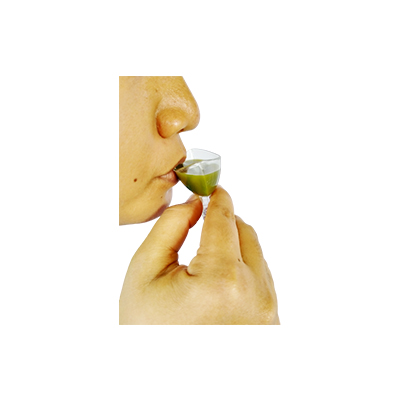
- Prepare 10 g fresh senggani bulu leaves then wash. Pound the material, add 2-3 tbsp water then squeeze and take the liquid for gargling.
- Treat 3 times a day.
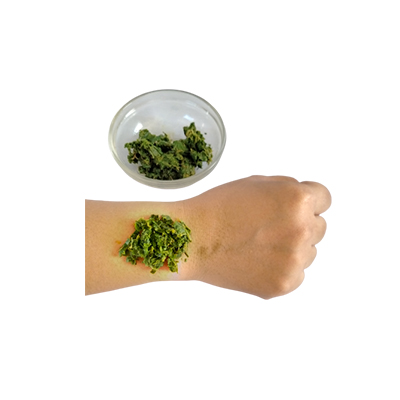
2. Reducing Bleeding from a Wound
- Prepare 1 handful of senggani bulu leaves then wash.
- Pound until mashed.
- Wrap on the wounded area.
Reference Sources
- Dianita R. 2011. Antibacterial Activity of Different Extracts of Clidemia hirta (L.) D. Don leaves. Planta Medica 77(12)
- Pardede A. 2018. Uji aktivitas antioksidan dari ekstrak etanol buah Senduduk bulu (Clidemia hirta [L.] D. Don.) dengan metode pemerangkapan DPPH (1,1-diphenyl-2-picrylhidrazil). Skripsi. Fakultas Farmasi. Universitas Sumatera Utara. Medan.
- Ken Fern. tropical. theferns. info. http://tropical.theferns.info/viewtropical.php?id=Clidemia+hirta 09-12-2019
- http://tropical.theferns.info/viewtropical.php?id=Clidemia+hirta