Morinda citrifolia L.
Summary
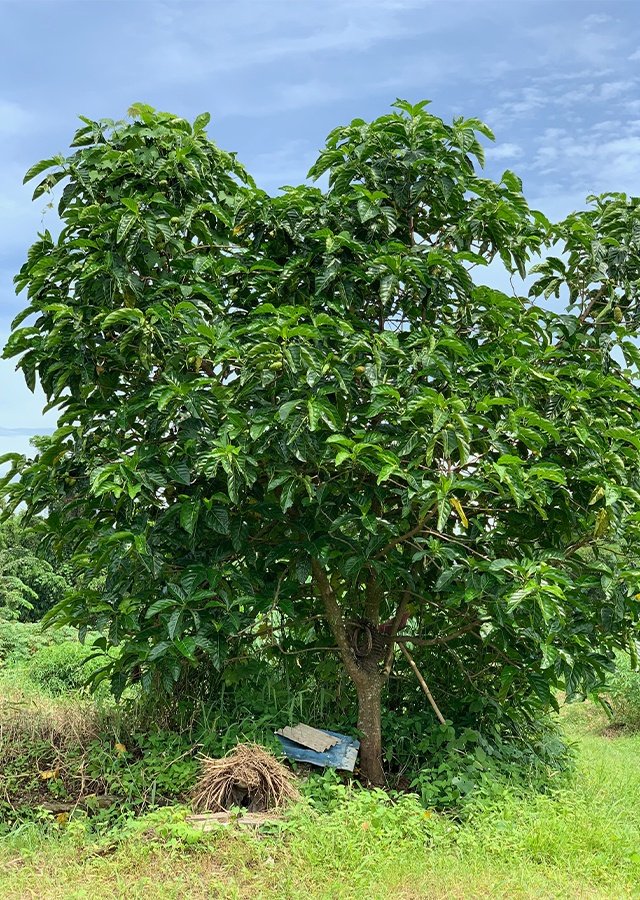
Mengkudu or noni (Morinda citrifolia) is a tree 2-6 meters tall of the Rubiaceae family, a plant native to Queensland, Australia, that spread by ocean currents to Hawaii and Easter Island before becoming widely known in Southeast Asia. Its root bark is used as a natural red dye for fabric. Its distinctively pungent fruit has long been traditionally known to lower high blood pressure and relieve joint inflammation.
Agroecology
Grows well up to elevations starting from 1,500 m above sea level, annual rainfall 1,500-3,000 mm/year, temperature 22-30°C. Prefers clay loam soil texture, sandy soil and sandy clay soil. Mengkudu also requires adequate sunlight.
Morphology
- Roots deep taproot.
- Stem hairy, rectangular shaped, grayish or yellowish-brown.
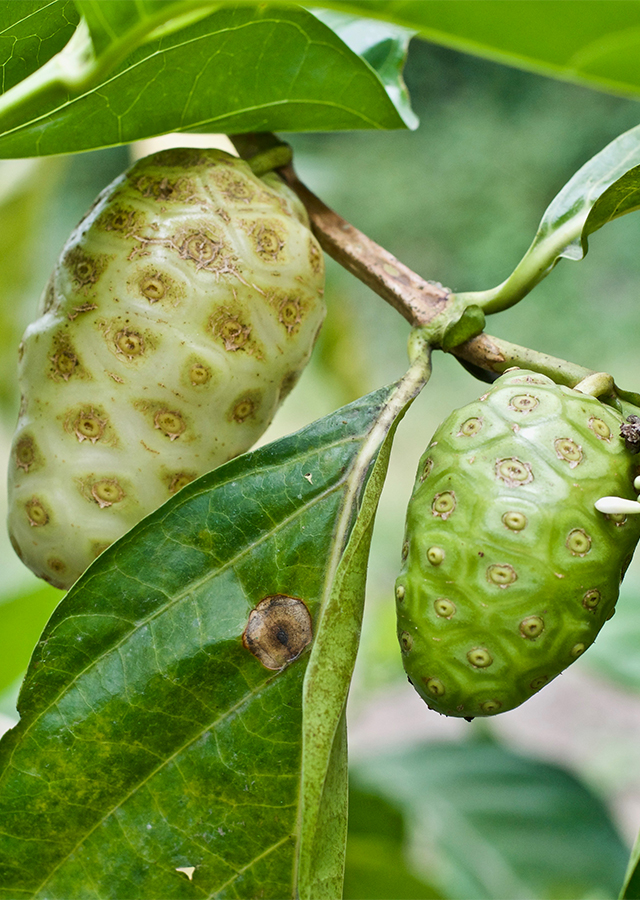
- Leaves green, oblong to elliptical, somewhat rough wavy leaf surface, smooth leaf edges, short pointed tip.
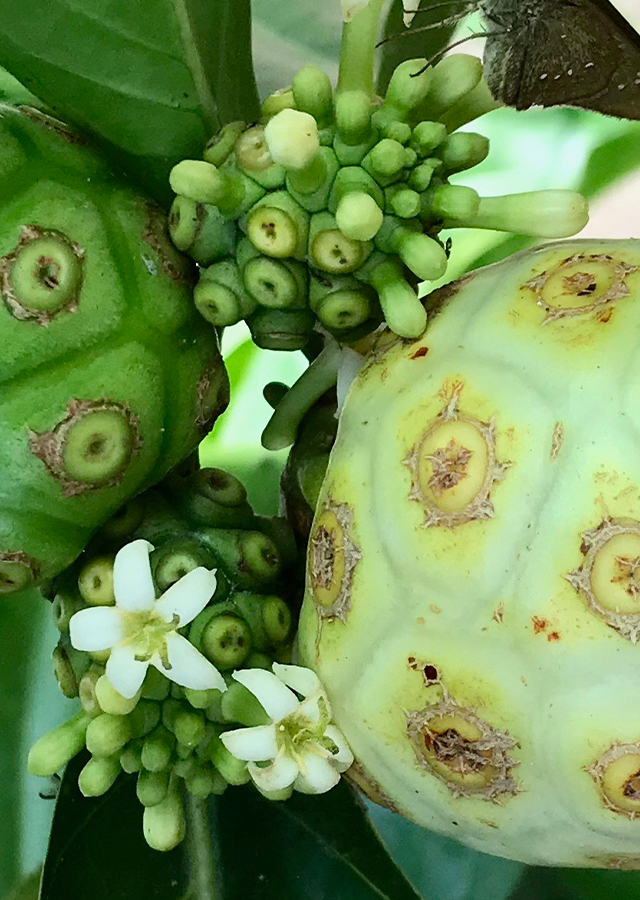
- Flowers head-shaped, emerging from leaf axils, bisexual, funnel-shaped petals.
- Fruit a compound berry, uneven fruit surface, divided into polygonal cells that are spotted and warty.
Cultivation
- Propagated generatively (by seed) and vegetatively (cuttings).
- Sow the seed first. Once germinated, transplant the seedling to the field with a planting distance of 1.2 x 1.2 m.
Chemical Content
Lignans (americanin A), amino acids, flavonoids, triterpenoids, sterols, iridoids, chlorophyll derivatives, coumarin derivatives, fatty acids, fatty acid esters, anthraquinones, alkaloids, saponins, polyphenols.
Benefits
Antiseptic, antioxidant, lowers high blood pressure and fever, promotes urination, remedy for constipation and stomach ache, treats joint inflammation, kidney inflammation, boils, wounds, headache, influenza.
Simplisia
- Harvest mengkudu fruit that is evenly yellowish-white and the flesh is still firm.
- Wash the fruit thoroughly, drain and cut into thin pieces.
- Slice the fruit thinly, then dry in the sun or use an oven at 40°C for 3 hours. Drying is done until the fruit slices are completely dry. Once dry, separate the fruit flesh from the seeds.
- Grind the dried fruit flesh into powder using a blender.
Local Names
Keumeudee (Aceh), Pace, Kemudu, Kudu (Java), Cangkudu (Sunda), Noni (Manado and Maluku), Tibah (Bali), Kodhuk (Madura).
Traditional Recipes
The following recipes reflect traditional knowledge passed down through generations, not a substitute for professional medical diagnosis or advice. Consult a healthcare provider before use.
1. Hypertension
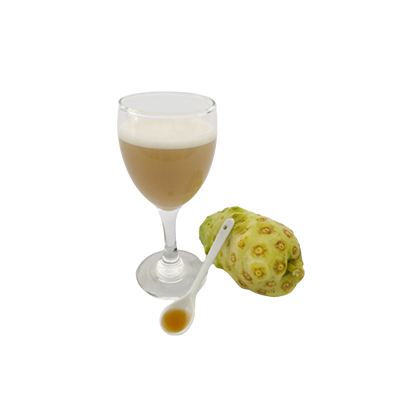
- Take 2 ripe mengkudu fruits and 1 tbsp honey.
- Squeeze the mengkudu fruit, take the liquid then mix with honey until well combined and strain.
- Drink twice a day.
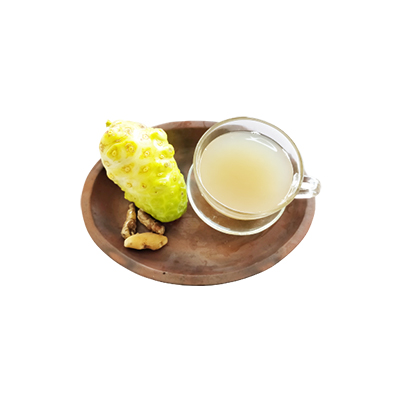
2. Fever and Influenza
- Take 1 mengkudu fruit and 1 kencur rhizome.
- Boil all ingredients with 2 glasses of water until it boils and 1 glass of water remains, then strain.
- Drink twice a day.
Reference Sources
- Assi RA, Darwis Y, Abdulbaqi IM, Vuanghao L, Laghari MH. 2017. Morinda citrifolia (Noni): A comprehensive review on its industrial uses, pharmacological activities, and clinical trials. Arabian Journal of Chemistry 10(5): 691-707.
- Kementrian Kesehatan Republik Indonesia. 2017. Formularium Ramuan Obat Tradisional Indonesia.
- Prosea. 2016. Morinda citrifolia. https://uses.plantnet-project.org/en/Morinda_citrifolia_ (PROSEA) 12-06-2020.
- Rahayu S, Refelita F. 2017. Pemanfaatan buah Mengkudu terhadap kualitas minyak jelantah sebagai sumber belajar kimia di SMA Kuantan Singingi. Konfigurasi: Jurnal Pendidikan Kimia dan Terapan 1(1): 41-48.
- Singh DR. 2012. Morinda citrifolia L. (Noni): A review of the scientific validation for its nutritional and therapeutic properties. J. Diabetes Endocrinol. 3(6): 77-91.
- Utami AM. 2010. Aktivitas antioksidan ekstrak buah dan daun Mengkudu. Skripsi. Fakultas Matematika dan Ilmu Pengetahuan Alam. Institut Pertanian Bogor. Bogor.
- Tropical Plants Database, Ken Fern. tropical.theferns.info. Morinda citrifolia. http://tropical.theferns.info/viewtropical.php?id=Morinda+citrifolia. 03-02-2021.