Muehlenbeckia platyclada (F.Muell.) Meisn.
Summary
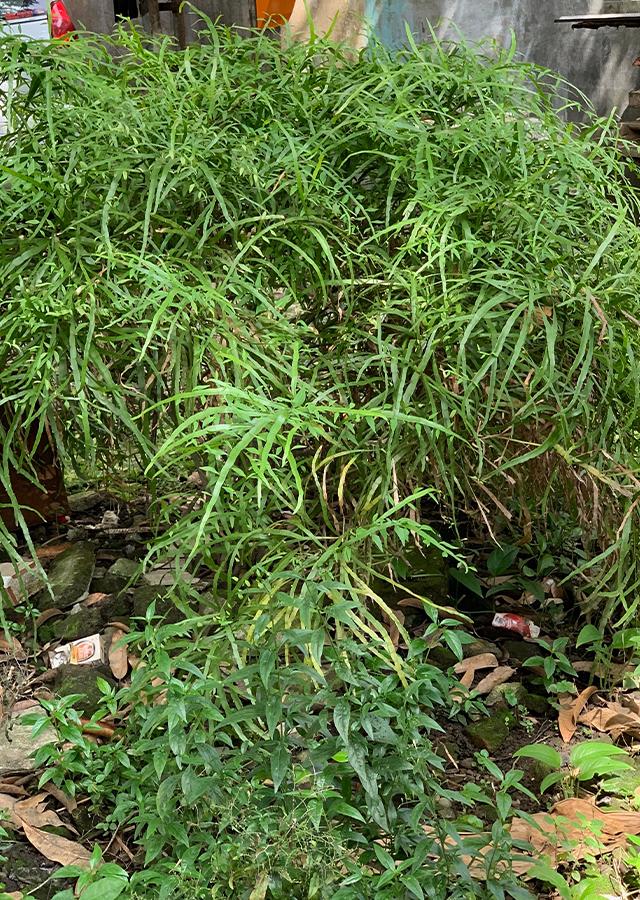
Ribbon bush (Muehlenbeckia platyclada) is an erect shrub 1-3 meters tall of the Polygonaceae family, native to the Solomon Islands and Papua New Guinea, now distributed to India, Madagascar, and throughout the Nusantara. Its flattened, leaf-like stems give it a unique appearance as a garden ornamental. Traditionally, ribbon bush is used to treat bruises, snakebites, and rheumatic pain.
Agroecology
Grows ideally in areas with somewhat dry sandy soil, in full sun to partial shade. Favors shade or partial shade, moisture, and loose soil. Commonly found in front yards, forest edges, and also grown in pots.
Morphology
- Roots taproot, brownish-white.
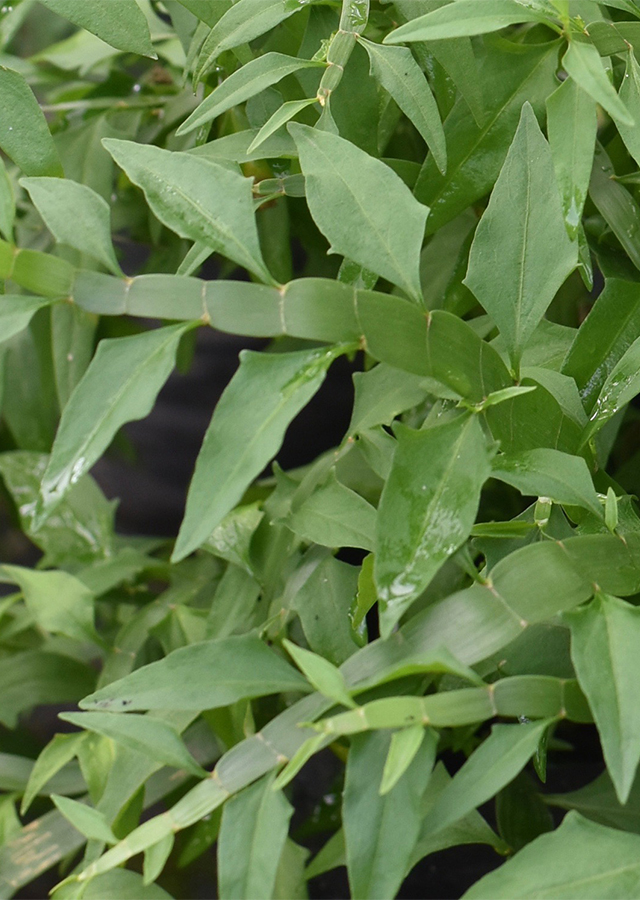
- Stem round and cylindrical, 1-3 cm in diameter, woody, heavily branched, with branches shaped like elongated, jointed ribbons 10-30 cm long, 1-5 cm wide, green, and about 7-12 mm thick.
- Leaves emerge at each branch node, elongated shape, tapering petiole and tip, green, small size.
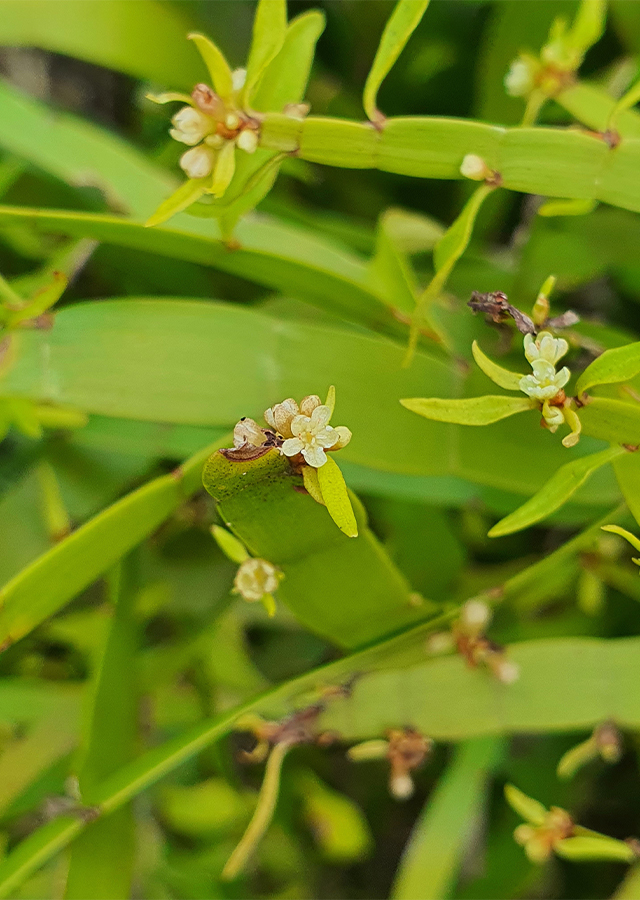
- Flowers bisexual, round, white calyx, small and clustered.
- Fruit round-oblong and red.
Cultivation
- Propagated generatively (by seed) and vegetatively (by cuttings).
- Sown seeds must be fresh, germinating within 14-21 days at 21 °C.
Chemical Content
Saponins, flavonoids (kaempferol-3-O-α-rhamnopyranoside and kaempferol-3-O-β-glucopyranoside), alkaloids, acetophenone, lignin, anthraquinones, tannins.
Benefits
Treats skin infections, burns, bruises such as from falls; treats anthrax; treats pain and rheumatism; treats snake and insect bites; acts as an astringent to tighten skin pores.
Simplisia
- Select fresh, undamaged leaves. Wash the leaves under clean running water, then drain.
- Sun-dry, covering the leaves with a dark cloth to avoid direct sun exposure, or use an oven (50-60 °C).
- Dry-sort to remove unwanted foreign material. Store the dried material in a plastic bag, at room temperature, well-ventilated, away from direct sunlight, not in direct contact with the floor.
Local Names
Cakra birawa (Java), Puring jakang.
Traditional Recipes
The following recipes reflect traditional knowledge passed down through generations, not a substitute for professional medical diagnosis or advice. Consult a healthcare provider before use.
1. Swelling or Bruising
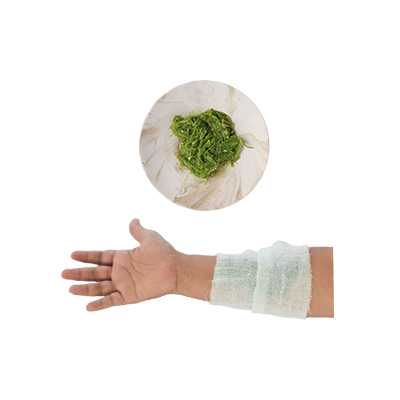
- Prepare 60 g of fresh ribbon bush twigs.
- Wash thoroughly under running water.
- Finely pound the twigs and add a sufficient amount of rice wine (arak).
- Apply the residue to the swollen area, wrap with a bandage.
Reference Sources
- Grant, A., (2018). Tapeworm Plant Care – How To Grow A Tapeworm Plant. https://www.gardeningknowhow.com/ornamental/shrubs/tapeworm-ribbon-bush/tapeworm-plant-care.htm. 01-09-2020
- Hear (PIER). (2012) Pacific Island Ecosystems at Risk - Muehlenbeckia platyclada. http://www.hear.org/pier/commonnames/details/muehlenbeckia_platyclada.htm. 01-09-2020
- Herb Pathy. (No date). Make Life Healthy. https://herbpathy.com/Uses-and-Benefits-of-Homalocladium-Platycladum-Cid5767. 05-01-2021
- Medicinal Plant Images Database. (2007). Homalocladium platycladum (F.Muell.) Bailey. https://libproject.hkbu.edu.hk/was40/detail?lang=en&channelid=1288&searchword=herb_id=D00533#:~:text=Clearing%20heat%2C%20detoxifying%2C%20dissipating%20stasis%20and%20dispersing%20swelling.&text=Used%20for%20anthracia%20and%20sores,bites%20by%20snakes%20and%20insects. 05-01-2021
- Top Tropicals. (No date). Homalocladium platycladum, Muehlenbeckia platyclada. https://toptropicals.com/catalog/uid/Homalocladium_platycladum.htm. 01-09-2020
- Ncbi. (2010). Pharmacological Proprieties of the Ethanol Extract of Muehlenbeckia platyclada (F. Muell.) Meisn. Leaves. https://www.ncbi.nlm.nih.gov/pmc/articles/PMC2996782/. 01-09-2020