Mussaenda erythrophylla Schumach. & Thonn.
Summary
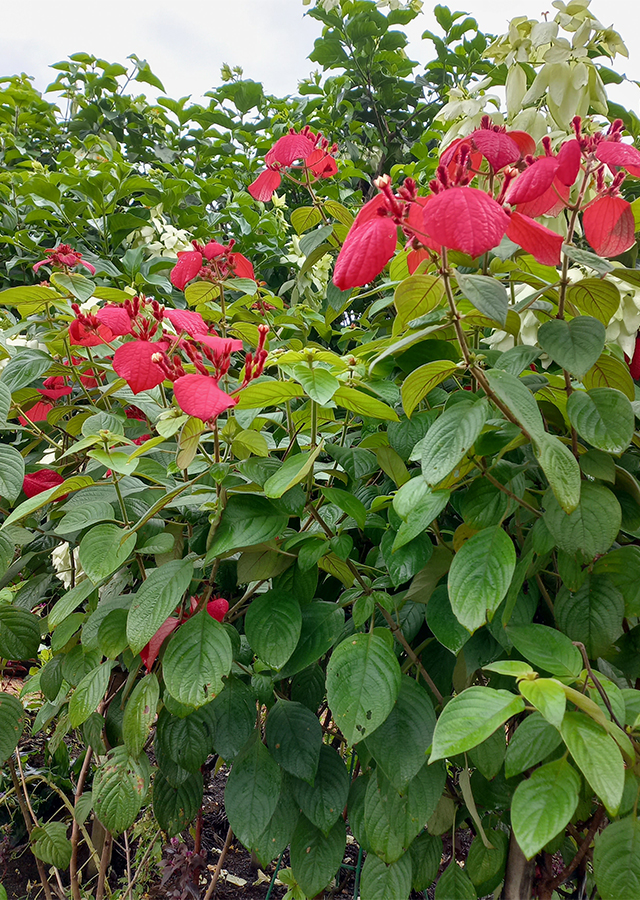
Nusa indah merah (Mussaenda erythrophylla) is a shrub 1.5-3 meters tall, even up to 8 meters in the wild, from the Rubiaceae family that originates from tropical Africa. Its blazing red, long-lasting inflorescence makes it a popular ornamental throughout the tropical world. Nusa indah merah is traditionally used in Africa and Asia to address worms and dysentery.
Agroecology
Nusa indah merah is generally found growing in old cocoa plantations with remnants of native forest, secondary thickets along streams, forest edges, riverbanks, shrubby savannas and in thickets along roadsides. In Fiji, this plant is cultivated on sandy soil near sea level. This plant prefers warm, humid habitats, but also adapts to semi-deciduous and dry locations. Grows best in areas with full sun and porous soil with a soil acidity (pH) in the range of 7-8.5. This plant also requires quite a lot of water so it prefers regular watering without the roots being submerged in water, and is not drought-tolerant.
Morphology
- Roots branched taproot.
- Stem round, light brown surface, monopodial branching.
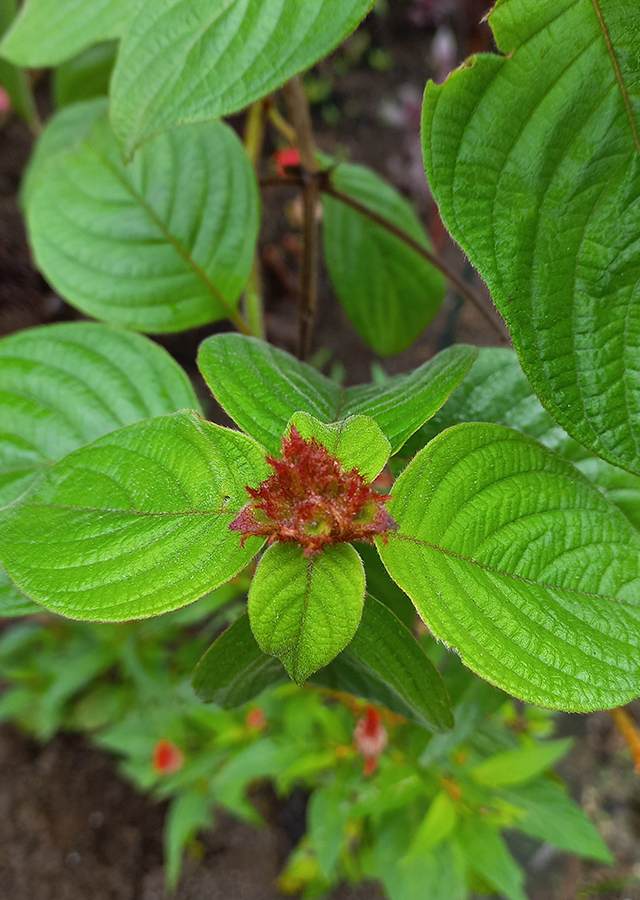
- Leaves single, oppositely crossed, green, oblong-ovate to almost heart-shaped (when young), leaf tip tapering, leaf base blunt to somewhat pointed, smooth leaf margin, many pilose (fine, soft hairs), prominent leaf veins, pinnate venation, rough surface.
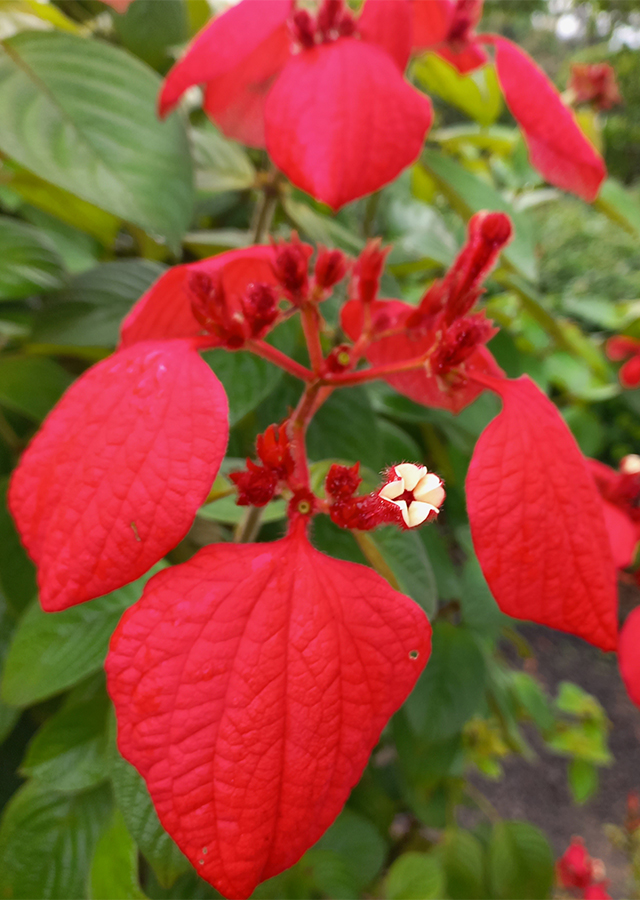
- Flowers have a calyx modified into a broad petal-like blade, 5 lobes, one of the five calyx lobes develops rapidly and enlarges, ovate-lanceolate shaped, bright red above and somewhat paler below, pubescent, while the other lobes are narrowly linear-lanceolate and red or bright red. Corolla tubular, has 5 lobes, pubescent, whitish-cream white, pale yellow with a reddish ring in the center. Stamens numbering 5, filaments yellowish-white, anthers green. Inflorescence terminal, a panicle.
- Fruit a berry, ovate-shaped.
- Seeds small, numerous.
Cultivation
Propagation can be done generatively (seeds) and vegetatively (stem cuttings, layering or air layering).
Chemical Content
Alkaloid, phytosterol, flavonoid, saponin, steroid, phenolic, triterpenoid, glycoside, tannin, β-sitosterol, 5-hydroxy-7,4′-dimethoxy flavones, 3-iso cumaryloxy-cyclopropane-1-oic acid, 4-hydroxy-3-methoxy cinnamic acid, mussaendoside A-C, M and N with clyclolanostene and aureusidin type aglycones, iridoid glycoside.
Benefits
Addresses coughs, jaundice, treats eye infections, worms, body aches, diarrhea, dysentery, intestinal inflammation, food poisoning, kidney inflammation, respiratory tract inflammation, tonsils, influenza, prevents breast cancer, bronchitis, has antirheumatic, diuretic, and hepatoprotective activity.
Simplisia
- Prepare nusa indah merah flower leaves, wash clean with running water.
- Dry under sunlight or with an oven at 40 °C until moisture content reaches 10%.
- Store in a clean, airtight place.
Local Names
Mussaenda merah, Golang galing, Walik adep, Kalik adep, Bunga darah Ashanti.
Traditional Recipes
The following recipes reflect traditional knowledge passed down through generations, not a substitute for professional medical diagnosis or advice. Consult a healthcare provider before use.
1. Addressing coughs
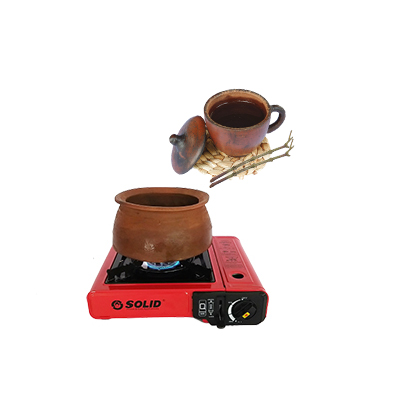
- Take nusa indah merah plant stem and wash until clean.
- Boil the stem until boiling.
- Strain the decoction.
- Drink while warm.
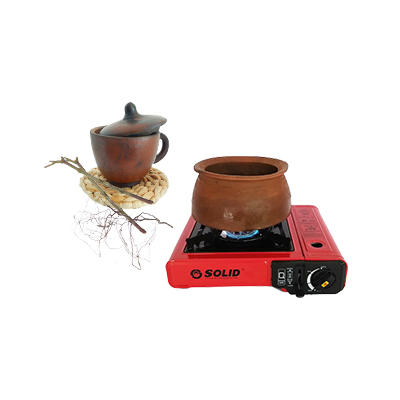
2. Worms
- Prepare nusa indah merah plant stem and root and wash until clean.
- Boil both ingredients until boiling.
- Let stand until warm/cool.
- Strain, then drink.
Reference Sources
- Royal Botanic Gardens. 2021. Plants of the World Online: Mussaenda erythrophylla Schumach. & Thonn. http://www.plantsoftheworldonline.org/taxon/urn:lsid:ipni.org:names:756618-1. 29-10-2021.
- Botanical Clearing House Universitas Negeri Surabaya. 2021. Nusa Indah. http://bch.unesa.ac.id/hayati/nusa-indah. 29-10-2021.
- CAB International. 2021. Invasive Species Compendium: Mussaenda erythrophylla (red flag bush). https://www.cabi.org/isc/datasheet/120124#tosummaryOfInvasiveness. 29-10-2021.
- Stuartxchange. 2015. Philippine Medicinal Plants: Doña Trining. http://stuartxchange.com/DonaTrining. 29-10-2021.
- Flora Fauna Web. 2019. Mussaenda erythrophylla 'Dona Luz'. https://www.nparks.gov.sg/florafaunaweb/flora/2/2/2252. 29-10-2021.
- Gunasekaran S., Sundaramoorthy S., Sathiavelu M., Arunachalam S. 2015. The genus Mussaenda: A phytopharmacological review. Journal of Chemical and Pharmaceutical Research, 7(7):1037-1042.