Nepenthes ampullaria Jack
Summary
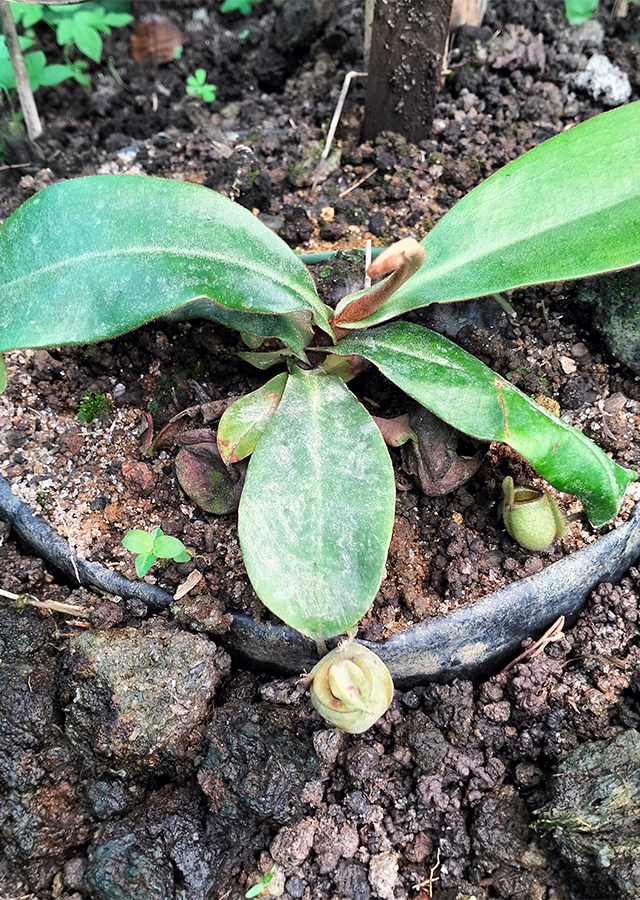
Nepenthes ampullaria or flask-shaped pitcher plant is a distinctive plant of the genus Nepenthes distributed in Borneo, Sumatra, Thailand, the Malay Peninsula, and as far as Papua New Guinea. Unique among its relatives, this species is nicknamed the 'vegetarian' pitcher plant because its pitcher rim lacks nectar glands, so it rarely traps insects. Besides being traded as an ornamental, this plant is also one of the pitcher plant species most commonly used in traditional medicine, among others to regulate the menstrual cycle and relieve fever.
Agroecology
Nepenthes ampullaria grows in secondary forest or swamps, and wet open areas, from lowlands up to elevations of about 2,100 m. Prefers bright indirect sunlight. Prefers an acidic, moist, nutrient-poor medium such as peat, sphagnum moss, or salt-free cocopeat. Avoid fertilizing, especially with fast-release fertilizer, which can burn or kill the plant, or result in excessive leaf growth without pitcher formation.
Morphology
- Stem slender, with many short branches with leaf rosettes at intervals on the lower part of the stem, but in the higher parts, fewer branches and more leaves are borne.
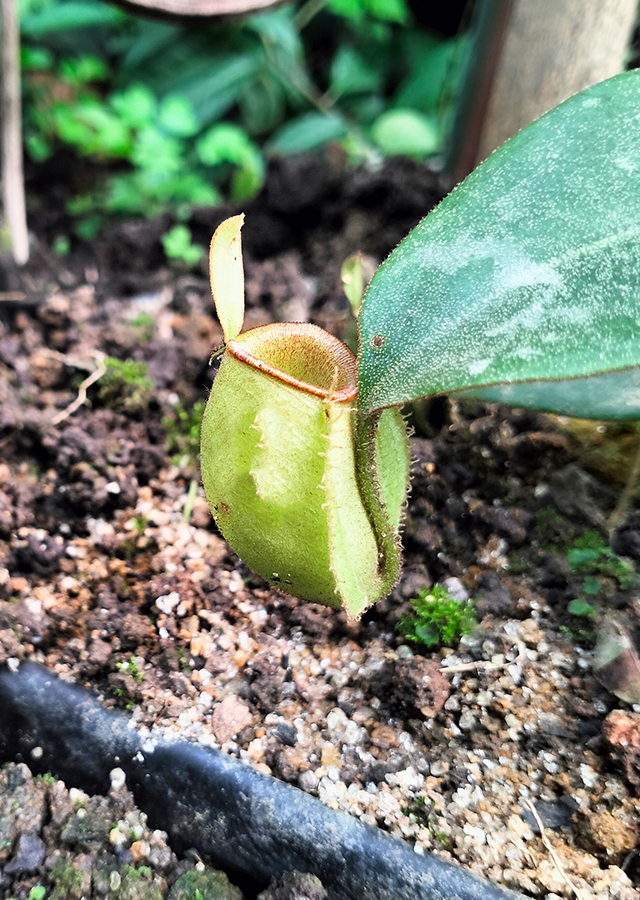
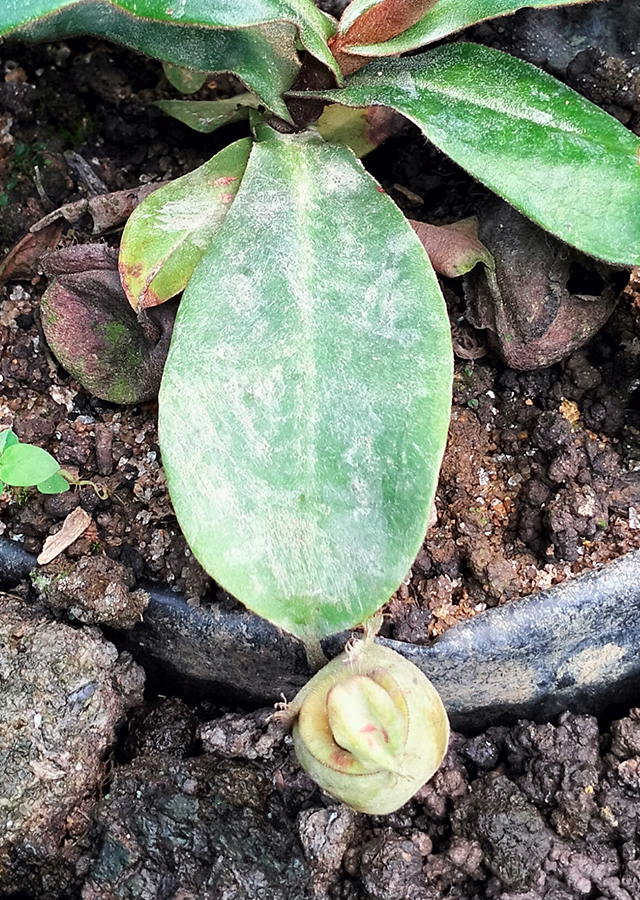
- Leaves simple, spatulate shaped, surface smooth, underside rough and hairy, tip pointed, petiole present, <2 cm long. Tendril <15 cm long. Pitcher urn-shaped, pitcher height <7 cm, pitcher width <5 cm, green color with purplish-red spots. Peristome curved and expanded, green colored. Pitcher lid forming an angle >180°, lanceolate shaped. Spur length <10 mm, unbranched. For rosette-leaved branches, the alternate leaf blades, stalked to leaves without a stalk, spear- or spoon-shaped, and 2-5 by 0.5 cm in size. At the tip of the rosette leaf there is a jar- to egg-shaped pitcher, 2-10 cm long with a narrow lip. Pitchers are also green to nearly white, with pink or red spots or patches. For leaves on the upper part of the stem, the leaf blades are narrow and long, about 25 by 6 cm, with an elongated tip forming a slender, coiled tendril. Pitchers almost never form here, but if they do, they are small, funnel-shaped and do not develop as well as pitchers on rosette leaves. These upper pitchers rarely develop and are rarely observed, and are considered a vestigial structure formed as a result of the plant being stressed by very poor soil.
- Flowers green, 1.3 cm wide, growing on a shoot up to 45 cm long. Small, yellow, without petals, clustered into an upright raceme inflorescence up to 45 cm long. The plant is dioecious, with male and female flowers found on separate plants. Blooming occurs once or twice a year, lasting several weeks, pollinated by nocturnal insects. When the blooming period coincides with other nearby Nepenthes species, hybridization can occur. Natural hybrids in Singapore include: Nepenthes × trichocarpa (= N. ampullaria × N. gracilis) and Nepenthes × hookeriana (= N. ampullaria × N. rafflesiana).
- Fruit 2.5 cm long, a capsule that ripens from green to brown, splitting into four parts when ripe to release seeds.
- Seeds small, thread-like, wind-dispersed.
Cultivation
Propagation with seed (variable progenies), or stem cuttings. If taking a tip cutting, use a 4-node cutting (tip plus 3 lower leaves) to prevent rotting of the soft shoot tip before planting. Single cuttings from the lower part of the plant are also possible. Underground-fused basal rosettes can be divided and potted separately.
Chemical Content
Glycosides and phenols.
Benefits
Regulates the menstrual cycle, eases childbirth, relieves asthma, treats eye inflammation and acts as a stamina booster, treats malaria, relieves fever, stomachache, and dysentery.
Local Names
Periuk kera.
Traditional Recipes
The following recipes reflect traditional knowledge passed down through generations, not a substitute for professional medical diagnosis or advice. Consult a healthcare provider before use.
1. Treats stomachache
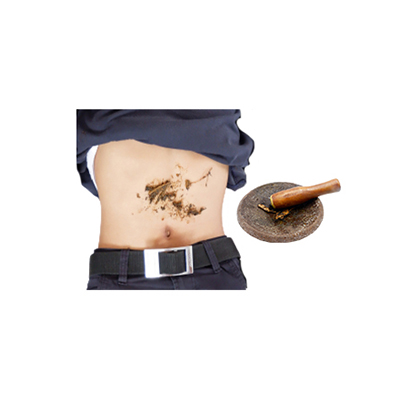
- Take an adequate amount of flask-shaped pitcher plant root and wash until clean.
- Boil then grind until it becomes a paste.
- Apply as a poultice on the stomach.
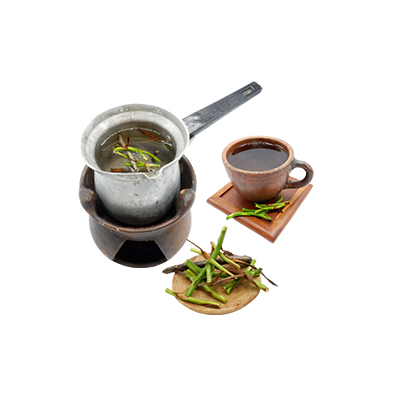
2. Relieves fever
- Take an adequate amount of flask-shaped pitcher plant stem and wash until clean.
- Boil until it boils.
- Let it cool to warm/cold.
- Strain then drink.
Reference Sources
- Royal Botanic Gardens. Plants of the World Online: Nepenthes ampullaria Jack. https://powo.science.kew.org/taxon/urn:lsid:ipni.org:names:603652-1#synonyms. 26-07-2022.
- Flora Fauna Web. 2022. Nepenthes ampullaria Jack. https://www.nparks.gov.sg/florafaunaweb/flora/3/4/3438. 26-07-2022.
- Ismail N A, Kamariah A S, Lim L B L, Ahmad N . Phytochemical and Pharmacological Evaluation of Methanolic Extracts of the Leaves of Nepenthes bicalcarata Hook. F.. International Journal of Pharmacognosy and Phytochemical Research 2015; 7(6); 1127-1138. https://www.researchgate.net/publication/333648518_Two_New_Ethnobotanical_Uses_for_Nepenthes_Ampullaria_Jack_Among_the_Miyanmin_of_Yapsiei_Station_Papua_New_Guinea.
- SHUAIBU BABAJI SANUSI, MOHD FADZELLY ABU BAKAR, MARYATI MOHAMED, SITI FATIMAH SABRAN, MUHAMMAD MURTALA MAINASARA. 2017. ETHNOBOTANICAL, PHYTOCHEMICAL, AND PHARMACOLOGICAL PROPERTIES OF NEPENTHES SPECIES: A REVIEW. Asian Journal Pharmaceutical and Clinical Reseach. Vol 10, Issue 11, 2017. DOI: http://dx.doi.org/10.22159/ajpcr.2017.v10i11.20050.